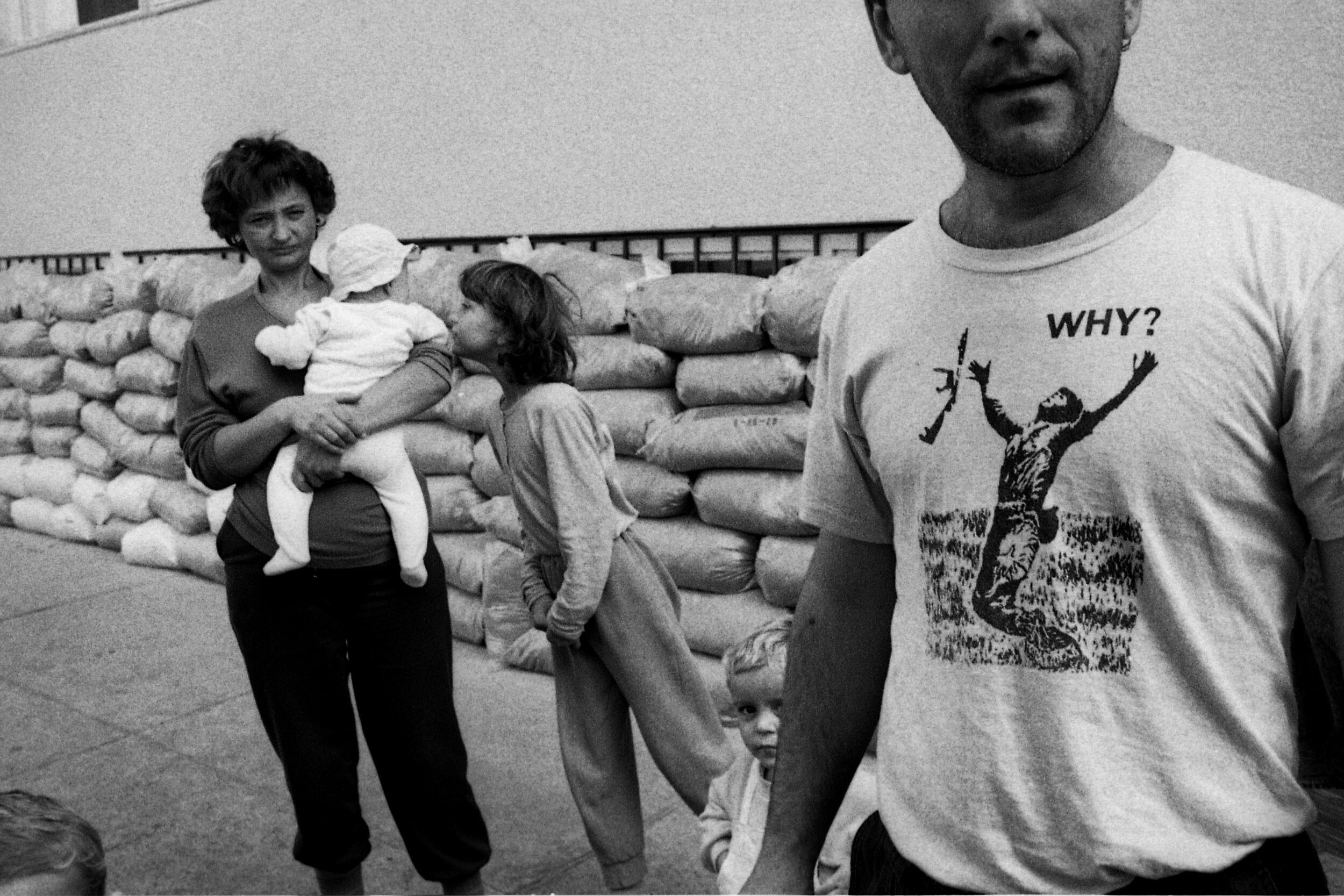
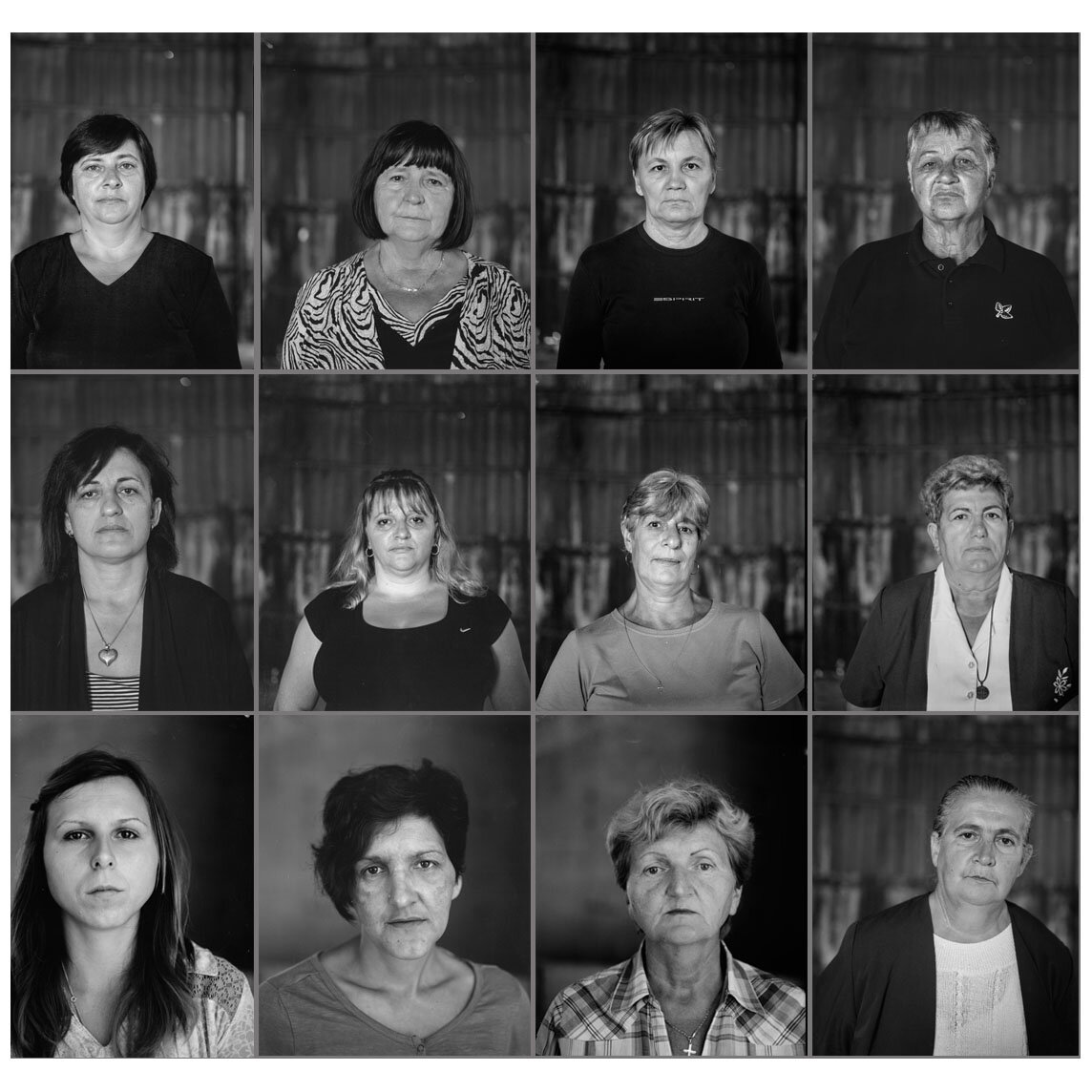
1991-1995. Yugoslavia War. Once Upon a Time in Europe.
The Yugoslav Wars.
Teachers, schools, and institutes in some Galician cities showed interest in the 90s, in learning about the experience of a direct witness to the Balkan wars in Yugoslavia. Several organizations in Galicia and Catalonia were working on how to learn about peace and detach from war in times of conflict in old Europe. It basically consisted of speaking free of charge to young people in secondary schools, explaining my experience as a "special correspondent" or "reporter." " It was enriching, at least for me, to interact and answer doubts and questions related to the life of a reporter in the field and the methodology that, in 1991 and subsequent years, could be used to raise awareness about the secondary effects or collateral damage of photography. At the beginning of each meeting, I made it clear that I am not a war photographer, unlike other colleagues who do dedicate themselves fully to it.
Croatian soldiers and a mother and her daughter are covered in a safe place during the bombing of Vukovar, Croatia. 1991
One of the most frequently asked questions was precisely this: How does one become a war reporter?
The misconception surrounding this role, often perpetuated by film, is far removed from reality. Therefore, it's important to explain to children and teenagers that this profession requires being selfish with one's family, thinking of no one but oneself, having basic medical knowledge, knowing how to stop the bleeding and suture a wound, not being terrified of blood, remaining calm in the face of an ambush where four men corner you and rob you blind, or understanding that you could end up with all the winning lottery tickets and return to your village in a tin box, or whatever is left of you, among many other situations, including the case of young girls who have just been raped by an anonymous soldier. Empathy, composure, and sticking to the script assigned to you as a witness without taking part in the conflict are also crucial. The mission is to survive these situations and tell the world what you have just seen and experienced. If you succeed, you can consider yourself satisfied, having given a voice to the voiceless.
A man explained to the soldiers the recent attacks of Chetniks. Chetekovca. 1991
Having explained this, we can begin by discussing how the conflict in Yugoslavia dragged on for far too long, generating social criticism as to why, on the European continent, the massacres continued unabated. Before each talk or conference, I explained that I am not a war photographer. I disagree with that label, which some media outlets often apply simply because I have documented people's suffering and the destruction of towns with civilians inside.
The term "war photographer" was coined long ago and popularized by those who frequently went to wars, always encountered the same people, and died in them. Wars are documented as another type of conflict and belong to the genre of documentary photography. "War photographer" sounds like a mysterious figure, a hero who risks his life with his camera. Breaking that misconception has been a long and difficult process. Soldiers are heroes defending their country, and they receive medals as such, many of which they take to their graves. In conclusion, wars shouldn't exist, and that's the starting point of every talk I give to the public, including children and teenagers who have never heard of war or photography. I always explain how we work, how we live, and how we send our photographs to the world. In every talk, I reflect on the necessity of people dying for the whims of the powerful, because there is no war without vested interests; diplomacy and negotiations should always prevail. Proof of this in the 21st century is the massacre of the Palestinian people or in Ukraine.
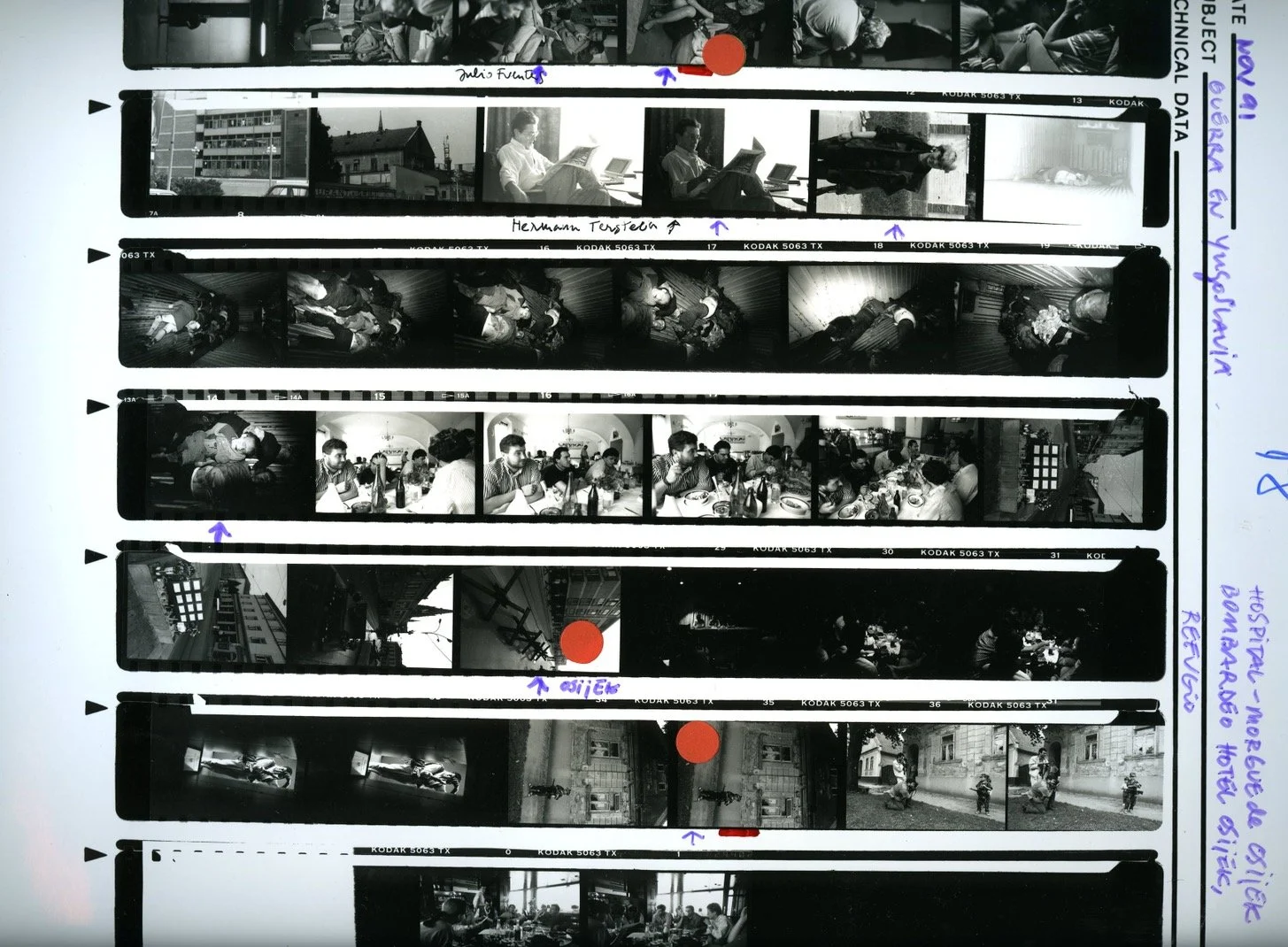
Contact sheet of Vukovar, Osijek, covering. 1991
In every conference or talk, this question almost always comes up: What does it take to be a war reporter? The answer is that I don't have an answer; even I doubt what it takes to become a reporter immersed in one war after another. Let me clarify first and foremost that I am not, nor do I consider myself to be, a war photographer. Today, in 2026, I'm sure that if I give a talk about what I saw in the war in Yugoslavia, no one will ask that question. One reason? Life is beautiful, and you can't go to war without knowing what you're leaving behind.
If I had to find theories or hypotheses to answer that million-dollar question, I'd say that film and television have done their job of creating an air of romanticism, heroes, and adventures around the figure of the reporter, but when you actually experience it, it's the complete opposite. If we have to look for a reason or a motive why someone chooses that path without anyone calling them, perhaps it's a spiritual calling (they should create NGOs), a sense of duty to the world, or their world to denounce an inhuman situation, a genocide, or a motive stemming from being a direct witness as a photographer, cameraman, or reporter, trying to show the world that human beings have no feelings, that they don't care about anything.
And a day will come when we will self-destruct. Some photographers I've met say the adrenaline rush is so intense that's why they repeat the experience. Others claim they do it the same way I believe: to document and for the images to serve as social commentary. The journalist shouldn't be the news of the news.
“Morir por la pasión de informar.” DAVID ARMENDÁRIZ MORENO, JAVIER ACÍN
28 NOVIEMBRE, 2001https://www.aceprensa.com/cultura/morir-por-la-pasi-n-de-informar/
A Croatian soldier gathers supplies during the bombing of Vulovar. 1991
These could be definitions of a first-year journalism student's response, categorized within the sciences of psychology and psychiatry for study. Nobody goes into a place where it's (literally) raining fire to try to take a photo and get paid 50 euros gross, minus the corresponding percentage of VAT or income tax.
War reporters are that infantry without stripes or medals who advance on the front lines until they're right under the enemy's nose and ask, "How's everything here, friend?" or "Could you give me a light?" War and conflict journalism has reported lies and truths, with or without empathy for the sides. Journalists have fallen on the battlefield like paratroopers, like any other soldier. They have been torn apart by shrapnel from stray grenades, shot, murdered in a roadside ditch in the middle of nowhere, robbed, or even raped by someone with a firearm. The press photographer has been idealized since the days of black-and-white television. Vietnam, for many, was the seed of the war photographer figures Robert Capa and Gerda Taro. They were such figures in the Spanish Civil War, and years later, while sipping Magnum champagne, they created the most famous agency in the history of press photography.
Is it really necessary to expose oneself so much to explain to the world that some kill others?
"Teacher, do bullets kill children too?" asks a seven-year-old during a school talk about how to unlearn war and the business of mines and bullets.
War journalist Julio Fuentes near the front line in Vukovar. Croatia. 1991
You might ask, "Why did you go?" And then I might contradict myself, but I knew when to retreat, after some serious scares and a lot of fear. It was a war in the heart of Europe; it made no sense. I went once and went back, and it's addictive; of course it's addictive, and it leaves your PTSD completely wrecked, but you have to know when to retreat, at the right moment, after seeing a friend killed by a bullet or a grenade, and you don't recognize them; you don't think it was going to happen to them and not you.
You then enter a roulette of colored numbers where you don't choose; you're dealt a hand. I went because I saw children dying, or being raped by their own neighbors; women tortured and raped by entire platoons, day after day; or in hangars like the ones at Velepromet in Vukovar, in places, sites, or cities I had been to before. Perhaps it was because it enraged me that this was happening, that innocent people were being murdered while the rest of Europe turned a blind eye and politicians and the UN were incapable of bringing a radical end to it.
We call ourselves "ses" (a derogatory term for activists) and spent years going back and forth, never imagining that this could end up as a book. I assumed (in my ignorance and youth) that what I was doing was right and could be helpful, among so many other things, to prevent wars from happening again. That assumption of wanting a better world disappointed me; I entered a typical spiral of frustration, and pragmatism did its job well.
A grenate explode in a roof. Osijek. 1991
We call ourselves civilized, but when faced with a massacre, where the dried, rotten blood smells metallic, the vengeance of History brings me back to reality, and all you have to do is search the internet or books and read the history of old Europe to understand that wars existed, exist, and will continue to reap with their scythe until the end of humanity.
To escape the downward spiral of trauma, a Catalan university invited me to participate in an educational project. Initially aimed at children, it consisted of talks in which a direct witness to a conflict spoke about their experience, but it was the children who took the lead and directed the discussion.
The conflict in Yugoslavia is the only one I've been to where I was significantly exposed. We were young, eager to learn the truth, or at least try to. After that, I realized that risking your life is pointless, that the world is full of psychopaths and murderers who don't care about killing their own mother or wife. That's how I see it.
Yes, I cried in Idomeni, seeing the father with his half-asleep baby in his arms in the middle of a muddy field. There's a very old photo from a war showing a dead girl and people walking by. That image fills me with rage, and I ask myself, why do children have to die when they are still children and innocent? The question cuts deeper now that I'm a father of three girls and have stopped giving lectures and talks. I don't have the courage to explain all this; it seems shameful, unjust, and inhumane. Recently, Trump killed 147 girls at a school in Iran. But what kind of world did I live in?
Did we see? We've gone mad and become insensitive to everything, or at least nothing seems different to us anymore. We wanted television to give us more news, and it has. Every day, we're bombarded with all the bad things, but there aren't the televised debates like there used to be, the ones that made people say enough is enough.
Faced with the innocent questions of children who wanted to know what wars were all about, I projected some images from my book onto the white walls of the classrooms, but never the ones the adults wanted to see, the harsh, the traumatic ones. Always, and before starting a projection or a talk anywhere—university, school, or association—the first thing I want to make clear is the demystification of the war photographer, of that figure who, as I said before, film and television have recreated to their liking. War photographers are witnesses or direct observers of an event where there is a conflict in which few survive, and it's necessary to be there to denounce it so that the world knows. I also make it clear that it's a profession where you can become addicted and descend into madness, where the adrenaline rush demands more. I've lost colleagues, true war reporters, killed on the road alongside others, and I quote Julio Fuentes.
The project developed by teachers consisted of explaining to the children how to "unlearn war" and the price of a bullet, a grenade, or an antipersonnel mine before and after someone steps on it and it explodes. Wars are big business: first the weapons, and then the contracts for rebuilding what's been destroyed, which amount to billions of dollars.
"What is an antipersonnel grenade, and how much does it cost on the market?" the children ask.
"An antipersonnel grenade might cost $5, but disarming it costs thousands or millions."
"Why does my country manufacture bombs, weapons to kill other children like us?"
Vukovar. Summer 1991.
A difficult question with an even worse answer. Your country, like others in the "civilized" world, manufactures weapons for its economy, to buy gold and oil, and to sign agreements with other countries that provide profits; generally, only a few get rich. These are the mediators or intermediaries, since there are countries to which weapons cannot be sold due to prohibitions, and they sell them anyway, get rich, and keep the states happy.
Do you know how many journalists have been killed, murdered, or torn apart by shrapnel in the last ten years worldwide while doing their job of informing the world?
—No, no idea.
—Let me remind you: The most recent report from Reporters Without Borders (RSF) shows that 1,668 journalists have been killed worldwide since 2003, for a total of 80 professionals killed in the line of duty each year.
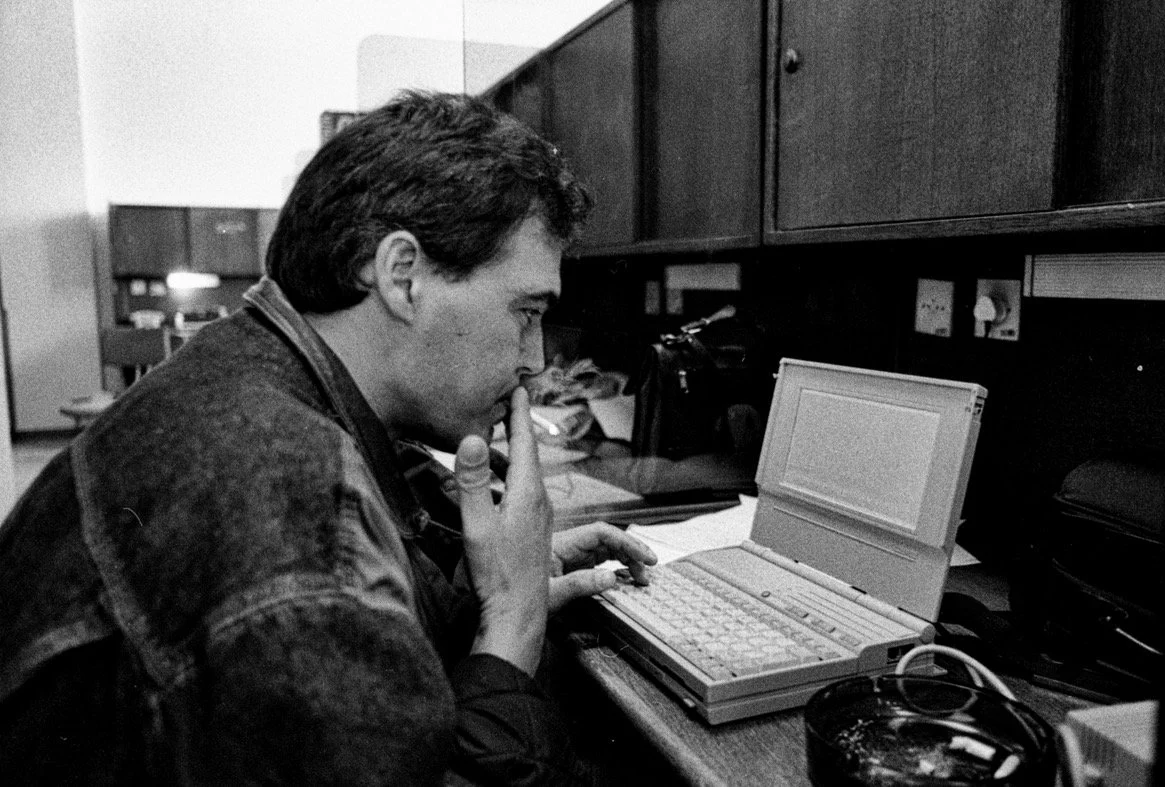
Julio Fuentes. Osijek, Croacia, 1991.
In the summer of 1991, after returning from Cuba, where I had spent a year documenting the Special Period—a time when the Cuban people suffered from shortages due to the collapse of the socialist bloc. That is, the USSR, or Soviet Union, had ceased to exist with the fall of the Berlin Wall in 1989. There, like other photographers, I was documenting a historic event: the crossing of the first East Germans into Berlin. I symbolically collaborated with hammer and chisel to break down the kilometer-long wall that separated a city and a divided state. The wall had been erected in the early hours of August 13, 1961, dividing the city in two for 28 years to stem the flow of people from the communist east to the capitalist west. The structure separated families and East Berlin from West Berlin until its fall on November 9, 1989.
I traveled to A Coruña to meet with the international section of La Voz de Galicia—Pedro, Almudena, and Jacobo—and after explaining the project, we agreed to send dispatches from the ground. La Voz, like other media outlets, didn't take responsibility for establishing a collaborative relationship; any connection with the company would later imply, in the event of an unfortunate incident, having to cover the cost of repatriation in a zinc coffin. Companies know this and leave the problem to the state's diplomacy. Life insurance in a war zone cost no less than 500 euros a week, and I was nobody to be able to afford that.
Little was known about the war; it was in its early stages. Slovenia had quickly resolved the situation, and the responsibility had passed to its neighbor, the fertile, mountainous paradise of newlyweds on their honeymoons in the Adriatic.
Without a contract, without a stipend or fixed fees, only with a commission for each dispatch sent, and with my savings, my own cameras—Nikon FM2s bought from my Jewish friend at Adorama in New York—I left Madrid for Belgrade. This whole story is recounted in two books: *Reporteiro de guerra en Yugoslavia* (Xerais) and *Érase una vez en Europa* (Verkami).
Having to summarize in a few paragraphs the three years going back and forth to the conflict becomes complicated, because you always leave things out or want to add others you'd forgotten.
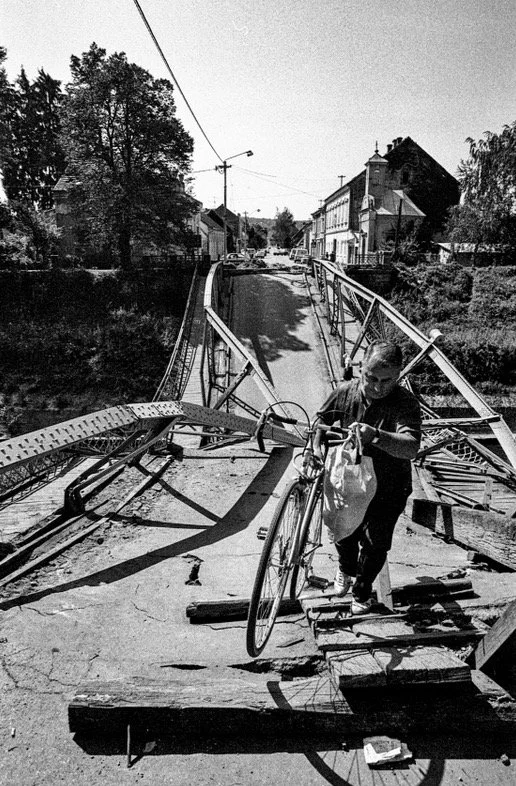
The Petrinja Bridge, the one Márquez never got to film. He was obsessed with bridges; I, with walls riddled with bullet holes. Any forensic anthropologist dreams of seeing places like that. Petrinja. Croatia. 1991.
As mentioned in previous posts, looking at the images and reviewing the notes in my notebooks helps me recover small moments that can be significant for the reader. Notebooks or field journals freeze time and your emotional state at that moment and help you unload what you swallowed. I have colleagues who, after that experience in the war that Europe either didn't know about or didn't want to know about, have completely abandoned photography and wanted nothing more to do with that damned war, killing each other. When I visit them, I see them, unfortunately, by rivers or gardening or carpentry, or, unfortunately, they've entered a spiral of depression from which they've never emerged: if you can't control it and the nut or bolt gets too tight, you're doomed for life; you sink or fall. Traumas, according to therapists and depending on the individual, are usually very damaging.
I arrived in Belgrade as dusk fell. The taxi driver, with a week's worth of beard, inquired about my trip and my visit to a country where war was rumored to be brewing in the distance. In my limited Russian and his limited English, we managed to exchange a few words, but I sensed that he felt unwelcome, a citizen of the West. He didn't mention my profession, and the only thing we completely disagreed on was football. He was a Real Madrid fan, and I'd supported Barcelona since I was seven. The man remembered plays and players with precision, goals, coaches, and matches. I kept quiet enough so he wouldn't kick me out of the taxi, opened the window, and felt the warmth of the dying afternoon in the distance, with flocks of swallows playing in the summer sky.
The Hotel Moscva was on Testá Street, on Terazije Street at the intersection with Prizrenska (which leads down to the river) and Balkanska Street. The taxi driver, who had sensed my Barcelona fandom, avoided getting out of the taxi. I paid him and opened the back door, taking my backpack and the camera equipment from my navy blue Domke camera. He barely acknowledged me. I approached his window, where I had my elbow resting, and politely said, "Spasibo i do svidaniya" (thank you and goodbye in Russian), but he didn't even flinch. His face gave the impression that he felt betrayed by a Barcelona supporter and that I had told him Johan Cruyff was one of the best coaches the team had ever had, ahead of Miguel Muñoz or Leo Beenhakker. He didn't get a tip, and I think he cursed me in his language. I learned that talking about football or politics in taxis in certain countries is dangerous.
I suppose they must study how to have a conversation with people in the first year of psychology, especially those who are so stubborn that what they say is the only truth. It's also not advisable to respond or start a conversation about women; you never know. The best thing, I think, is to say you're tired from the trip while keeping an eye on the taximeter—some drivers are very shrewd. Recently, in 2026, I opened a catalog of a retrospective I did in Vigo between 1983 and 1991, and I found clippings of some of my articles published in La Voz de Galicia from that time, which my colleague X.M. Marra had carefully saved to give to me someday. I see. My father did the same; he kept every story I sent, and I recognize that my writing style was very different from how I write today. I think it was influenced by the hostile environment I was in, with hardly any points of reference, feelings, or contradictions of what I was seeing and feeling naturally without falling into the clichés of typical journalistic reporting—that's what my colleagues in the international section were for: to correct any errors. Pure gold. Seeing those paper clippings, in today's world of technology and screens with millions of pixels, brought me closer to remembering and appreciating the moment I wrote them: on a wonderful Brother Toshiba T1000XE and a Brother with thermal paper, which I used in Cuba and which, unfortunately, never worked again. I once lent the charger to someone who never returned it, and I've been looking for it for years, or for someone who can recover all the chronicles from Cuba and Yugoslavia. The problem with thermal paper is that it fades over time, whether exposed to light or not, and the only solution was to make photocopies of some of the texts. The rest lie dormant until an angel arrives and awakens them so I can recover them.
Hotel Moskva. Belgrade, 1991. On the left side, a Brother typewriter for thermic paper; the Kummerly & Frey map for the roads; an agency telefax or teletype; the Panasonic portable RF-B10 multiband FM/MW/SW; original Rayban sunglasses; the key to the door of Hotel Moskva, Beograd; one of my pocket notebooks for the field; and a copy of a newspaper.
May lightning strike whoever I lent my Toshiba T1000XE charger to in 1994, with the best of intentions. This was the computer that accompanied me to Cuba to document the Special Period between 1990 and 1991 and also my dispatches from Yugoslavia between 1991 and 1993. It no longer turns on, and I don't have the charger, but I found some DIY solutions that might fix the problem and allow me to recover all the texts from those years. The computer printed on thermal paper, but if it were exposed to light, the text would quickly fade. It had to be stored in a special place.
Look inside the briefcase and make photocopies of everything. But I forgot that protocol, and now the texts are languishing on a tiny 20MB hard drive!
I know; I should have brought my Olivetti Lettera 22, which I still have and works, or my Olympia Traveller, which is also lightning fast. You can't trust technology, and so I've installed several applications on my 2012 MacBook Pro, which I'm rebuilding with parts from other people, just to experience the pleasure of hearing the keyboard click. I refuse to accept Apple's planned obsolescence.
The hotel receptionist looked like he'd had a rough night. Disheveled, with a cigarette dangling from the corner of his mouth and a slight smile, he guessed who I was: Mr. Álvarez?
He asked for my passport and gave me a room key. I was so tired that I turned off MTV on the TV and fell asleep until I woke up at 6 p.m. I went back down to reception, and my friend, the political commissar receptionist who kept tabs on everyone staying at the hotel, was busy with someone else. I stood next to him, and his face seemed familiar, even though we hadn't met.
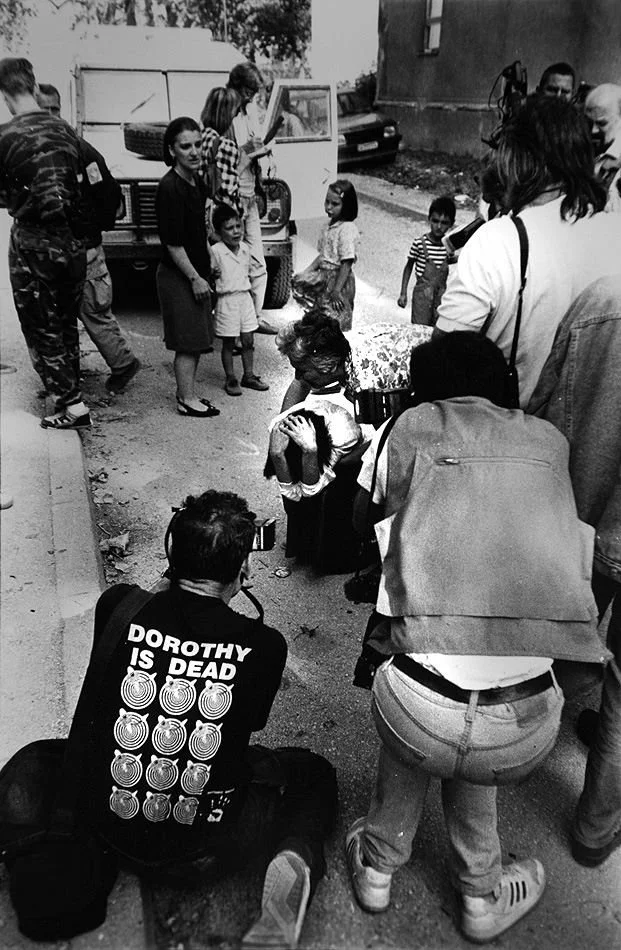
"Dorothy is dead. A mother got the news at the door of a hospital about her daughter having been killed during a bombing raid. Sarajevo, 1993.
"Hello, Julio Fuentes, from El Mundo."
"How are you, Delmi Álvarez, from La Voz de Galicia?"
He stared at me and whispered, "From La Voz de Galicia?" He raised his left eyebrow and frowned. Without meaning to, he made a comment that was somewhere between sarcastic, ironic, and derogatory, which I didn't take offense to.
"I just got here, and I'm hungry. Do you know of any place to eat?" I asked him.
"Come on, follow me."
Just a few meters from the hotel was a McDonald's, packed with kids, and when we managed to get a meal with a hamburger, fries, and a Coke, we sat on the curb in front of a shop window. We didn't talk much while we appeased our hunger, and only then did he begin to ask about my experience and what my plans or expectations were. I answered honestly: I have two. The first is that I go with the flow when I see that someone is smarter than me and knows how to handle the situation, and the second is to make some proposal that could be beneficial for both of us. It was the first time I had come to cover or document a conflict, and even then it wasn't clear whether it was a serious, real war or just a power struggle for independence among countries of the Yugoslav Federation. For all intents and purposes, the Yugoslav wars formally began on June 26, 1991, when the Yugoslav People's Army (JNA) intervened militarily after the declarations of independence by Slovenia and Croatia. There was no traditional formal declaration of war, but rather an immediate military response to the breakup of the federated state.
“I was here not too long ago. Things are getting complicated, and it’s going to end badly,” Julio said, sounding pessimistic as he listened to the radio through a small earpiece, in addition to his hearing aid in one ear.
I spent the next few days at the press center, where news arrived via TV and telex machines. Heavy gunfire, tanks, wounded, and dead in small villages in northwestern Croatia. Vukovar was the name that came up most often, the clear favorite to take home the biggest prize by the end of the day. In one of the rooms at the press center, a large map had been set up, on which a woman was pinning colored pins that corresponded to bombings, wounded, dead, blocked roads, villages, towns, fighting…
Márquez, Arturo Pérez-Reverte, Julio Fuentes, Hermann Hotel Osijek. 1991
The woman worked hard to keep the map up-to-date so that journalists could make their predictions, forecasts, and a final summary to send back to their respective newsrooms as a kind of report. You could hear people speaking in English or French, shouting at someone to go to hell, or giving explanations of what was happening, but little else could be gleaned from the deluge of news spewed out by the wire service, the BBC, or the television stations to make a proper assessment. Discussion groups were forming among war veterans, sharing information, but I longed to be on the ground; the idea of being cooped up between walls, waiting for a colleague who had been in the area, seemed almost impossible, but that's how it happened. A few days later, a British TV crew arrived. They hadn't been able to cross into Croatia because the highway was closed and the checkpoints were so numerous and varied that it was madness to risk it all in a no-man's-land that belonged to everyone at the same time. The Serbian press pass was no longer sufficient at a Croatian checkpoint; it was best not to even show it, because the army and the Chetniks didn't like journalists at all; the risk was too great.
In short, I told Julio I was looking for a car to rent and head north, hoping to visit Vukovar, the most besieged and heavily bombed city on that map.
"I have a car, a Serbian Volkswagen Golf," he replied to my question. I suggested we share it, and he thought it was a perfect idea, as he'd been considering it for a while.
Time to get out of that place. A born journalist. In journalism, when you're working with a colleague, sometimes it's a little push that gets you moving; sparks ideas; and makes travel plans this way or that, and you finally end up in a supermarket buying water, bread, and fruit.
"It's mandatory," he said. "I'm going to put some European Union stickers on the car's license plates to make it look legitimate," Julio said.
It was a great idea. At several of the checkpoints, almost all Croatian, the blue flag with the stars really reinforced the idea of wanting to reach Vukovar.