The Hotel Osijek. 1991
August/September, 1991. Osijek, Croatia.
Room on the seventh floor.
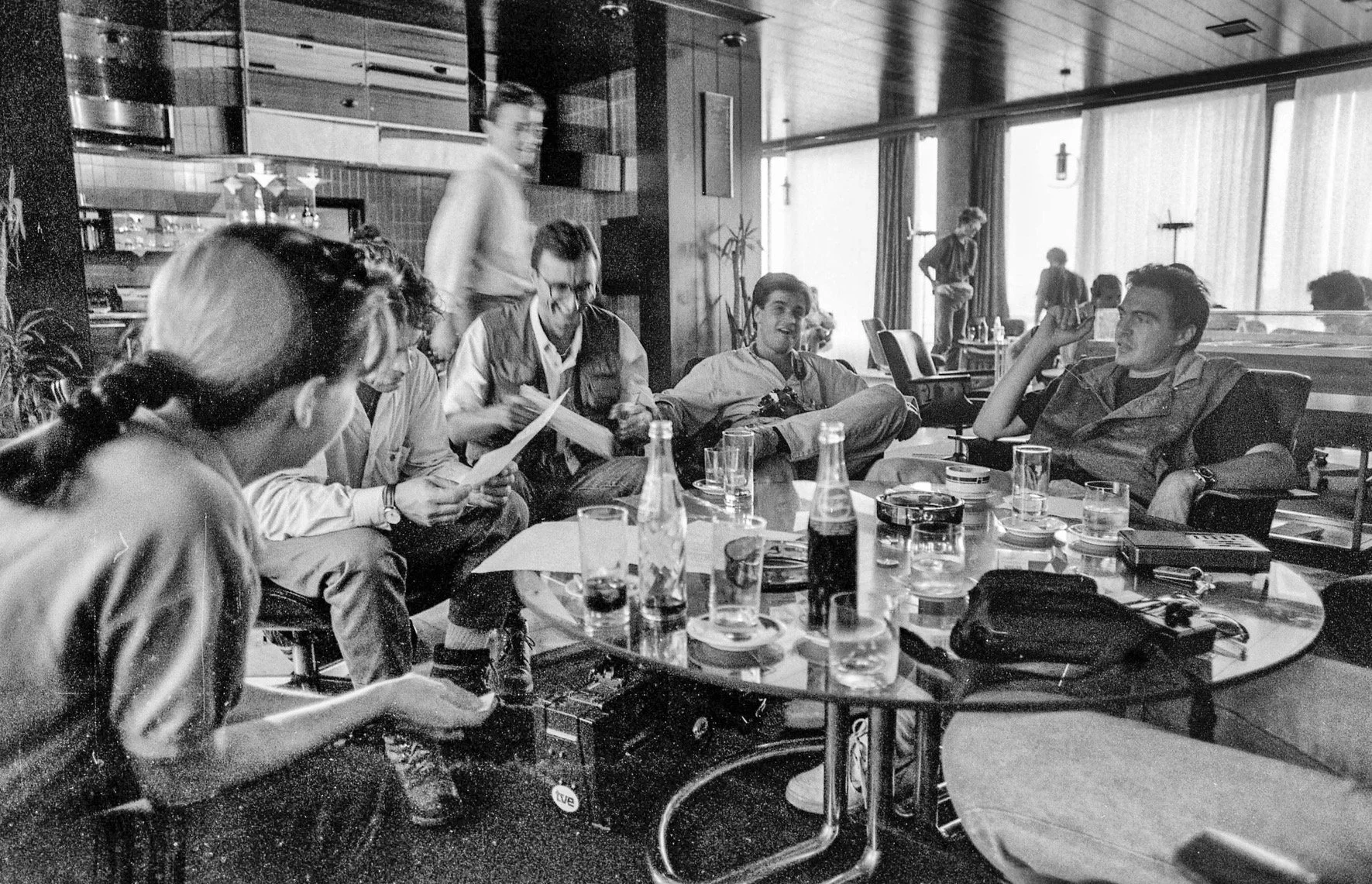
The cafeteria of the Hotel Osijek, September, summer of 1991. From left to right: Maite Lizundia, Ramiro Villapadierna, Arturo Pérez-Reverte, Álvaro Benavent, Julio Fuentes and Herman Tertsch.
In late summer 1991, Nirvana's "Smells Like Teen Spirit" was playing everywhere, although it wasn't officially released until September 10th. I had a friend who was an "expert" at getting hold of songs sent to critics for their opinions. That was definitely the one I wanted to hear, and I played it on repeat along with others on my portable boombox. The cassette was on the Eagles' "This Could Be Heaven or This Could Be Hell," and it came on just as I was looking for a hotel in the dead of night and two armed men stopped me. The Renault 4 I'd rented in Zagreb had a sliding window, not one that rolled down like any other car, and I had it open, on the advice of the soldier I'd picked up while hitchhiking near the village of Cetekovca. The song was playing in the background; the soldiers seemed to like it. They asked me where I was going, and I told them I was looking for the Hotel Osijek. I had three credentials hanging around my neck, but I was very unsure whether to take any of them out or show them all because I had no idea who they could be. If they were Bosnians or Chetniks, I was screwed; I'd really mess things up, they'd consider me an enemy journalist and a swindler. I should get out of the car, and we'd see. The second one was from the Croatian government; in that case, friends. And the third was from a Spanish newspaper, which would make anyone who saw it laugh.
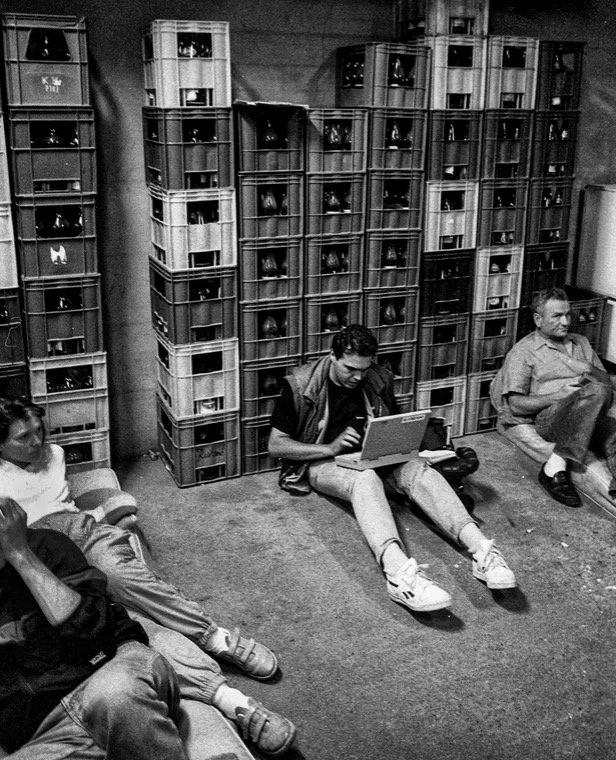
Julio Fuentes, journalist for El Mundo, writing his chronicle in the bunker of Hotel Osijek during a bombing session in September 1991.
OSIJEK. AUGUST/SEPTEMBER 1991. "We're Croatians, don't worry," I thought I understood, and the only words I knew were "Bok, ja sam novinar" (Hello, I'm a journalist).
Positively, and with Kalashnikovs held at the magazine, they told me in a mix of Russian, German, and English that I was a bit far away but that I couldn't drive with the lights on. I thanked them: Hvala!
I parked on a corner and waited a while until my pupils dilated as much as they could to adjust to the streetlight, which was pitch-black. I opened the door and drove very slowly in first gear, mainly to avoid hitting the curbs. There was no GPS in 1991, and it was all pure intuition; there was no one on the street and not a single light to guide me. The only thing I knew was that it was near a river and the building stood out because of its height.
The only thing I knew was that the German map, Kumerly & Frey, indicated the Drava River as I entered the city via the main access from the Zagreb highway, heading north (N) and east (E) using the compass I won in a night orienteering competition when I was a member of a mountaineering club in Vigo. Following that direction and using the flashlight's Colonel Tapioca red filter mode, I arrived at a place with many parked cars and a large building in front: it was the Hotel Osijek. I bolted up onto the curb without damaging the axles and parked wherever I found a spot. The main entrance was visible thanks to some candles.
I rewound the cassette again and played "This Could Be Heaven or This Could Be Hell" as many times as the inspiration struck.
The verse narrates the moment the traveler arrives at the mysterious hotel, which is exactly what he was looking for:
There she stood in the doorway.
I heard the mission bell.
And I was thinking to myself,
"This could be heaven, or this could be hell."
Then she lit up a candle.
And she showed me the way.
There were voices down the corridor.
I thought I heard them say...
Welcome to the Hotel California…
I crossed the threshold, and the receptionist, who had placed a row of candles, greeted me and welcomed me.
The Osijek Hotel was like a welcome home, sweet home.
In peacetime, the hotel was used to accommodate tourists and host weddings, banquets, and meetings. It became a second home, even though it wasn't cheap. Most journalists had their hotel, meals, and drinks covered, as well as per diems (expenses), which they always had to justify to the relevant department whenever possible. From what I understand, it was a real headache having to tell a manager or administrator that you'd spent 200 German marks on emergency transportation or having to pay someone 20 US dollars for a couple of packs of cigarettes or a pizza on a Sunday when all of Osijek was closed. Everything without a ticket. This created in the accountants the typical doubt of money wasted or used for other purposes.
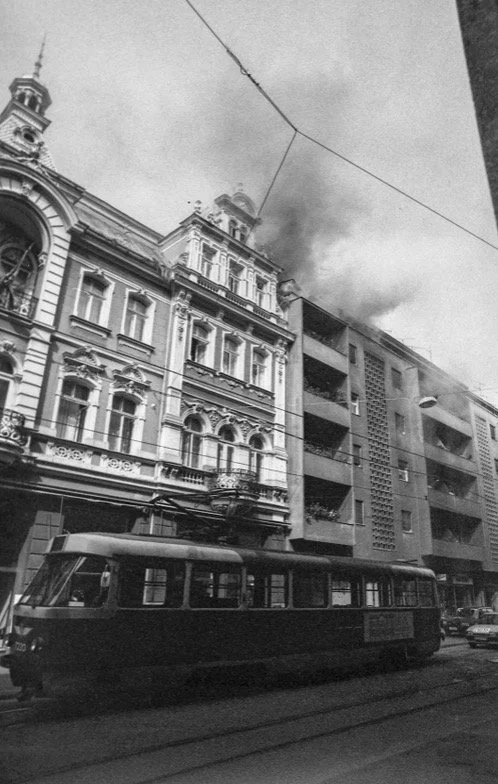
It was a calm Sunday; we had just finished eating some delicious pizzas when a bombing raid began right in front of us. The grenade explosions kept hitting the rooftops, and one even knocked us to the ground with its shockwave. We had to scatter and help an elderly woman who had shards of glass embedded in her back. Osijek 1991.
The first few days I floated the idea as much as I could. The important thing was to find out what kind of groups existed in the hotel. The wealthy press, with all expenses paid, and the poor workers and freelancers who also wanted to get involved photographed and documented without knowing if we would later sell anything or not. In my case, I had a promise —with only a verbal agreement to publish chronicles—from La Voz de Galicia, but the price they paid for each piece only covered the hotel room; the rest was money I kept in a special pocket on my belt in case of robbery or assault and to eat whatever I could. Drink water to avoid dehydration; eat chocolate, almonds, fruit, and little else. Looting shops during wartime was acceptable for chocolate bars, bags of crisps, or snacks.
The two groups I mentioned were very different; they had their own cars. I had a Renault 4 for a month, telling the Hertz driver I was an archaeologist. With Group A, it was difficult to befriend them. They considered themselves war veterans, old wolves who traveled independently with all expenses paid, and they saw those in Group B as rookie kids who thought they were just coming to the war for a stroll. In reality, nobody knew there was a war going on in August 1991. That came later, when things got complicated.
As in all hotels frequented by artists, photographers, and writers—all a bunch of shady characters—there's a bar nearby, used during bombing raids, right across from the hotel's bunker door. A short dash across the street and you'd enter another world of Somoditas, drunks, and happy people unloading the day's bad vibes. You could say it was group therapy at its finest.
That's why it was easier to meet colleagues from the media who came with all expenses paid and who helped with anything. Alliances, pacts of honor, were formed, in which we committed to sharing information, going to cover the events, and always returning together. Nobody got left behind.
Julio Alonso, a veteran; Julio Fuentes; Ramiro Villapadierna; Ramón, a photographer for ABC in Valencia; Edu, Alonso's colleague; Mimo, a very supportive Italian; and then the volunteer translators who accompanied us everywhere. They didn't charge a single penny and did it out of pure solidarity, although we knew that among all there were infiltrators who would later pass information about what we were doing to the Javeo bosses (HVO).
Every morning we had a briefing to coordinate. We had several cars, and to save on gas, we all traveled together in one car each time, crammed in, but together.
The Javeos offered us free transportation every morning after breakfast to go see the corpses that had arrived at the morgue (the Osijek hospital's morgue), which became known as "vermouth hour." They were refrigerated trucks loaded with the bodies of civilians and soldiers, piled one on top of the other. This way they were preserved for later autopsies or direct delivery to families.
The trucks traveled through the villages where massacres had occurred and brought them to Osijek so the international press could photograph them. The scenes were horrific.
Like the one in Četekovac, possibly one of the most horrific massacres in September 1991. The soldier I had picked up hitchhiking told me he came from that specific village, where he had seen women and men beheaded by the Chetniks. I mentioned it to Group B, a group of fellow journalists, and we drove in my car to Četekovac (also known as the Četekovac, Čojlug, and Balinci massacres), which took place on September 3, 1991, near Podravske Slatine. That afternoon, we discussed the trip, and each of us called our respective media outlets to sell the story, including text and photos. We left early; the drive to the nearest point took about an hour and a half, and we didn't encounter any problems along the way, although we were warned that Chetnik groups were ambushing people everywhere.
The road was paved, with some potholes, and as a precaution, following rule number one, we drove slowly with the doors open in case we had to jump out onto the side of the road. On a descent, we encountered a group of Croatian militiamen, and although we...
That's why the Hotel Osijek was also an international press center, where CNN, which had several floors and rooms just for them with satellite dishes installed on the balconies, broadcast the day's news. They used several large vans, dressed in black, and when they arrived at the hotel, they barely interacted with others. "The Tribe," the name Leguineche gave to the Spanish journalists. I didn't have the opportunity to meet Manu, but he's a legend.
Manu Leguineche christened the war correspondents and reporters "The Tribe." The term became so popular that he himself ended up being nicknamed "The Chief of the Tribe."
Nomadic and supportive spirit: He compared conflict journalists to a nomadic tribe or a band of explorers. They wandered the world together, experiencing extreme situations, depending on one another, and sharing information, fears, and experiences far from their newsrooms.
The origin in Equatorial Guinea: The term arose from their experiences covering Teodoro Obiang's coup against his uncle Macías in Equatorial Guinea. There, he christened the group of Spanish journalists covering the conflict with this name. Leguineche gave physical form to this "tribe" in Spain by founding and directing pioneering agencies such as Colpisa and Cover Press. In these newsrooms, he trained and mentored the next generations of reporters under the same ethical and human principles.
The only novel: In 1980, Leguineche captured this concept in his only work of fiction, titled *La tribu* (The Tribe), a testimonial novel based precisely on the adventures of the reporters deployed to Equatorial Guinea.
The origin and enduring use of the term "La Tribu" can be explained by several key factors in journalism at the time: The correspondents found themselves in hotels and on battlefronts around the world. Despite competing for exclusive stories, they formed a close-knit community that protected each other and shared information, vehicles, and experiences. Nomadic lifestyle: They moved from one conflict to another, sharing their own codes, anecdotes, and a strong sense of camaraderie. They were a traveling "family" united by the "bug" of pure journalism.
The pre-digital era: Lacking the internet or modern search engines, journalists relied entirely on their network of contacts and mutual collaboration on the ground to verify information.

The night Arturo Pérez-Reverte said, "We count to three, and on the third count we leave," was at the Grill restaurant at the Royal Palace Hotel. The thing is, they'd served us some frog legs, wine, and bread, but the roast lamb was missing. The Serbian artillerymen were trying to ruin our dinner again, and a bombardment began. The explosions got closer and closer until the third one hit us. It didn't explode, but it landed on a roof, and we heard the clank-clonk... We threw ourselves to the ground and crawled out as best we could in the dark. I remember a very drunk man standing there, asking, "But where are you going? The party's about to start!" And there he stayed, glued to his wine cup. The next day, nothing remained of the Royal Restaurant. Osijek. 1991
The second time they wouldn't let us have dinner in peace was when the cook or owner of the Grill Royal, which belonged to the hotel and I suppose was also a pizza maker, prepared frog legs and roast lamb for us. We ate the frog legs, but we didn't get to the lamb. It was a lovely summer evening in a kind of patio with a covered area, a large table, and Arturo presiding over it. We were the ones in the photo.
I didn't know anyone personally; I mean, we hadn't become close enough to start a conversation, and asking Marquez, who was sitting across from me, how many wars he'd fought in was non-negotiable. I liked him: he was quiet, kind, and minding his own business; the kind of person we like, not a bully or storyteller about his damn military service; serious; and always smoking. I offered him my Winston from the tin can and the others too, although few of them smoked. Arturo was telling a story that amused the men nearby. While we waited for the lamb, we heard the first "plow!"—the sharp, cracking sound of the mortar grenades. To ease the tension, we counted the seconds until the explosion, just like we counted thunder and lightning.
The "plows" continued, and the lamb didn't arrive, getting closer and closer.
We heard something fall onto a roof, and we fell silent. Something hadn't exploded. We heard the next "plow," and again it fell onto a nearby roof because we heard the typical "clonk clonk"... and it was then that Arturo said that phrase he was in the habit of saying to Márquez, about "the rule of three." "By the third grenade, or whatever it was, they'd run away. The first grenade warns you, the second corrects your aim, and the third hits you squarely." So, after the second shot, Barlés would slowly count to three while Márquez finished the shot, and then they'd run for cover.
Talking to Ramiro Villapadierna, who was right in front of Arturo that night, he told me he thought he heard him say, "Okay, we wait until the third and then we're out of here," which is what I also think I heard—something like, "We count to three and on the third we're out of here." And in seconds we were all on the ground, because again, the grenade we'd heard with the "plop!" had landed on a roof and hadn't exploded. Lying on the ground, one on top of the other, crawling, and dragging ourselves, we got out as best we could and ran toward the hotel. The next day everything was destroyed.
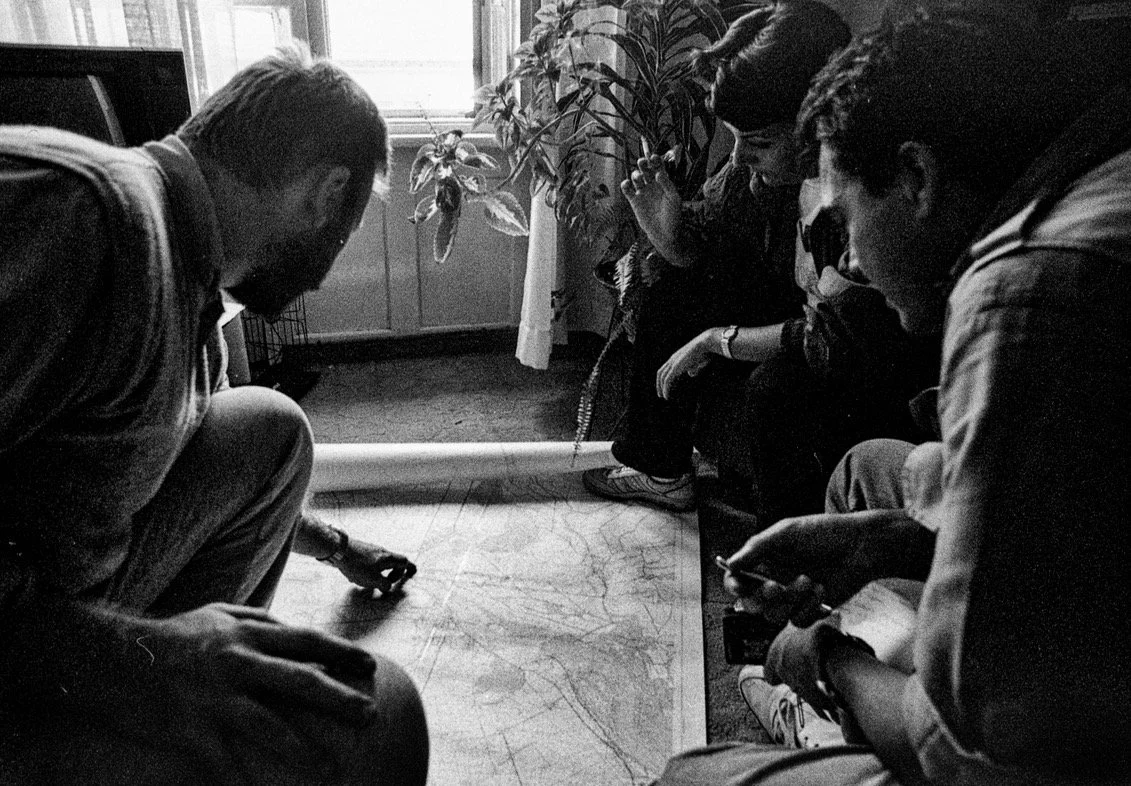
Julio Fuentes is with other journalists checking a map of places being attacked. Croatia. August 1991
The militiamen were grilling something; they were out of tobacco, and we gave them several packs, which somewhat broke down their resistance, assuming they had orders from someone not to let anyone through. We explained our good intentions to make the massacre known to the world, and they consulted with someone by radio. They gave the green light, but they would accompany us. Now I remember better that there were two cars, not just mine, so we split up between the vehicles. One soldier in the front with the driver and another in the back, crammed in, always with the doors open.
They forced us to stop; from that point, we had to continue on foot. We could see some houses still smoldering. We found dead animals on the road, a cow—what had the cow done to deserve this? We wondered. A little further up from where we parked the vehicles, which we turned around in case we had to make a hasty retreat, Shidone, an older man who was weeping uncontrollably, was explaining the situation to the soldiers. He had been lucky; he was one of the few who survived when the Chetniks stormed in like a horde, shooting and slitting the throats of people still in bed. During our tour, the open windows facing the street revealed sheets and pillows soaked in blood—blood everywhere.
Shidone explained how several men were lined up against a wall and shot dead right there. He didn't finish explaining how he survived, but it seemed he must have offered them something valuable. He took us to another house where an elderly couple were thanking the soldiers; they were unable to speak, the fear still lingering. They explained that they had survived because they hid in a hard-to-reach biretta (a type of open-sided shelter). In fact, when I returned to Vukovar in 2013, I went to visit them, and they were still alive, as was Shidone. The village had changed somewhat; the house, which had unplastered walls in 1991, now sported a white paint job with flowers in the windows.
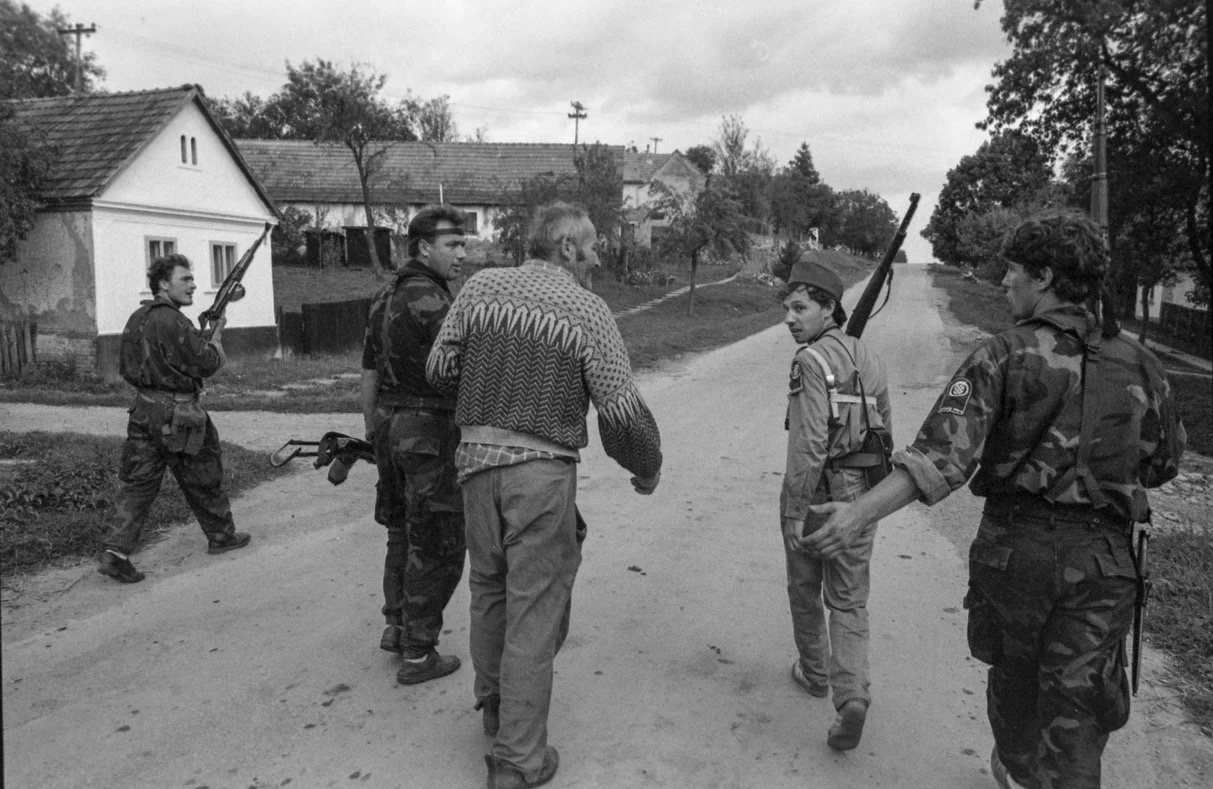
Shidone explains to the soldiers where the enemy is, the fearsome Chetniks, and warns them that there are quite a few of them. Terrified, we follow them, and along the way we find a dead cow and several stray pigs. Cetekovca. Croatia, September 1991.
We continued walking hunched over, the militiamen in front, Shidone explaining, and past the dead cow, the old man told us not to go any further, that the Chetniks were still nearby. The soldiers ordered a retreat because gunfire could be heard, and in 2012 we retraced that route that had remained unfinished. The cemetery on the right and a two-story house were still the same as in 1991, completely destroyed.
We ran as fast as we could and floored both cars until we reached the checkpoint. The soldiers explained to those on guard duty that they should radio for reinforcements, and we left there for Osijek. A few days later, the refrigerated truck arrived with the bodies of the elderly and some young people; there were no soldiers among the dead. Pérez-Reverte, Márquez, Ramón, Julio Alonso, Julio Fuentes, Edu, Ramiro Villapadierna, and I think Homero Nava, along with the other photographers, were shown the body of a young man they had taken out of the truck to explain how he had been killed. We climbed onto the truck to see if there were any children's bodies and to photograph them, and we had to walk carefully among the corpses so as not to step on them. Our fellow reporters asked us what we saw, and we told them. The smell of decomposing blood was terrible; it's like the smoke from a forest fire—it clings to your body, and no matter how much you wash, it's still there. We saw several elderly women with their underwear pulled down, and our colleagues said in unison: "Rape." Rape is a weapon of war.
When we got back to the hotel, we agreed to give the story all on the same day, since some of our colleagues worked for weekly magazines and we had to freeze the story. We were all in solidarity, and that's what we did. We didn't have televisions, so we were spared the long wait.
The news shocked the world; it was the first massacre documented by multiple media outlets and reported by everyone simultaneously like an atomic bomb.
The Serbian military grew tired of the group of young men living in a sort of commune at the hotel, tired of seeing and reading so many lies. So, one morning, the locals told us what the Serbs had said on television, with a clear and unequivocal message for the press: "If your weapons are pencils and cameras, ours are cannons and grenades."
The next day, Spanish and other diplomats wanted to evacuate us and take us to Zagreb, to a safe place. We said no repatriation, and certainly no more threats like the ones we're used to seeing every day. Therefore, some journalists left the hotel, others of us stayed, and a few days later, the first grenades began to fall. Unfortunately, Ramiro Villapadierna was hit, but luckily it was a low-value grenade. The glass shards pierced him all over, and we had to carry him out of the hotel in a chair.
A few nights later, from the windows of our seventh-floor rooms, we watched the bombings approaching in the distance, turning the night into a grim spectacle. Who knows how many people—children, women, the elderly—were dying or traumatized by such a bombardment. The hotel siren sounded, and we dragged our mattresses out into the hallway. The walls were thick and made of good concrete, but the older folks said that, by their calculations, the Serbs didn't have any long-range shells left, and the grenades didn't travel that far. And so it was; the hotel was out of range of the artillerymen. What we did in the seventh-floor hallway was chat, sip liquor, snack, drink the last of my Winston cigarettes, and tell jokes. The Pérez-Reverte jokes were so good they even lulled me to sleep until some British idiot woke me up to demand his mattress.
The explosion of the first grenade in the attic of the building that was in front of the Royal Hotel, where we were eating pizza. Osijek. 1991.
The veterans of "the tribe" were good at organizing lunches or dinners. Two were particularly memorable. The first was the day they opened a restaurant (I think it was the Royal Hotel) to eat wood-fired pizza. Food was scarce in the city, and there were only a handful of bars open. The pizzas were delicious, and the company was even better. Ramón, Arturo, Ramiro, the Julios, Hermann, Edu, and someone else whose name I can't recall. We didn't even get to dessert, which was probably tiramisu. We heard shouts in the street; the trams stopped like clocks without batteries, and we went outside to see what was happening. Some women were running across the street, and at that moment, there was a first explosion on the roof of a house opposite us. The shockwave was so strong that it knocked Julio, Edu, and me to the ground. I grabbed my Nikon and took a picture, but I couldn't even get to the next frame; the ringing in our ears had left us dazed. I saw Julio grab Edu's camera and film the smoke from the explosion. A second grenade exploded again, and this time we were caught off guard. It had landed almost in the same spot, but in the courtyard. Smoke and dust, smelling of gunpowder, billowed from the tunnel leading to the building. I saw Hermann running toward the Osijek Hotel. We heard screams, and Ramiro Villapadierna, Julio Alonso, and I followed. We went through the tunnel and up a small staircase where we saw an elderly woman crying, her back covered in shards of glass. Julio asked for Betadine, and I took the bottle from my first-aid kit, the one I carry on my belt. He started removing the shards one by one, but the risk of staying there was too great. We took her to the Royal Hotel, and an ambulance came to pick her up. They said the grenades were meant for the royals, as we were able to confirm days later.
"Your mattress?" Yes, my mattress; turn it over and you'll see my name. Sure enough, there was his name written on it. Nobody knew how his mattress had ended up in my room or how I knew it was his. There was a bit of a commotion from some of the tribe members, reminding the Brit that this was a peaceful commune, but he won the argument. I gave him his mattress back, and he left.
The Četekovac Massacre
Serbian forces murdered 21 Croatian civilians (16 men and 5 women) ranging in age from 18 to 91. The victims were found dead on their doorsteps and in their yards, bearing gunshot wounds or signs of brutal executions. As the group of journalists who arrived in the village detailed, this was one of the atrocities that spread across three rural villages in the Slavonia region: Četekovac, Čojlug, and Balinci. The context of the massacre indicated that it was one of the first large-scale war crimes in that area at the beginning of the Yugoslav conflict.
The Osijek Hotel was gradually emptying; the front lines were shifting to other parts of the country, as was the Serbian and Croatian weaponry. The crescent-shaped border between Serbia and Croatia, the Krajina, was becoming more entrenched and expanding towards the sea. Time was running out. I'd been traveling between Velgrad, Vukovar, and Osijek for over two months, and my plane ticket from Tivat was about to expire. The journey was long, and I was supposed to return the Renault 4 in Zagreb, but I called Hertz, and they let me leave it in Tivat. What luck! The Hertz employee asked me if the car had any holes in it, and I told him, "Fortunately not; you can rest easy." When I rented it, I gave him a white lie, saying I was an archaeologist. I spun him a tall tale that I was getting married and wanted to see places to take my wife since that side of the Adriatic had been a popular honeymoon destination.
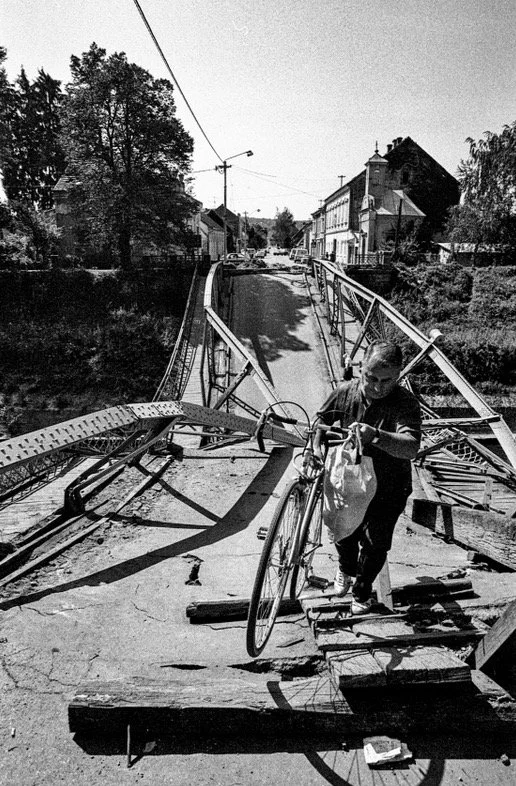
The Petrinja Bridge, the one Márquez never got to film. I dreamed of being able to film a bridge exploding into the air. I was looking for walls full of bullet holes to investigate if there had been a death wall there, where people are shot, the last place where they see the sky. Petrinja. Croatia. 1991.
The 12-hour journey required a few stops along the way, from Osijek towards Zadar, Karlobag, and Split. The hotel in Karlobag looked different; it had been converted into a field hospital.
I was happy because, up until then, the military checkpoints were few and far between and not too bothersome. At one of them, they made me pose with a Kalashnikov, and a few kilometers further on, I stopped two young hitchhikers. They were going to the Mali Prolog junction, which connects to Humac, Mostra, and Sarajevo, which in 1991 was not yet under siege, nor is it now. They were proposing. What no one could have foreseen was that on April 5, 1992, Sarajevo would be besieged until February 29, 1996. One of them said she wanted to go to Italy; both gave me their address in Sarajevo in case I happened to be passing through, and in 1993 I looked for them, but they were right; they had left a year earlier, as soon as they sensed that the Olympic city's days were numbered.
During the journey, we had time to talk about many things, especially the war, about the future they saw coming, about the stupidity of wars, and about what they heard from Osijek and Vukovar, which I confirmed was indeed true.
We said goodbye; it was getting late, but there was still enough light to keep trying to find someone kind-hearted to take them as far away as possible. We wished each other luck, and as always happens to me, I knew that would be the last time we would see each other.
In Karlobag, they offered me a small dinner, and I left them some of the medicine I had left, Tylenol, sugar packets, a first-aid kit, thread, and needles—because I have a habit of keeping little things for when I don't have them. Those little treasures can become a fortune when someone needs them more than anyone else.
Two young men approached my table, identified themselves as Czech journalists, and said they didn't have a vehicle to get to Gospić. It's only a 45-minute drive from Karlobag to Gospić, all along mountain roads with beautiful scenery and lots of greenery. We arrived, and they asked for their contact, who took us to the commander of a battalion fighting against the Serbs. I got myself into a big mess without meaning to; we were on the front line, right on the western flank of the attack by the Serbian paramilitaries and the JNA. We were invited into one of the bunkers where, in front of us, there were maps marking the most important points of the Battle of Gospić, whose resistance was vital for that area of Krajina to be recognized as part of Croatia years later.
The experience in Gospic couldn't have been more intense. They took us to the front lines; we were able to take photos and see the Serbs from almost a hundred meters away. The hatred was palpable in the air, knowing that many of the families in Gospić and the surrounding areas had direct ties to Serbia. What they had explained to me the first time so I could understand what was happening in Yugoslavia came to mind: you've had neighbors, Serbs or Croats; your sons or daughters have married; you've gone to parties, celebrations, and festivals together; and every Sunday morning there was a game of chess, and in the afternoon, football, where everyone played together in harmony. And one day, all of that changed. Your neighbor knocked on the door not to play chess, but to tell you that you had a few hours to leave and disappear off the face of the earth, or else others would come and rape your wife and daughters. And that's exactly what happened. The brothers who were on opposing sides killed each other, dismembering each other after horrific hours of torture. That's how they explained the war to me.
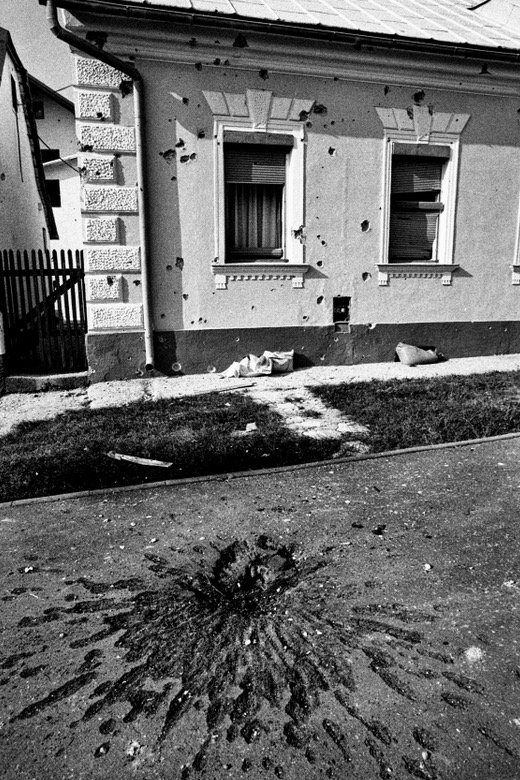
I arrived in Gospić with the two Czech journalists, and we were greeted with music, but not from an orchestra. The city was under heavy bombardment, and we were taken to headquarters, where the high command was located. The situation in Gospić was under Croatian control, and they predicted that the Croatians would soon gain ground. Gospic. September 1991.
We were trying to reach a hotspot in Gospic with a high-ranking officer. We had to cross a bridge, and bullets started whizzing past us. The officer told us to put our hands on our heads. We didn't have an escort patrol because we didn't think there would be a sniper stationed in that area. The officer kept saying to advance, crawling like a frog on the asphalt. My colleagues behind me fell back, and I couldn't see where to shoot. The bullets ricocheted and flew off pieces of asphalt. To my right was a kind of small river; I crawled until I fell into the water, and slowly, half-submerged, with the cameras held high so they wouldn't get wet, I gradually got out of the situation and out of the area of influence of the sniper or whoever the bastard was. I swam in the cold mountain water as far as I could and climbed an embankment where I found some soldiers who took me to the battalion. I dried my clothes, they gave me soup, and I fell asleep a few meters from the operating table, where some dim light bulbs illuminated the scene. I felt safe, and the next day they took me to the Renault to continue on to Tivat.
At the airport, I returned the car. The Hertz guy wanted to charge me, but I gave him the key, and he stayed there. I told him to call his colleague in Zagreb. The Renault was without a scratch.
I remembered that the boys from Vukovar had given me bullets of various colors and calibers and a backpack the day they shot down a tank. I realized I couldn't get the bullets through the scanner, so I put them in a toilet cistern. When the blue Domke bag went through the airport scanner, a policeman shouted that I was carrying bullets and was sure I had removed them all.
They mobilized and found them in a part of the bag. I didn't even remember they were there, but they were just empty casings and one bullet with the detonator removed.
I explained that it was a souvenir and offered, recalling the flight manifests that are done on every flight, that weapons or explosive materials could be given to the pilot. He agreed to take them, and when I arrived in Madrid, I had to explain it to the Civil Guard, who did the same. It must be somewhere at my mother's house in a drawer.
I was tired of playing my cassette of Guns & Roses. I've been to listen to "Losing My Religion" by R.E.M., and for sure, 1991 was one of the best years for rock music. I arrived in my city and threw myself into the sea to feel the salt water and the still-strong sun that stung me as I dried off. The images of the summer of 1991 flashed by like slides, one by one, but I preferred not to touch them; I always do the same. I let them mature, hanging on the walls of my house, until I like them or I take them down.
But you feel bad; you know you left that bloody hell, and so many people are still suffering there. But it's wrong, awful, to take on something that isn't yours, so the best thing is not to think too much nor to say, "Oh, I feel sorry for them; that war isn't my war." "That would be quite selfish. And we photojournalists, eyewitnesses, and writers are selfish, besides being incredibly vain, complete assholes.