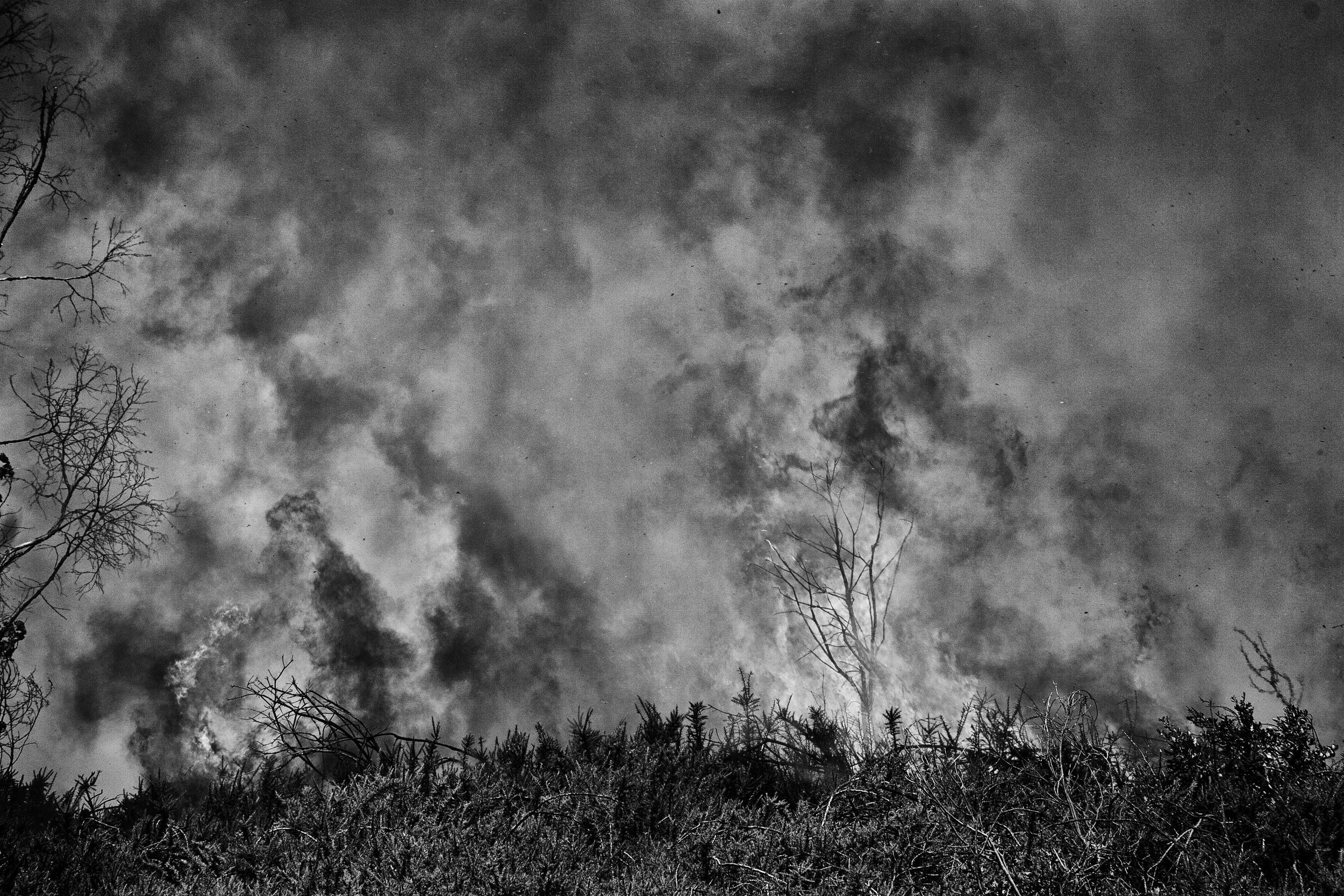
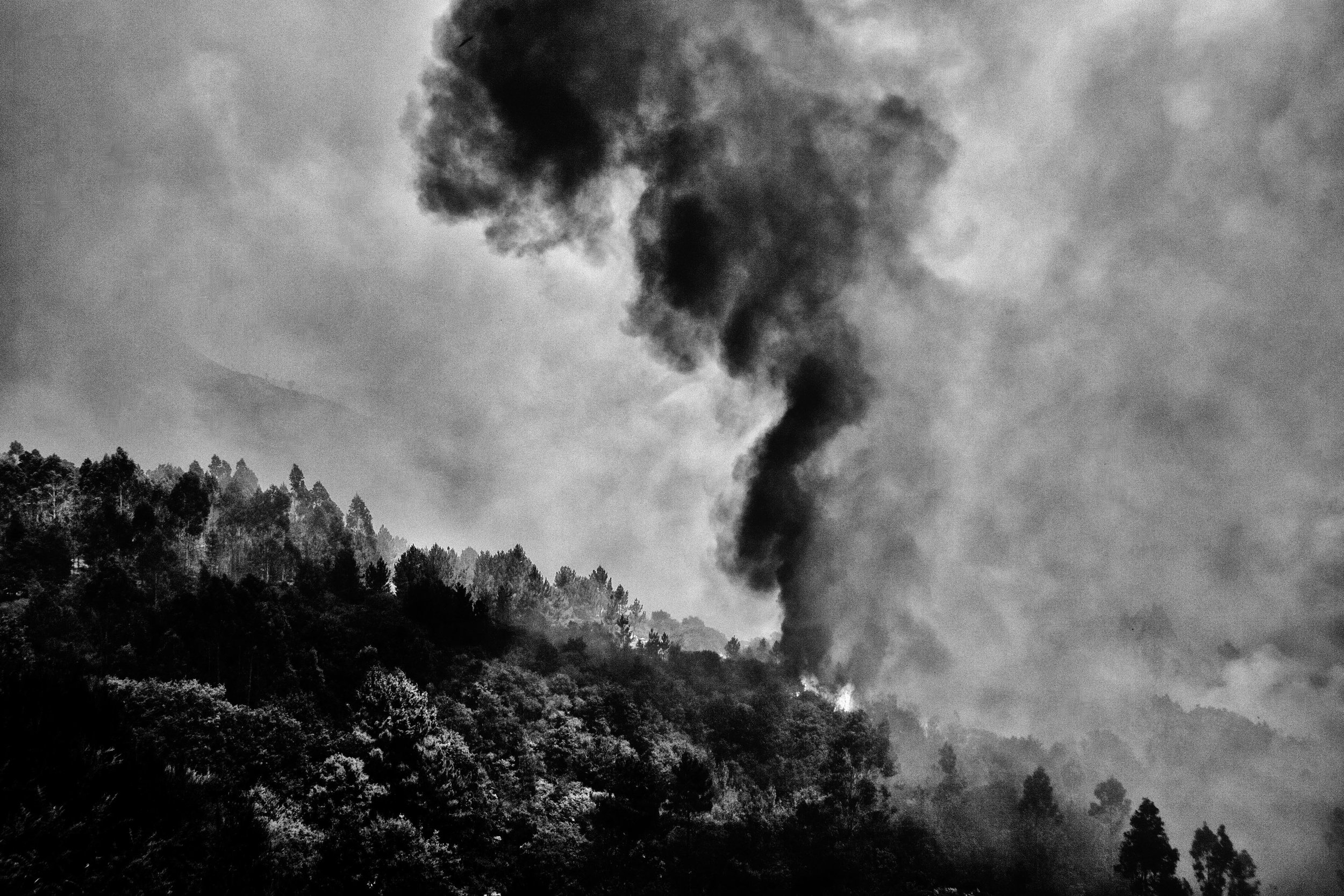
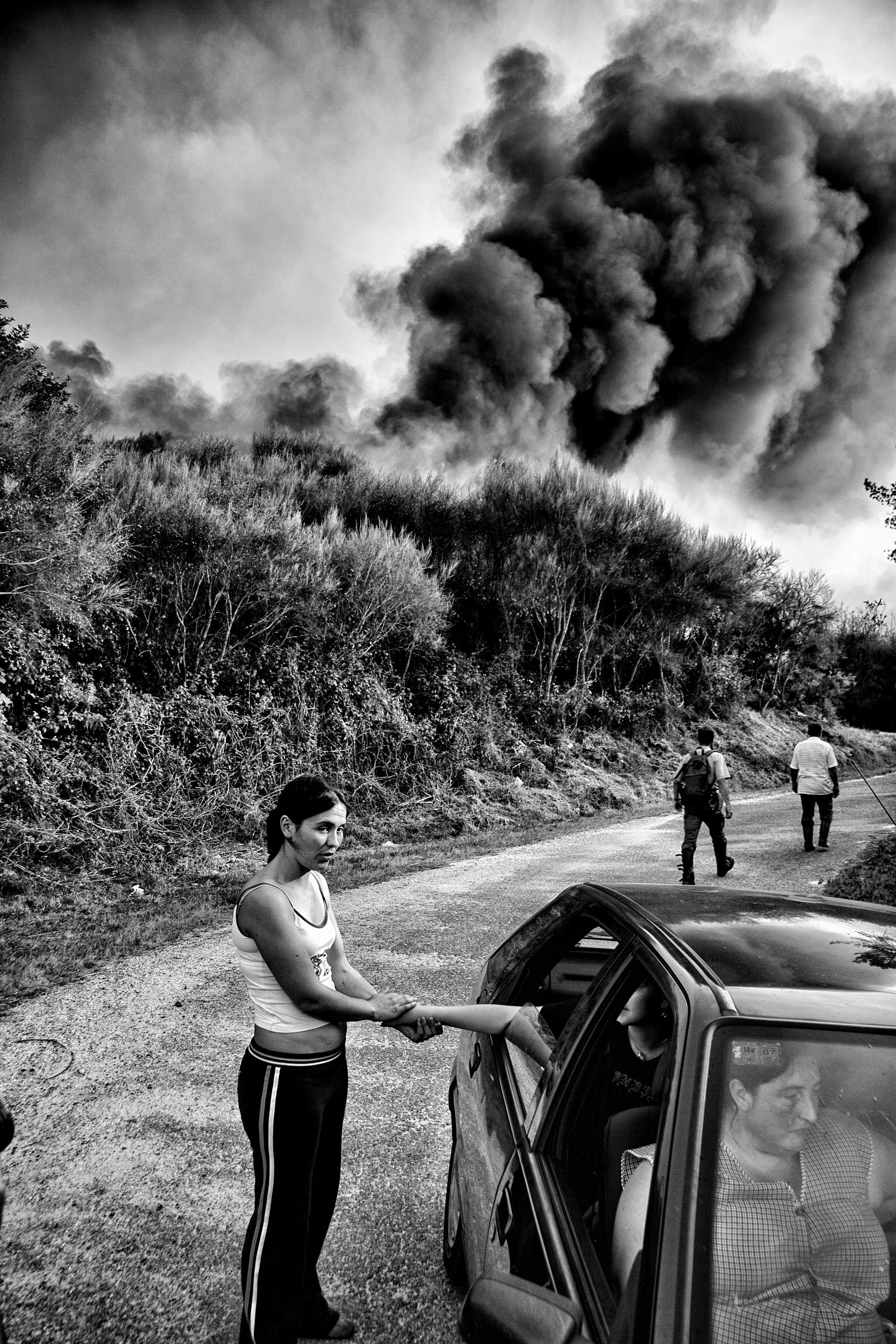
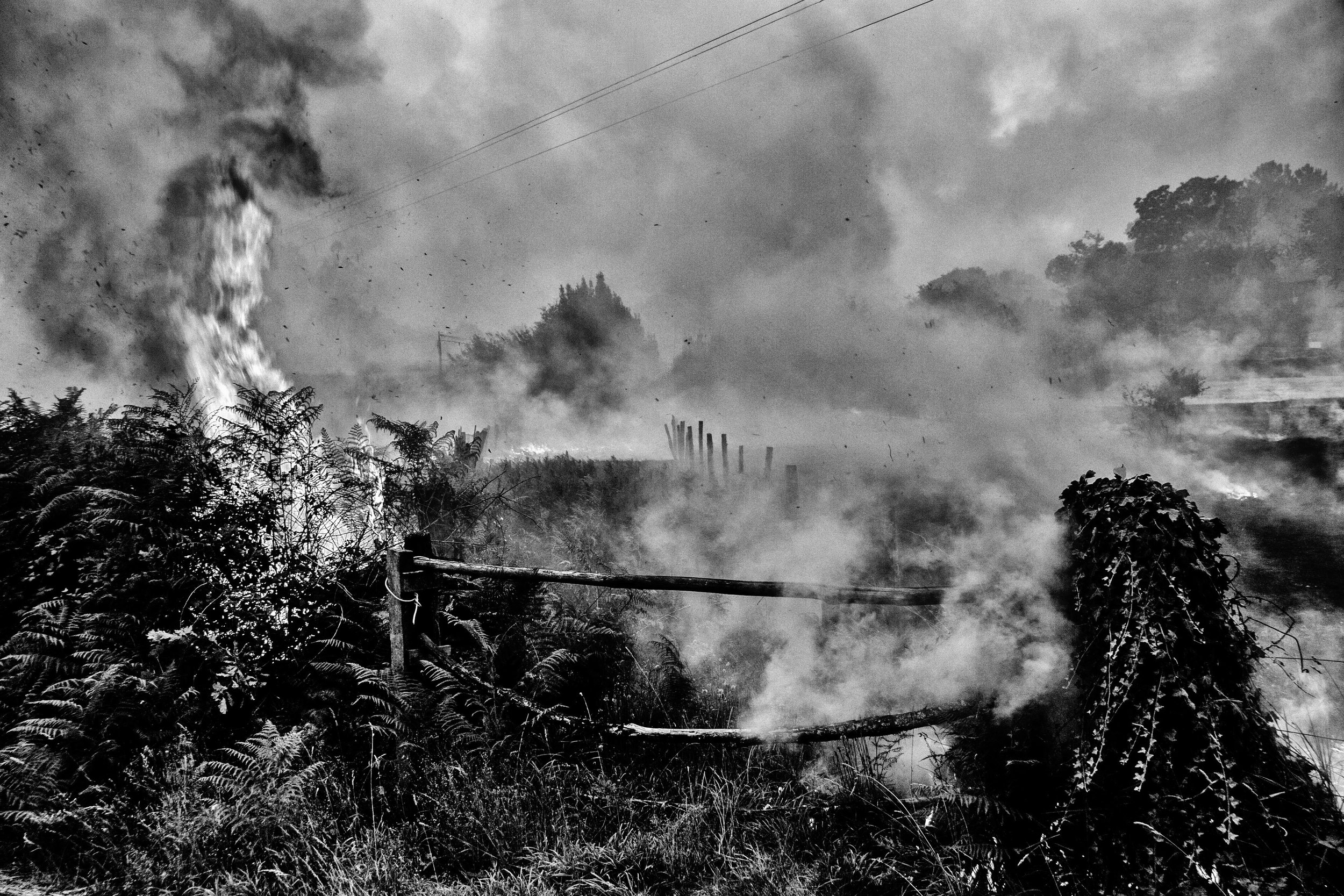
Burning land
The fire business in Galicia.
1985-2026 © Delmi Alvarez
Spring 2026
Long-term documentary in progress
Prevarication, oligopoly, bribes, trials without culprits, rural depopulation, exhausted and poorly paid pilots, firefighters without contracts, outdated forestry plans, eucalyptus proliferation, pulp mills.
The pilots of the Air Force's Canadair CL-215 seaplane ("43 Group") from the firefighting group based in Lavacolla started, one by one, the two Pratt & Whitney R-2800-83AM 18-cylinder radial piston engines, with a power of 2100 hp each, to load 5000 liters of water.
Pombeira, Ourense-, Ourense, saturday, 20SEP25.
I fastened my seatbelt in the carrier behind the captain and adjusted my headphones, and they did the pre-flight check.
"Can you hear me?" the captain asked.
—Loud and clear, captain.
The sound of the two turboprops was music to our ears; all parameters, gauges, and navigation systems were working, as well as oil and fuel pressures.
The captain gave a thumbs-up to the ground attendant outside and requested permission from the tower to taxi and line up. Fires in the 70s and 80s weren't as aggressive as they are now, but to be an air raider (slang for Canadair crews), you need very thorough and extensive training.
Are there dangers? Many.
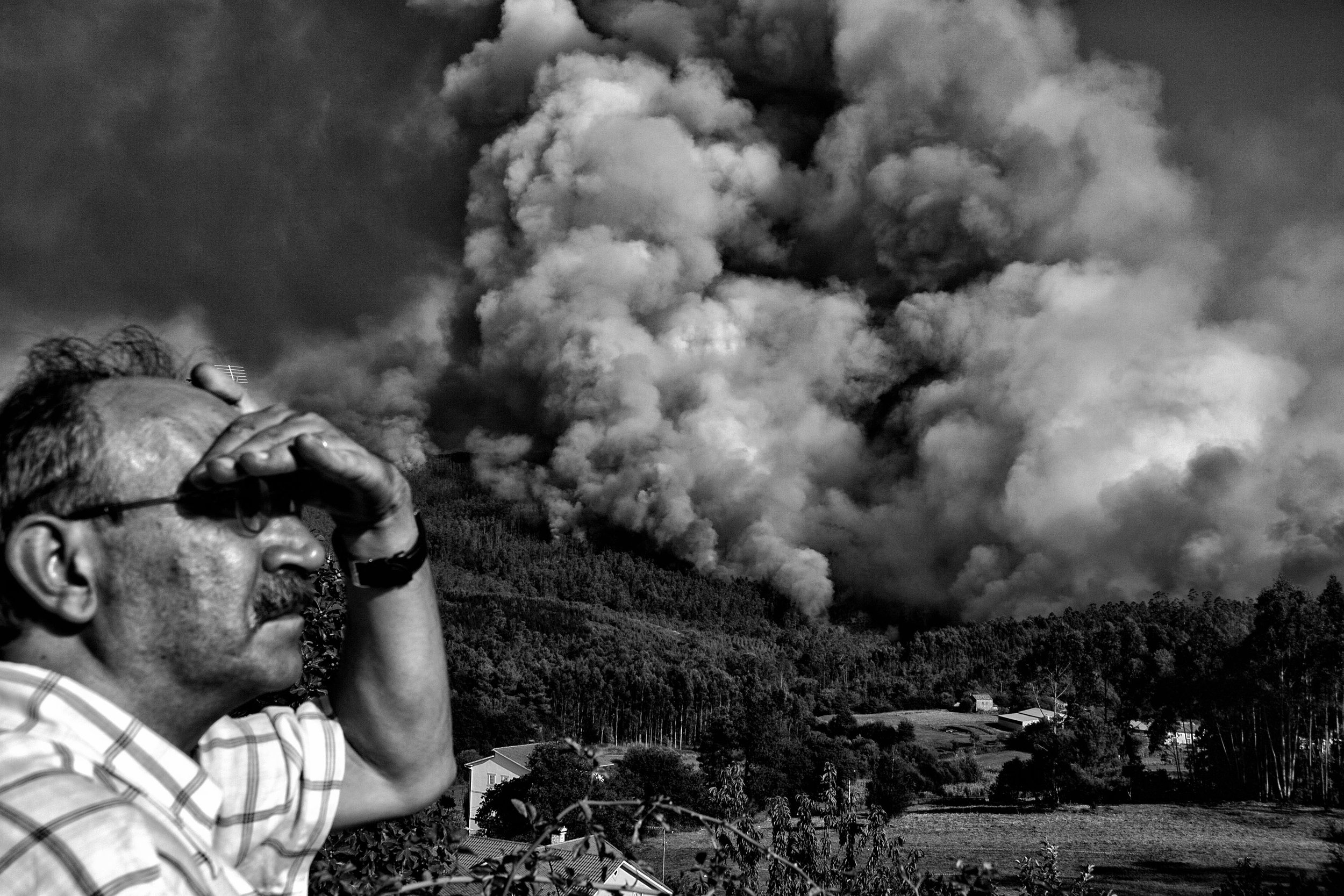
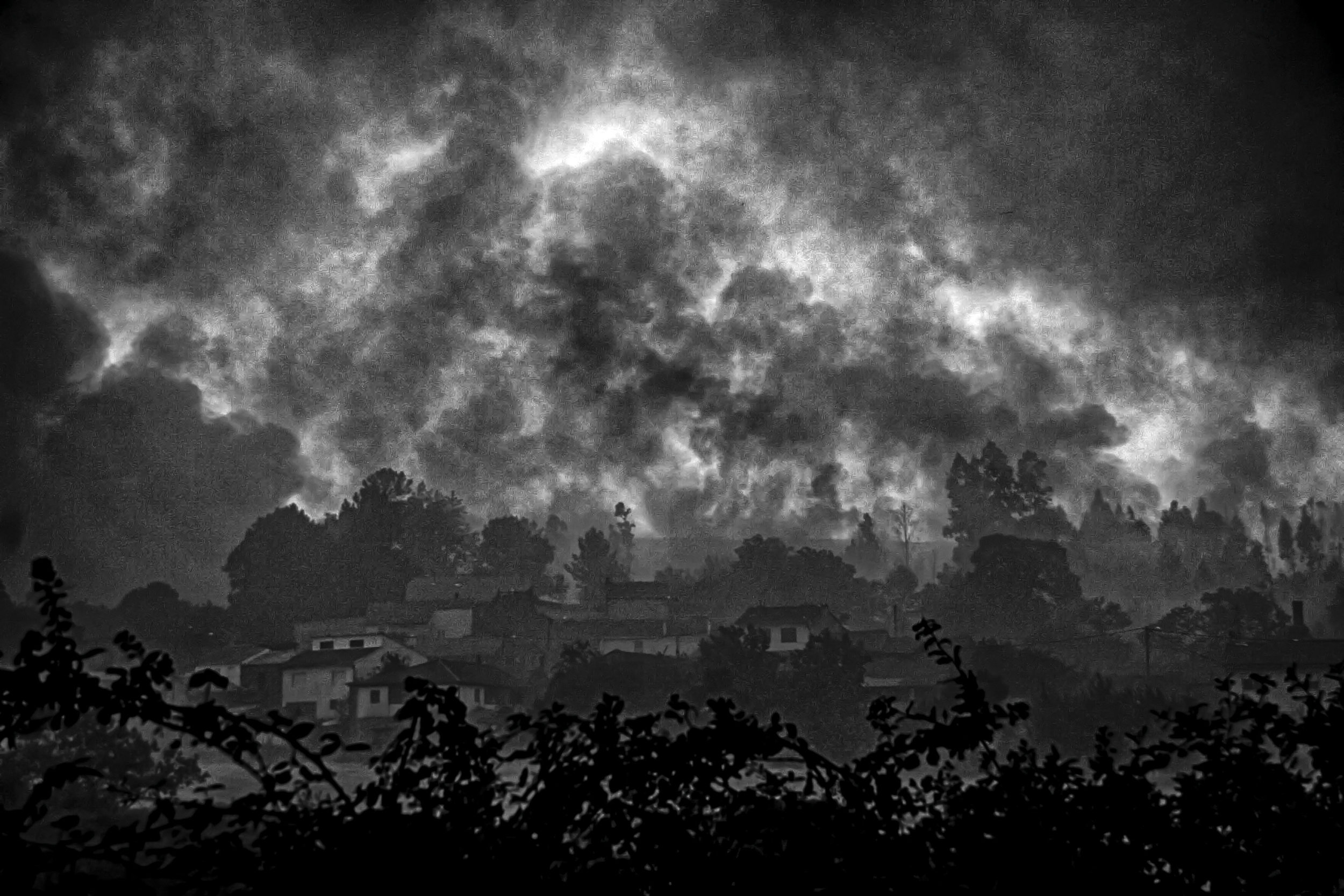
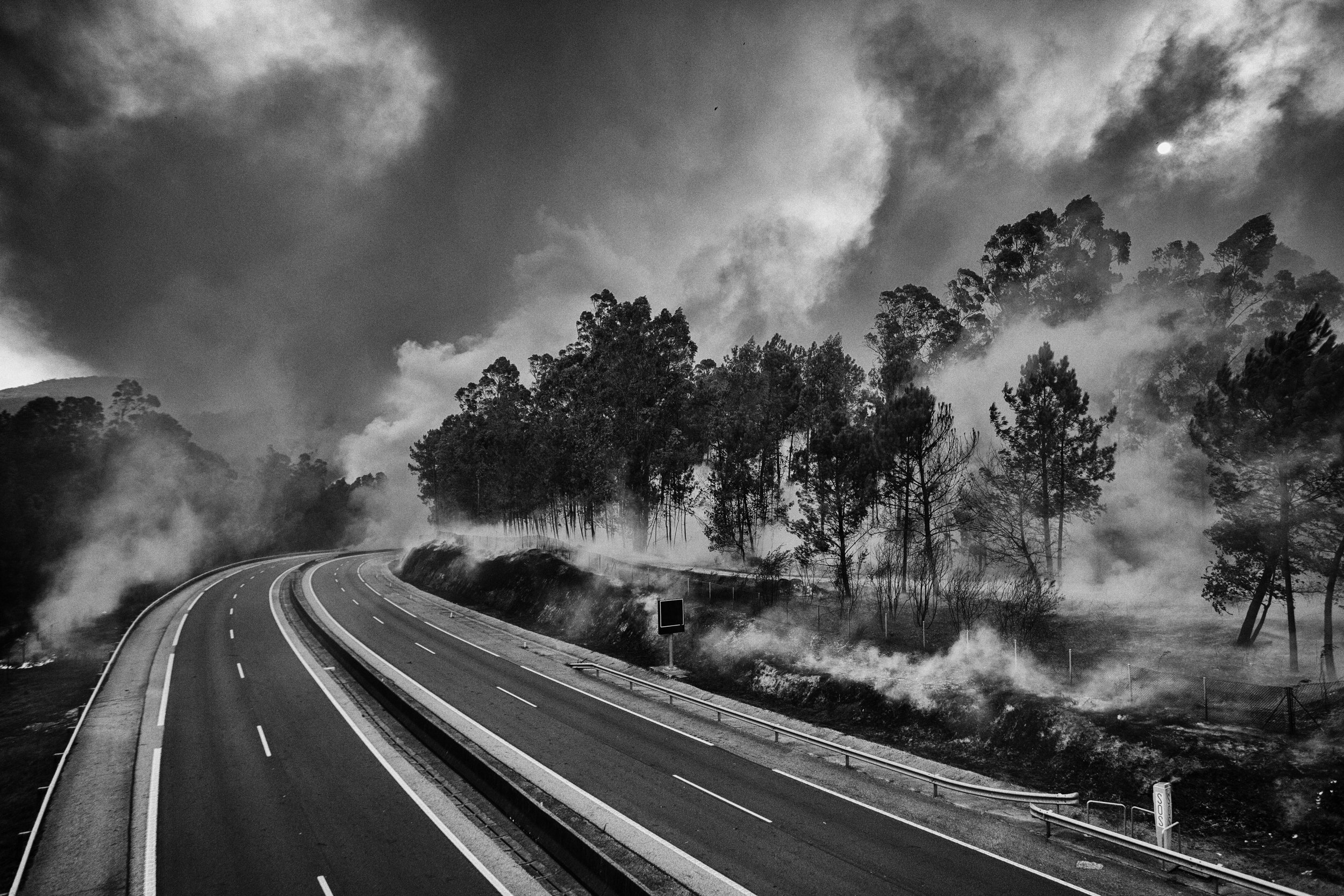
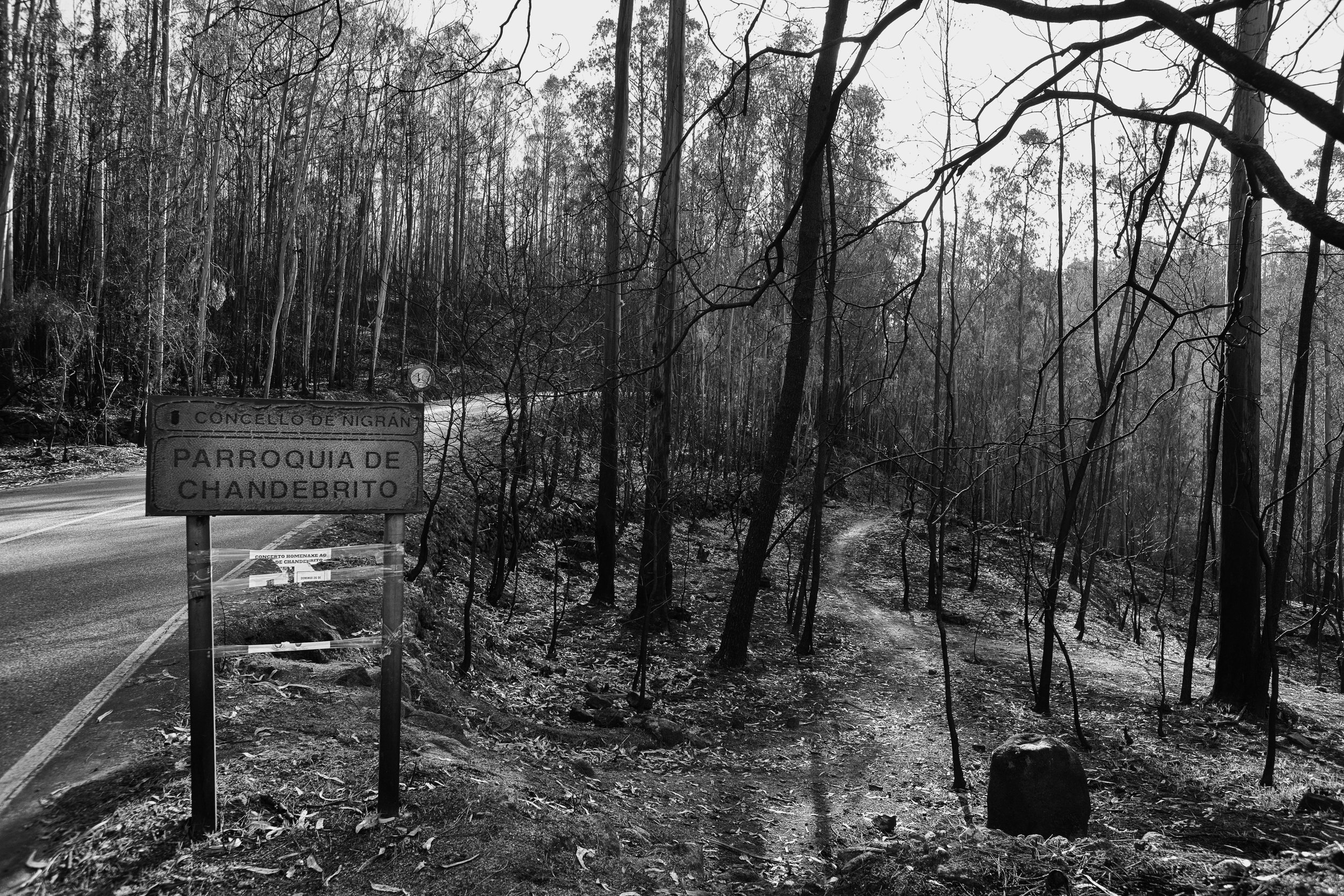
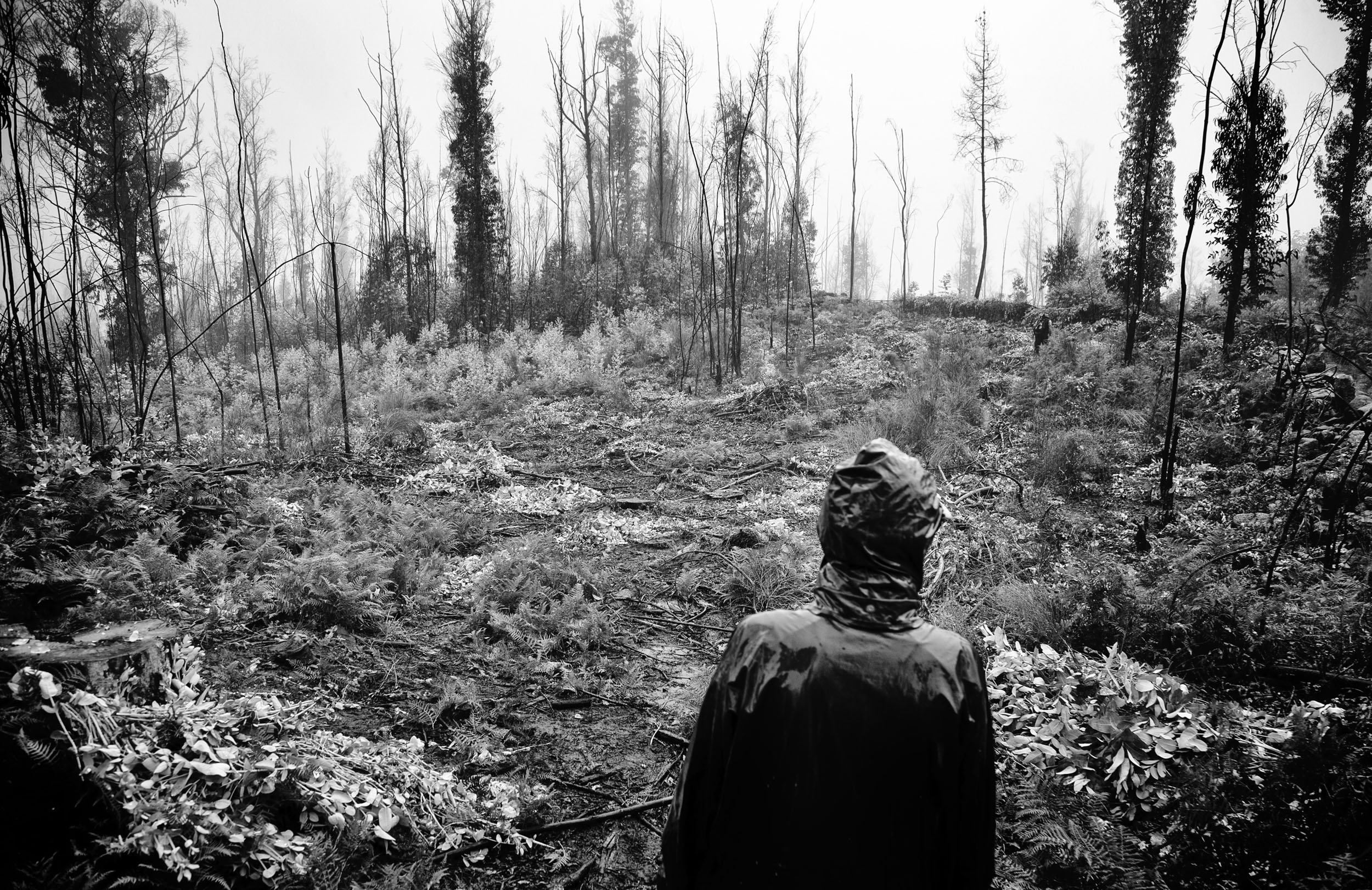
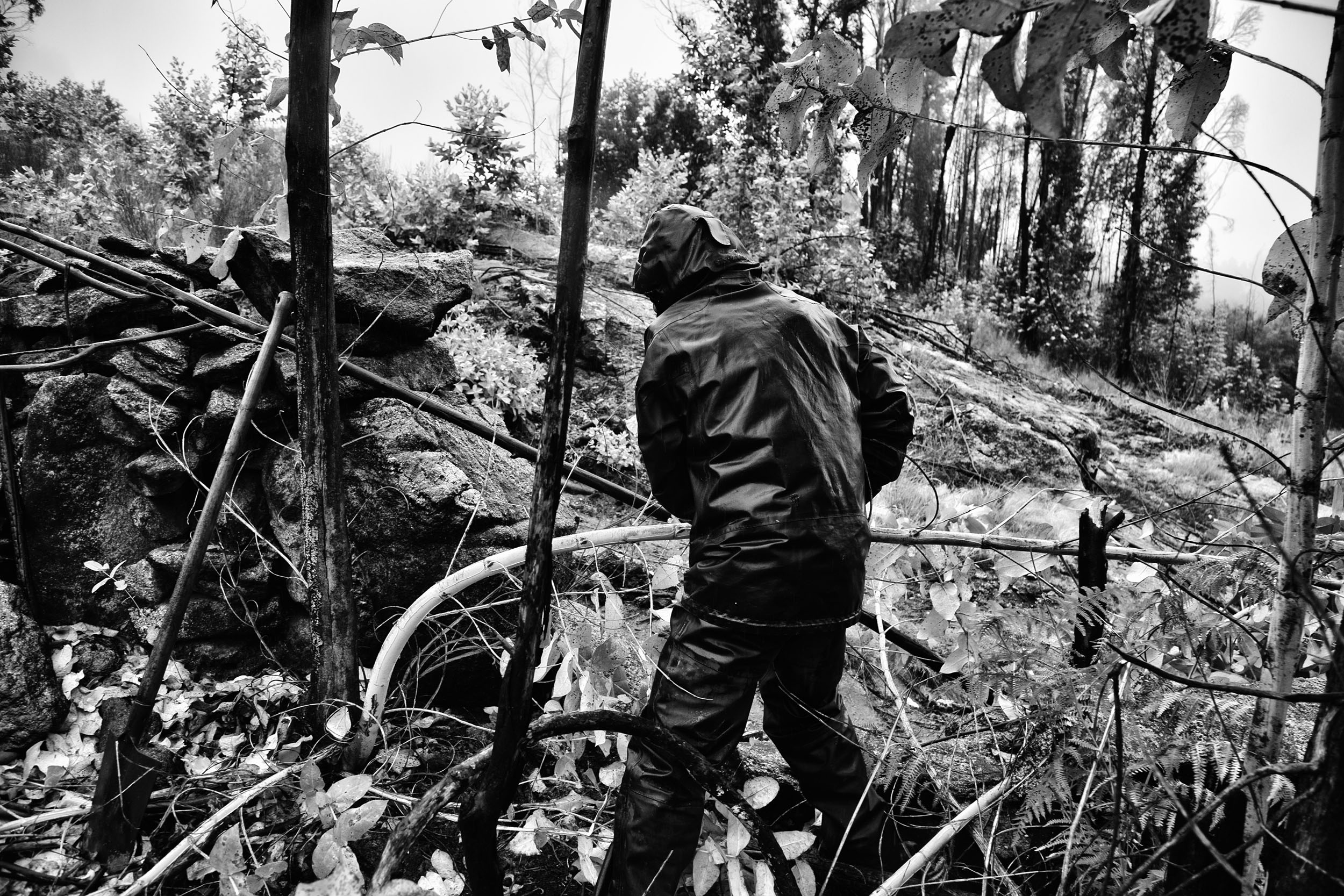
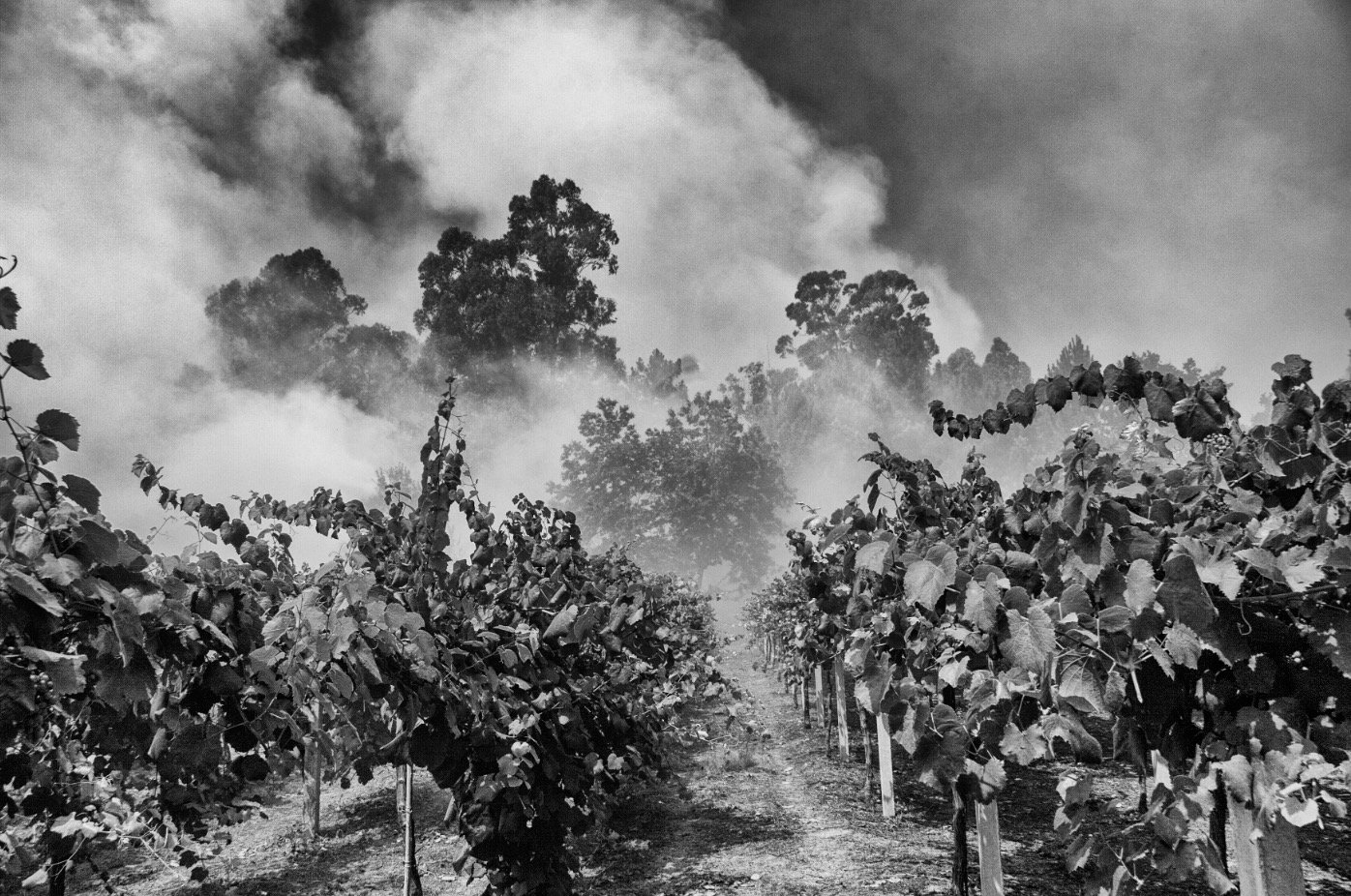
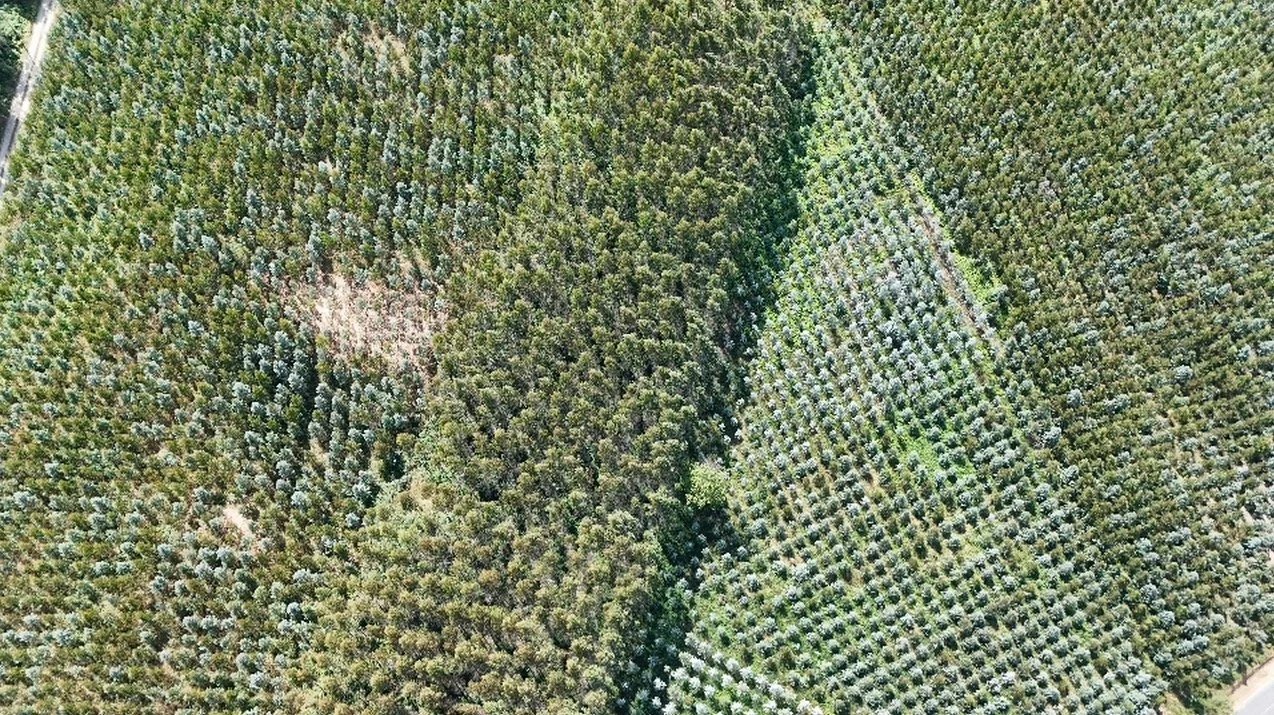
Eucalyptus plantation in O Sexo region. Galicia. 2025
The story was worthy of publication in La Región, and the permission to carry a civilian in the cockpit was a gift any aviation enthusiast would envy. It's hot inside: pilot, co-pilot, and mechanic, all essential for the probes that allow water into the tanks. This is like a diesel train; you have to be highly attuned to any unusual noise. The Canadair isn't a Cessna or a small sightseeing plane; here, the powerful engines must be carefully controlled to prevent them from running wild. When its belly is loaded with 5,000 liters of water, controlling the aircraft requires the precision of a watchmaker: the aerodynamics change due to the weight and the support the fuselage provides while containing so much weight, and when the captain releases the 5,000 liters by pressing a button on the controls, the plane rises several meters, just like when a parachute opens. All of this requires keen eyesight, good vision, monitoring for power lines, avoiding dropping thousands of liters of water directly onto them (as that would be catastrophic), calculating crosswinds and prevailing winds, whether headwinds or tailwinds, and understanding the terrain. To extinguish a fire front or halt its advance, it's essential to have excellent control of the "seafoil," a Canadair in aviation jargon; these are many tons and demand extensive training and skill from the crew in the cockpit. From the ground, they receive support and information about wind conditions and any cables or other obstacles that might impede maneuvering. Water bombers become inoperable at dusk, as flying in the dark is impossible due to the limited visibility at a fire.
They typically operate from a base with a runway that doesn't meet air traffic regulations, such as runway lights, VOR, ILS, etc. Like other aircraft, seaplanes fly under VFR (visual flight rules) or IFR (instrument flight rules), but due to their low altitude and environmental conditions (smoke, terrain, power lines, and towers), they withdraw at dusk. For water landings, the crew, in coordination with ground support, uses reservoirs or rivers. Although their power allows them to take off in a short distance, it's crucial to ensure there is no traffic in the area, including recreational boats, divers, or people practicing sports.
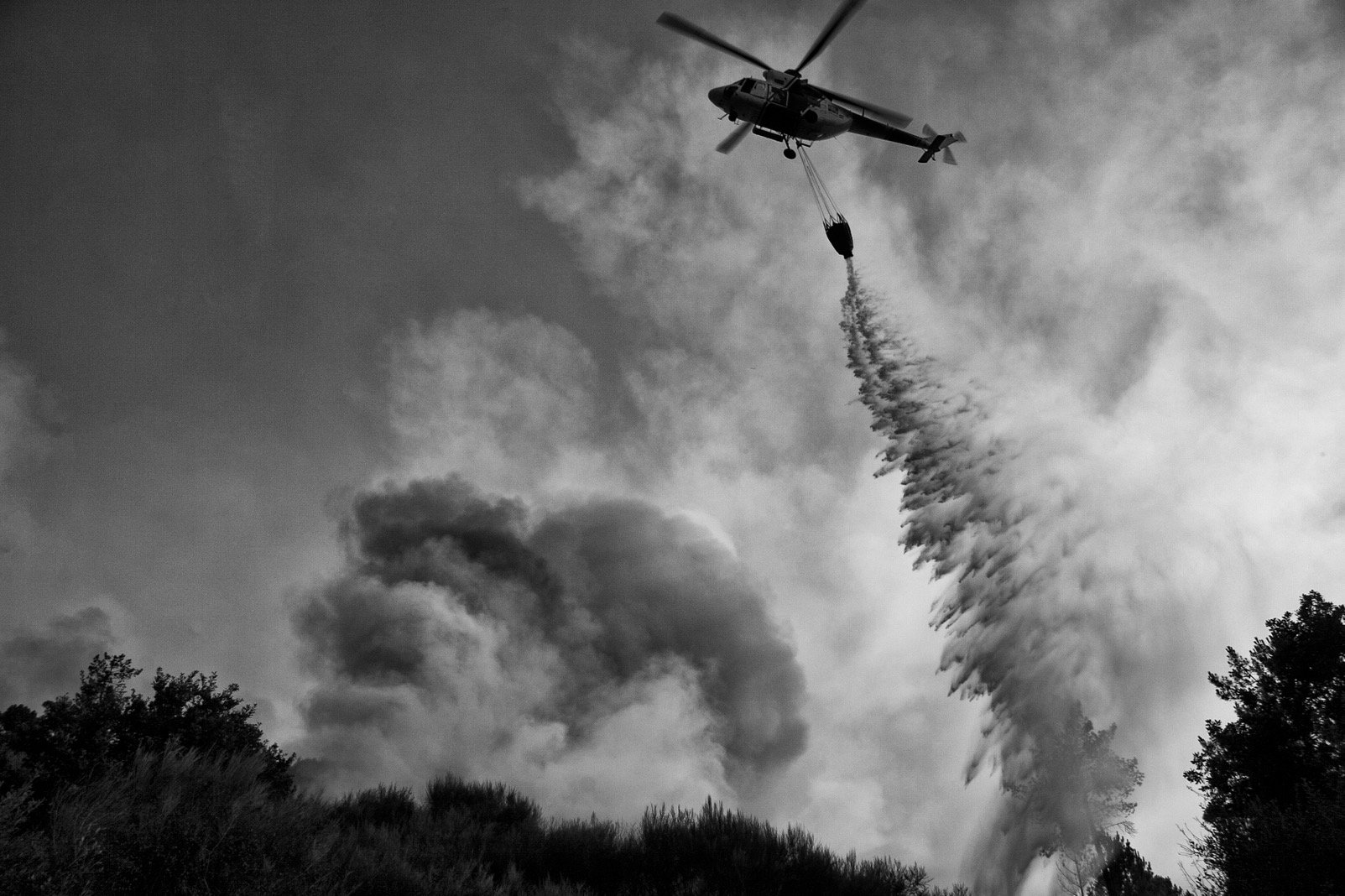
The probes are opened by the mechanic, who opens and closes them once the filling cycle is complete. The captain presses the button to empty the enormous drums containing 5,000 liters. Colored liquids, fire retardants, are also used to prevent the fire from spreading. Unfortunately, there have been many accidents with fatalities among these heroes who risk their lives to prevent disasters.
The fires in Galicia have followed a trajectory consistent with the times in which they occurred. That is to say, this writer, after photographing forest fires since the 1980s, with 2006, 2007, and subsequent years, and 2013 and 2025 being the most severe, has no choice but to say that, according to statistics, 97% of the fires are anthropogenic, that is, caused by human activity. With climate change intensifying and the obvious interest in having fires, it was discovered that in Spain there was a group, known as the G6, that was perfectly organized to receive millions of euros from public funds: a sweet deal.
The Galician forest fires of 2006 were a set of 1970 forest fires (37 of them large) that ravaged Galicia (Spain), especially Pontevedra and La Coruña, from August 3 to August 15, 2006, which is when this long-term documentary project (Burning Land) was born.
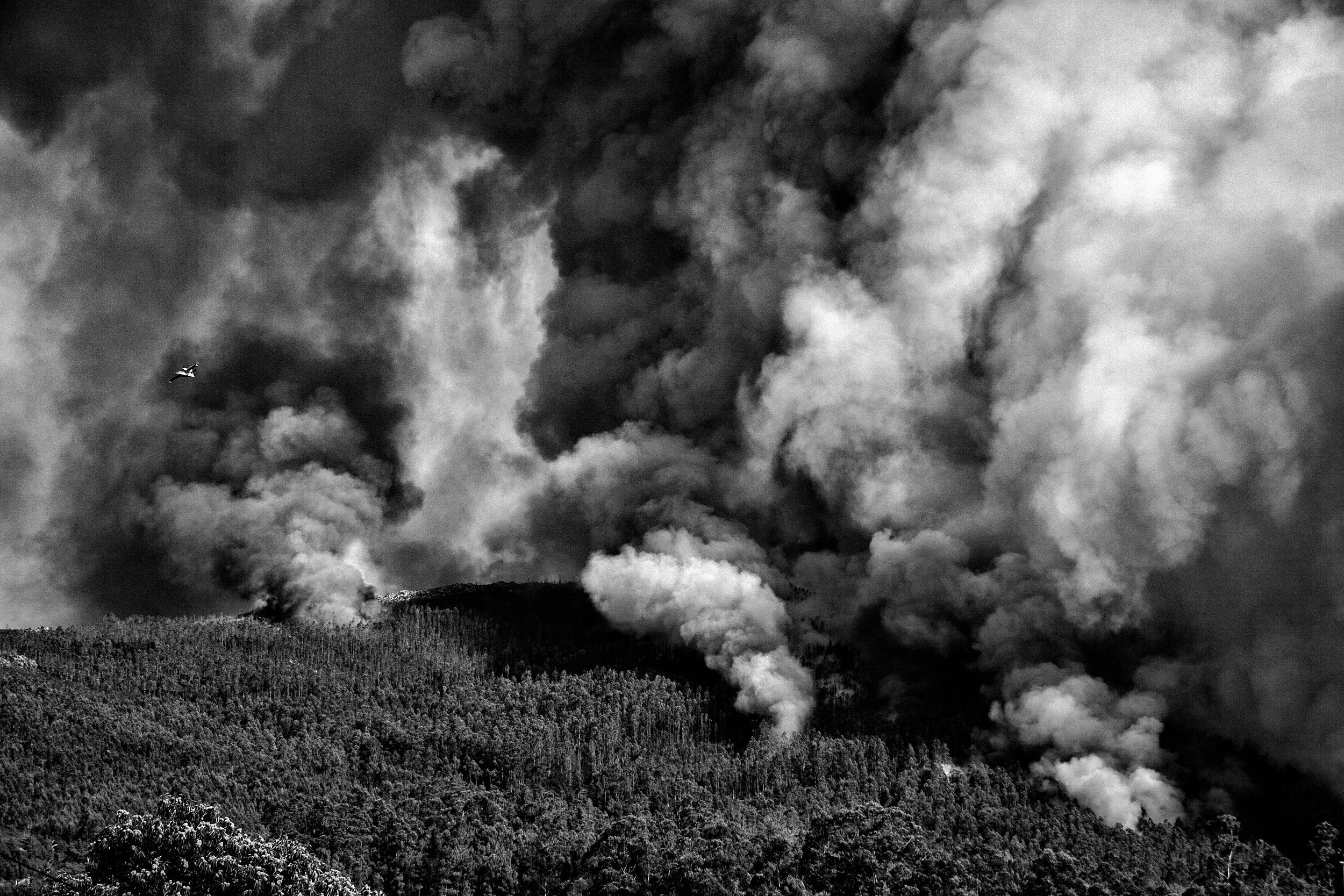
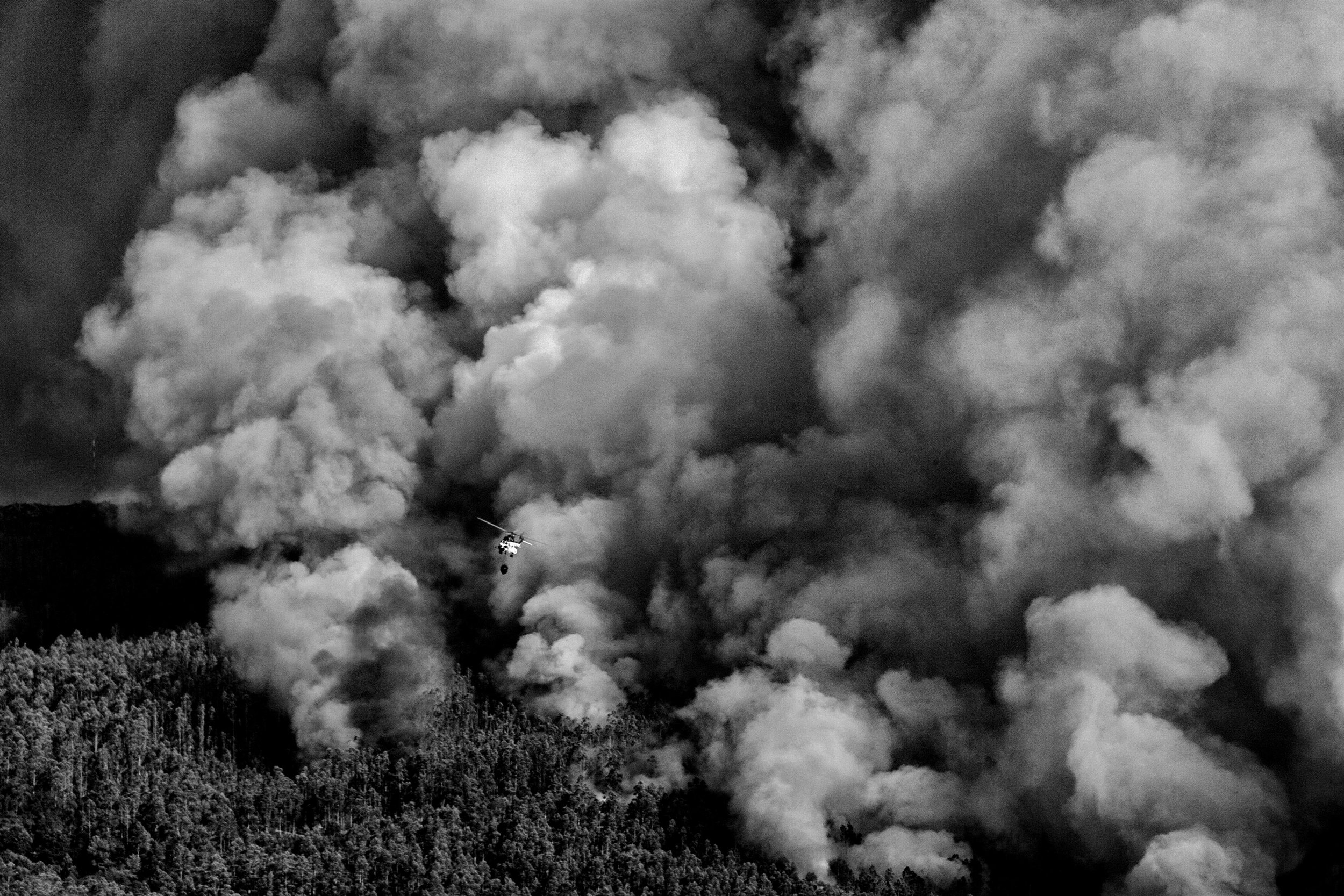
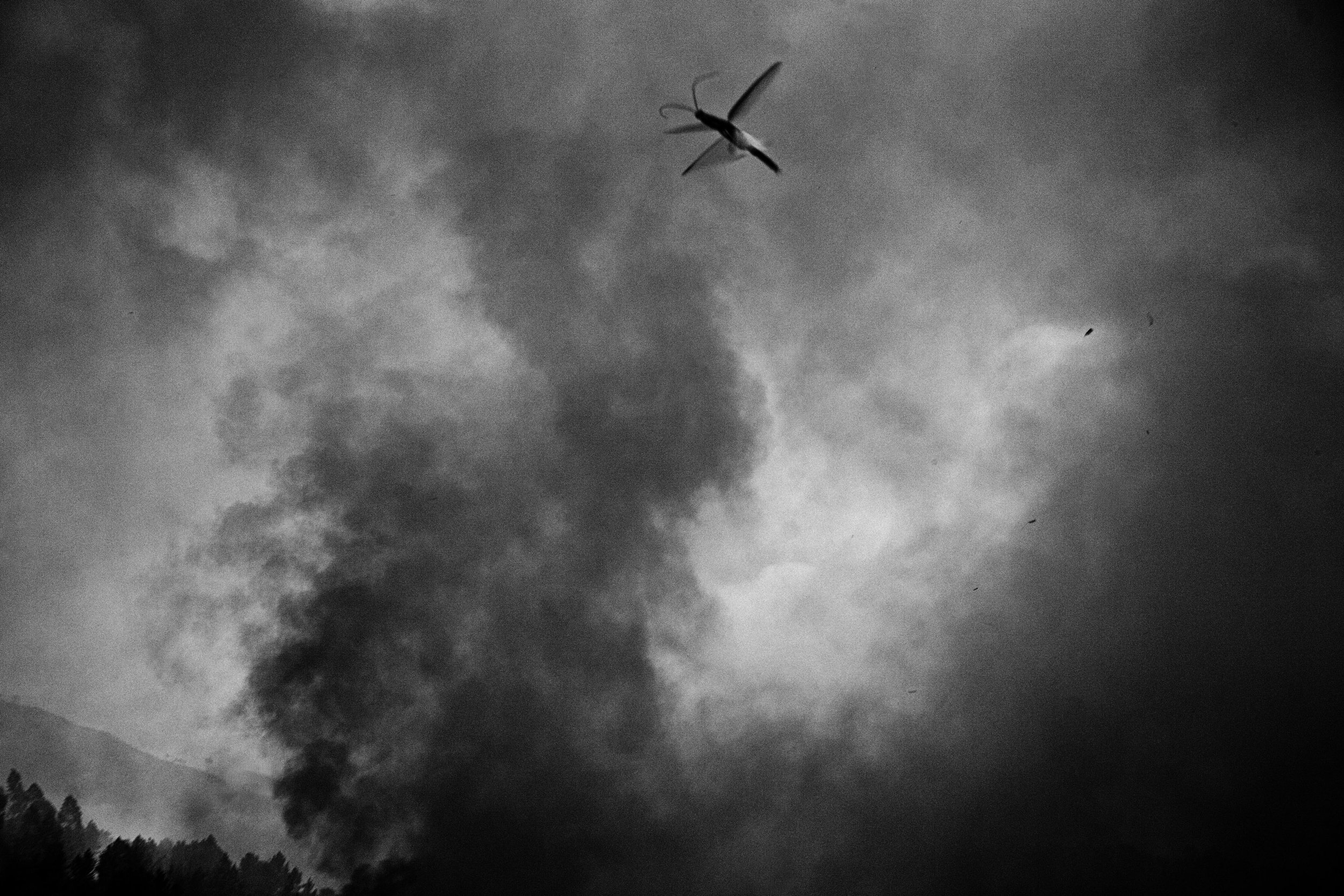
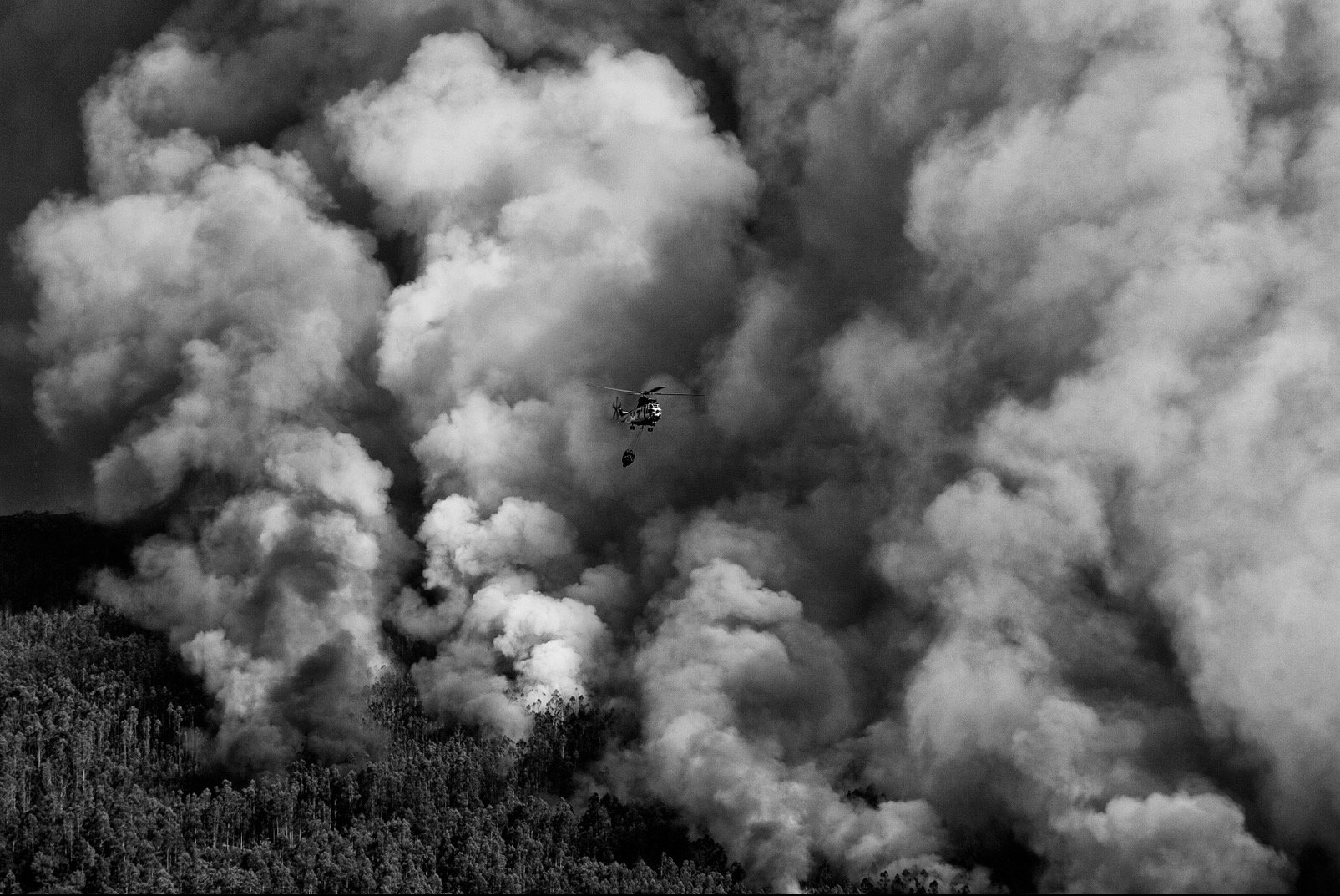
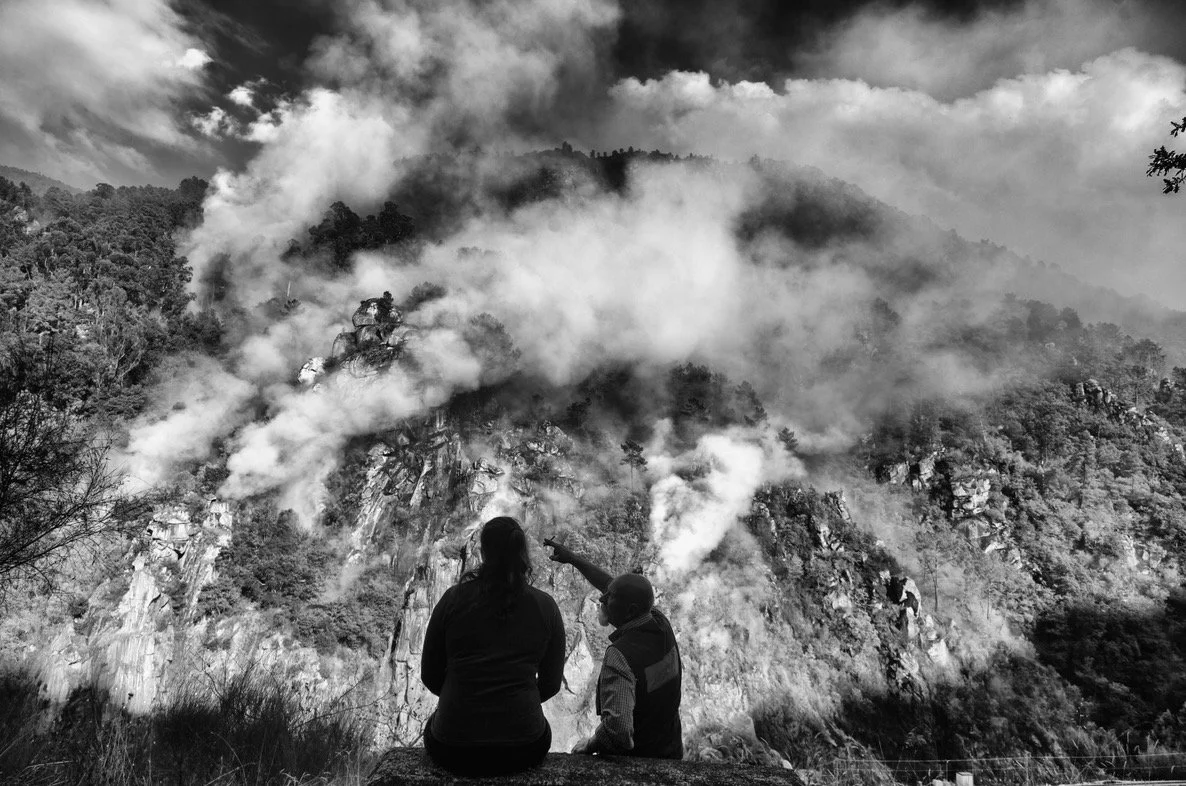
A firefighting Canadair of the Spanish Air Force (on the left side of the image) emerges from a dense cloud of smoke or forest fire in the province of Pontevedra in 2006.
The summer of 2006 marked the beginning of the fire business, the exposure of the G6 cartel, and the depopulation of rural areas, which, although denounced for years, became undeniable. The forestry plan was a disaster, with eucalyptus trees proliferating throughout the country, in greater numbers in coastal areas, where the wind and rainy winters nourish their roots so that, in 15 years, they can be cut down and generate income. They require no maintenance whatsoever and destroy everything around them; they are an abusive species that depletes the soil of water, killing other plants. And they are pyrophagous; they love fire. Their bark becomes a kind of torch that can fly, travel for kilometers, and ignite fire wherever they land.
That's what happened in the summer of 2017 in the province of Pontevedra: if there was anything like the apocalypse of those days, people lived on the edge. There were victims, women trapped in their cars, who burned alive due to coordination failures and a lack of knowledge about how to act in such cases in a Galicia of smallholdings, archaic and mired in the past. In the second half of August 2025, Galicia returned to that horrific past, with fires where 97% were caused by humans.
Hundreds of millions of euros went to the G6, who, under different company names, received money through emergency contracts. Despite an investigation by the National Court, no one went to jail, even though politicians had acted with blatant and complete impunity.
In 2025, the burned area, according to the EFE agency, was approximately 354,793 hectares incinerated by fire, which was one of the most devastating years in recent decades in terms of forest fires.
What is all this based on? If we analyze the available statistics and studies on fires, of which there are many, we discover that behind the fires is an undeclared criminal group, not organized from a criminal standpoint, that has operated legally for many years, with money, as I mentioned, of public origin. It is the fire business, “the self-styled 'Group 6' or fire cartel, a business network investigated by the Spanish National Court for the alleged rigging of public tenders, bribery, and anti-competitive practices in the forest fire suppression business for two decades.” The six main companies involved in this network, which controlled the oligopoly of aerial resources (airplanes and helicopters), are the following:
Faasa (now restructured and part of the Safa operating group)
Avialsa
Inaer (operating under the name Babcock MCS España, and later acquired by Avincis)
Martinez Ridao
Safrose
Helicsa (part of Faasa / Habock)
The conglomerate took advantage of the fragmentation of procurement processes, which depend on the various Spanish autonomous communities, to divide up the lots and emergency contracts, circumventing free competition. Alongside these schemes, and if we look at the legal and formal security and firefighting sector, the business network in this field in the country is grouped under official associations such as the Spanish Association of Fire Protection Companies (TECNIFUEGO) and the Spanish Association of Installation and Maintenance Companies (AERME).
On what basis did this group operate and continue to operate?
It's pure logic. Climate change studies are unfortunately alarming. Summers with very hot spells, lasting between one and two weeks, create ideal conditions for wildfires. The land itself provides the fuel: due to the significant rural depopulation, the forests no longer have animals to naturally clear the scrub, gorse, and all the pyrophagous material that grows a couple of meters above the ground, as they did in the 1950s, 60s, and 70s. Poor forest management and the increased use of species like eucalyptus in forestry policy have created a veritable tinderbox, which over time has given rise to the so-called fire triangle: Galicia, Castile and León, and Portugal. These are the areas where thousands of hectares burn every year.
In the years following 1989, the victims of fire not only included animals, wildlife, and ecosystems but also human lives, as if nature itself, angered by the treatment it receives, demanded human sacrifices in return. According to the magazine nuve.es, the Spanish government and companies linked to the aerial firefighting sector in Spain have secured and managed contracts worth hundreds of millions of euros. Public spending is channeled through the central government and the budgets of the autonomous communities.
The big pie of the Central Government (MITECO)
The Ministry for Ecological Transition and the Demographic Challenge (MITECO) awarded nearly 270 million euros over a two-year period to private air transport companies.
Of that sum, 156.4 million euros correspond to a multi-year macro-contract of three years.
This budget covers the availability and flight of 43 private aircraft deployed in support of the autonomous communities.
Meanwhile, the central government's regular expenditure on renting helicopters and private equipment is around 52 million euros annually.
Awards by specific companies
Despite investigations by the National Court and antitrust sanctions for the "cartel," these firms (many of them renamed) continue to dominate public tenders due to the lack of alternatives in the market:
Avincis (formerly Inaer/Babcock): It consolidated its position as the undisputed giant of the sector. It secured a package of contracts from the Ministry for Ecological Transition and the Demographic Challenge (MITECO) and regional governments (such as Castilla-La Mancha) valued at nearly 60 million euros to operate 14 additional helicopters.
Martínez Ridao: It remains active, securing key contracts in various autonomous communities. For example, the Castile and León regional government awarded it a multi-year contract worth 24 million euros. elperiodico.es
The conflict of rising prices
The private fire service sector in Spain operates under a regime of high corporate concentration. In fact, after deliberately failing to attract any bids in a major public tender, the aerial fire service oligopoly managed to force the public administration to accept a 43% price increase in contract fees (publico.es).
The National Court already issued a guilty verdict in February 2025. However, the reality of the prison sentences and why they continue to receive public money has very specific legal and market explanations:
1. Prison sentences: Why has no one gone to jail?
The National Court sentenced 12 people (businessmen and high-ranking public officials, including the former government delegate in the Valencian Community, Serafín Castellano) for crimes of price fixing in public tenders, bribery, and falsification.
Judicial Branch | CGPJ +2
The penalties are low: The sentences imposed range from 6 months to 2 and a half years in prison.
No prison sentence: In Spain, when a defendant has no prior criminal record and the sentence imposed is two years or less, judges usually suspend the execution of the prison sentence. Therefore, since the sentence did not exceed the threshold or because they negotiated reductions, none of the ringleaders actually went to prison.
2. Name changes and state contracts
It's exactly as you describe: the companies have undergone profound corporate restructuring processes, mergers, acquisitions by investment funds, or rebranding (for example, Inaer became Babcock and then Avincis). Despite this, they continue to operate and earn millions in public funds for two critical reasons:
The "blackmail" of public necessity: The National Court imposed a special disqualification from contracting with the government for only nine months. The court itself admitted that they could not be completely blocked long-term due to "the impact that the prohibition could generate both on the workers and on the public service itself." If the State were to permanently prohibit these companies from bidding, Spain would literally be left without planes or helicopters to fight forest fires in the summer, as there are no other alternative companies on the market.
The irreplaceable oligopoly: As owners of the vast majority of Spain's specialized aircraft fleet, the state and the autonomous communities are forced to continue bidding with them. In the vast majority of public tenders for aerial resources, only one company (the one that dominates that region) submits a bid, forcing the administration to award them the contract or leave the territory unprotected against fire. (Civio +1)
Legally, this situation is not absolute impunity because there has been a conviction with disqualification from public office and multimillion-dollar fines, but the practical outcome generates a profound sense of impunity. The correct legal term to define what the officials and politicians involved in this scheme did does include malfeasance, but the legal framework of the entire case encompasses a broader list of specific crimes.
The exact legal terms of the case
The National Court's ruling classified and punished these acts under the following criminal offenses:
Administrative malfeasance: This occurs when a public official or authority issues an arbitrary ruling in an administrative matter, knowing it to be unjust. In this case, it was applied to the public officials who rigged the bidding documents for firefighting contracts to benefit the cartel.
Price fixing in public tenders and auctions: This is the specific crime that punishes businessmen for agreeing (creating a cartel) to inflate the prices paid by the state, eliminate competition, and illegally divide the market.
Bribery: The crime of bribery. He was convicted for the payment of gifts (such as hunting trips, cars, or travel) and illegal commissions from businessmen to the politicians involved in exchange for contracts.
Falsification of commercial documents: Committed by companies when creating false invoices and contracts to camouflage bribe payments and justify cost overruns.
Why is it not legally "impunity"?
Even if those convicted do not go to prison, Spanish criminal law considers that they have already received their legal punishment through three means:
A suspended sentence is not a pardon; it is a legal benefit regulated in the Penal Code for any citizen without a criminal record who has received a sentence of less than two years. If they reoffend within the established timeframe, they will automatically be imprisoned.
Financial penalties: The companies and those involved have been ordered to pay millions in fines to return part of the defrauded money.
Disqualification: Convicted politicians and officials are legally barred from holding any public office.
The vacuum that companies are exploiting and the emergency contract
What happens with these companies is not a flaw in the penal code but a conflict of interest for the state. The principle of proportionality is applied judicially: the law allows for not closing or banning a company if the harm to the public interest (being left without firefighting aircraft and destroying thousands of jobs for innocent pilots and mechanics) is infinitely greater than the benefit of punishing the company's owners.
The company that continues to dominate the sector (with names). The company that absolutely leads the fire suppression market in Spain is Avincis (formerly known as Inaer, and later renamed Babcock MCS Spain).
The undisputed giant: After being acquired by an investment fund that revamped its corporate image by changing its name to Avincis, the company continues to dominate the vast majority of state and regional contracts. It holds, for example, contracts from the Ministry for Ecological Transition (MITECO) and key regions like Castilla-La Mancha to deploy fleets of Bell 412 and Super Puma helicopters. Furthermore, it maintains strategic international alliances with manufacturers such as De Havilland Canada to manage the maintenance of Canadair amphibious aircraft in Europe.
The other big survivor: The firm Martínez Ridao also maintains a huge market share in the field of ground cargo aircraft and continues to be a recurring recipient of multi-million euro contracts in communities such as Castilla y León and Andalusia.
The politicians implicated in the case
The most politically relevant name in this plot is Serafín Castellano, who was the government delegate in the Valencian Community and a figure of maximum importance in the Popular Party of that region (he became minister of governance and justice).
The public officials involved: Along with him, the investigation and subsequent sentence implicated general directors, division heads, and technicians from autonomous communities (especially in the Valencian Community, Catalonia, the Basque Country, and Andalusia) who provided internal information to companies so that they could adapt their offers.
The mechanism of prevarication: These officials signed unnecessary emergency contracts or drafted technical specifications with such highly specific requirements that only the cartel's companies possessed the suitable helicopters, leaving out any other competitor.
Have they been to prison?
No. Despite the enormous public outcry and media coverage of the luxuries they received (hunting, weapons, cars, and trips paid for by businessmen), none of the politicians or high-ranking officials have gone to jail.
The sentences initially sought were very high (the prosecution was asking for up to 21 years for Castellano). However, after years of judicial delays and the application of mitigating circumstances due to undue delays, the final sentences were substantially reduced. Since the sentences fell below the two-year threshold, the judges suspended the prison terms in exchange for fines and a special disqualification from holding any public office.
The company that continues to dominate the sector (with names)
The company that absolutely leads the fire extinguishing market in Spain is Avincis (formerly known as Inaer, and later renamed Babcock MCS Spain).
The undisputed giant: After being acquired by an investment fund that revamped its corporate image by changing its name to Avincis, the company continues to dominate the vast majority of state and regional contracts. It holds, for example, contracts from the Ministry for Ecological Transition (MITECO) and key regions like Castilla-La Mancha to deploy fleets of Bell 412 and Super Puma helicopters. Furthermore, it maintains strategic international alliances with manufacturers such as De Havilland Canada to manage the maintenance of Canadair amphibious aircraft in Europe.
The other big survivor: The firm Martínez Ridao also maintains a huge market share in the field of ground cargo aircraft and continues to be a recurring recipient of multi-million euro contracts in communities such as Castilla y León and Andalusia.
The paradox of the sector remains: the state fines the brands for organizing themselves illegally but continues to pay them millions each fire season because there is no other private infrastructure in the country capable of replacing their fleets.
Emergency procedures ("by decree") eliminate the usual controls of public procurement to give absolute priority to the immediacy of the catastrophe.
It's not a legal loophole but a fully regulated mechanism (Article 120 of the Public Sector Contracts Law in Spain) designed to respond to disasters. However, the fire cartel turned this citizen protection tool into its largest source of illicit business in the following way:
The mechanism of the perfect business
The declaration of emergency: When there is a major fire or the summer season is imminent and ordinary tenders are blocked, the administration can contract goods and services directly, without advertising, without competition and without the need to process a prior formal file [1].
Deliberate obstruction: The cartel companies learned to boycott ordinary public tenders. They would leave bids unanswered in a coordinated manner or file appeals to delay the deadlines.
The temporary blackmail: When summer arrived without signed contracts due to their own obstructions, they put the administration in competition, between a rock and a hard place. The politician in charge was forced to activate "emergency procedures" to prevent the forests from burning without aerial support.
The arbitrary allocation: In that situation of extreme urgency, the government administration awarded the contracts directly to the only companies that had aircraft available in the area (those of the cartel), accepting the inflated prices that they themselves imposed.
The shield of the general interest
Legally, the "niche" that protects them is the state of necessity. Before a court, both politicians and businesspeople defend themselves by arguing that the absolute priority was to save lives, homes, and protected natural areas.
This noble goal legally justifies the state spending millions of euros urgently without regard for who receives them, allowing companies to use the safety of citizens as the perfect hostage to guarantee their profits year after year.
The judicial investigations into the "fire cartel" never found evidence that the companies started the fires. They didn't need to; the combination of rural abandonment, overgrown forests, and negligence naturally guaranteed their business every summer.
Judicial Branch | General Council of the Judiciary
1. The billing model: The "just in case" business
Extinguishing companies operate with a dual revenue system:
Availability fee: They charge a fixed fee just for having their planes and pilots ready.
Pay per flight hour: They receive a substantial bonus when the aircraft takes off to put out a fire.
Guaranteed profit: Whether there are fires or not, the fixed rate guarantees annual profitability.
2. Who is really causing the fires in Spain?
Data from the Civil Guard (SEPRONA) and from Ministry for Ecological Transition (MITECO) They rule out the following companies:
www.miteco.gob.es
Human origin: 96% of fires are caused by people.
Intentional (55%-60%): Most are illegal agricultural or livestock burnings to regenerate pastures.
Negligence (30%): Cigarette butts, sparks from machinery, barbecues, and faulty electrical wiring.
Natural causes (4%): Mainly caused by lightning strikes.
the discrepancy
The "fuel" you're referring to is real: rural exodus leaves fields ungrazed and unmanaged. The accumulated biomass turns the mountains into tinderboxes that ignite with any spark.
Greenpeace
3. The employment paradox: The firefighter loop
The economic logic you propose regarding job creation touches on a real structural problem:
Extreme seasonality: Many forest firefighters are hired for only three or four months in the summer.
Catastrophe prediction: The system assumes in advance that the territory will burn cyclically.
Perverse incentive: Although firefighters risk their lives to put out fires, the labor model depends on the campaign being "high risk" to justify summer hiring.
To break this vicious cycle, experts from organizations like Greenpeace Spain They demand a radical change in strategy: investing money in forest management throughout the year (winter) instead of spending it urgently in summer when the forest is already burning.
Forest fires are currently burning in Spain. The season has started early due to a spring with high temperatures and water stress, with more than 1,300 fires and some 35,000 hectares burned so far this year.
The current situation is mainly concentrated in the south of the peninsula:
Huelva (Andalusia): The device INFOCA. They are working to stabilize a fire in Almonte that has required the mobilization of some 400 personnel and 20 aircraft. Previously, they collaborated with Extremadura on another fire in the neighboring region of Monesterio (Badajoz).
Granada (Andalusia): A large-scale operation involving land and air resources has been deployed to tackle a forest fire in the municipality of Játar.
Early start to the campaign: In response to the alarming situation, the Spanish government has announced that the official wildfire season will begin early, on June 1st. President Pedro Sánchez presented an increase in resources, including the deployment of amphibious aircraft and new Chinook helicopters, emphasizing the need for a national pact to address the climate emergency.
17 units of the new Chinook CH-47F model.
Are private companies "jealous"? The sector's unease
Yes, very much so. Historically, employers' associations of private firefighting companies (such as those associated with the former cartel) have viewed the rise of military resources in the fight against fires with enormous suspicion and indignation for strictly economic reasons:
Accusations of "unfair competition": The private sector has subtly criticized, through industry lobbies, the government's allocation of millions to train the Armed Forces (Army and Military Emergency Unit) for firefighting. They argue that this money should be put out to public tender so that private airlines can lease more aircraft and create civilian jobs.
They complain about the "loss of pie": By incorporating the government, the colossal Chinooks and the Airbus military aircraft with firefighting kits The state reduces its absolute dependence on emergency contracts with private companies during the worst days of August. Every flight hour flown by a military Chinook is a heavy-duty flight hour that the state "subtracts" from the revenue of the oligopoly's companies.
The clash of pilots: Private companies suffer constant losses of experienced pilots, many of whom leave burned out by the temporary nature of the civilian sector. Seeing that military pilots have year-round job security operating the best aircraft in the world creates obvious tension within the forestry aviation sector. (Infodefensa)
The government is using military force as a shield against pressure: by buying its own Chinook helicopters from Boeing and operating them with soldiers, it eliminates the fear of private companies challenging it amidst a wave of wildfires. (Infobae)
Burning land: Arde Galiza
During the time of A Nosa Terra, in the 80s and 90s, Pucheiro (Afonso Eyré), the editor, once told me, "Photograph the after, not the before,” and I've held onto his words ever since. I've reflected on them so many times that I can't help but thank him for it. When summer arrives, the media has to fill pages somehow; it's July and August, months with hardly any political news to grace the front pages during the rest of the year.
Those two months are when the "interns" want to show off, as is logical, and fires and events are the mother dough of the daily, digital, on paper, television, or radio.
The wise words of Afonso Eyré resonate every time the summer season begins with the start of the "fires"; it is shameful to see how year after year the triangle formed between Galicia, León, and northern Portugal always burns.
In 2006, I began documenting wildfires again. In previous years, the situation had been relatively calm, but from that year until 2025, the fires became increasingly virulent, resulting in human deaths and the loss of ecosystems, animals, diverse fauna, insects, and flora. The blame was placed on the forestry plan that allowed the proliferation of eucalyptus trees. Logically so. These trees had grown, and around them was an immensely thicket of flammable material—the fuel the forest needed to ignite the tragedy. The exodus from the villages led to a lack of brush clearing, both by humans and by animals, which would have occurred naturally. There are no longer cows, goats, or wild horses to clear millions of hectares daily; the elderly who remain in the towns and villages no longer have the strength to do the work necessary to keep everything clean and tidy. The political ordinance choked on a single misstep, and environmental organizations cried out that Galicia was a powder keg due to its ridiculous forestry plan. But, if there are no eucalyptus trees, there are also no companies that manufacture pulp or paper, and the more informed society hasn't woken up from its lethargy for years, pointing out, with commas, the proliferation of fires due in the vast majority to the aforementioned.
Who's burning the mountain? We asked ourselves, and in the end, a small part of the story was revealed. The interests of farmers, a few pyromaniacs, jealousies, and grudges—but the media, except for A Nosa Terra and a few others, didn't investigate in depth who benefited from the mountain burning.
For many years, the G6 group operated in Spain, an oligopoly of aerial firefighting companies that obtained millions of euros in contracts to use planes and helicopters depending on the location of the fire. This criminal group was tried in 2025, but no one went to jail; there is no conclusive evidence that this company deliberately sets fires in the mountains or pays anyone to send its aerial firefighting resources. The newspaper Público.es He talked a lot about this issue in 2025, but hundreds of millions of euros continued to be handed out arbitrarily to mitigate the fires.
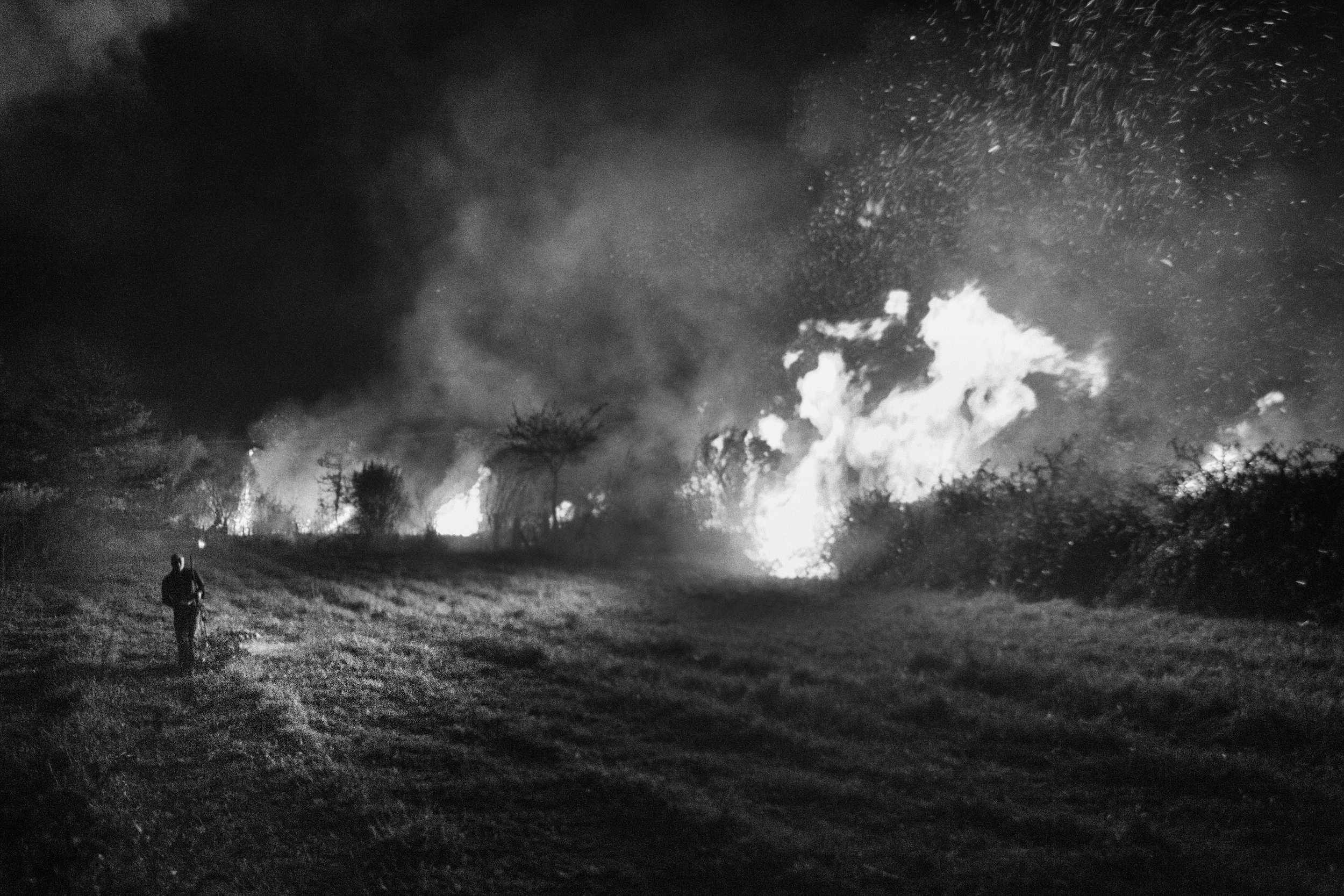
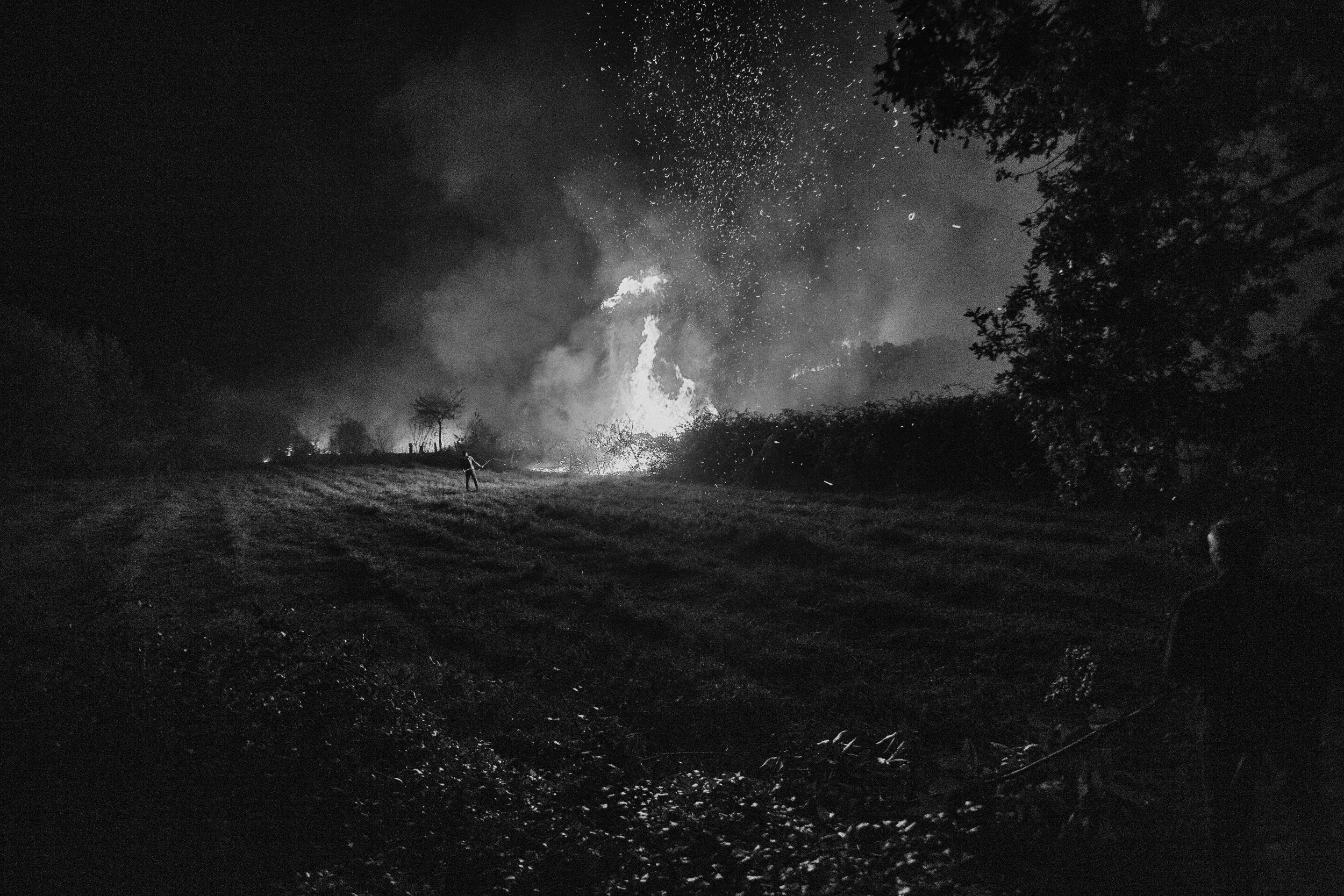
To this must be added the fact that scientists, professionals, the Civil Guard, the police, firefighters, and all those involved in firefighting investigations discovered that every summer, due to climate change, during the brief period when the 30-30-30 conditions are present, wildfires are devastating. By the end of 2025, 97% of these fires were of human origin—much faster and fewer in number but causing immense damage. In 2025, entire villages burned, along with almost no eucalyptus or scrubland, and the evidence found of the fires' origins was laughable: candles used at birthday parties, which never went out no matter how strong the wind; cats or rabbits carrying candles or other materials that started fires wherever they went; and, most outrageously, mountain paths where every 50 or 100 meters there was a small fire burning at night, precisely when the aerial firefighting resources, which withdraw at dusk, were taking advantage of the opportunity to start the blazes. We talked about the night, at night, during the night.
In 2026, a group of media outlets and journalists from that triangle submitted a project proposal to an organization in Brussels to investigate these events and requested funding—a very small amount. They submitted the proposal twice and were rejected both times. It was a very well-structured research project, containing information that had never been published in the media and testimonies from professionals fighting in the mountains, local residents, and law enforcement officers. Ultimately, they were told that, while it was an interesting topic, it was already well-covered.
Eucalyptus monoculture in Galicia has completely devastated the forest landscape, supported by a policy that encourages the planting of this pyrophytic species, which regenerates after a fire and alters the soil characteristics, reducing biodiversity. Among the most affected organisms are fungi, lichens, herbaceous plants, amphibians, birds, and aquatic invertebrates.
The 2006 Galician wildfires (93,000 hectares burned) were a series of 1,970 forest fires (37 of them large) that ravaged Galicia (Spain), primarily Pontevedra and A Coruña, from August 3 to August 15, 2006. The number of hectares burned varies depending on the source: 77,000 (Galician Regional Government), 86,033 (Ministry of the Environment), 86,232 (European Forest Information Centre), 88,000 (European Commission), 92,058 (Spanish National Research Council), 175,000 (People's Party). Four people died and one was seriously injured. Some studies analyzed the true magnitude of the 2006 wildfire crisis compared to what occurred in a "normal year." In several municipalities of the two Atlantic provinces, fires burned, during that 2006 season alone, an area larger than that of the previous five years combined.
Although the administration and many organizations do not confirm it because it is not in their interest, the fires in Galicia in 2006 and other subsequent years were organized and carried out by arsonists (52 were arrested), where the interests created a close, closed circle that cost the Galician economy at least 248 million euros (a figure that is equivalent to 0.62% of the gross domestic product (GDP) of the community).
The recent legislation on forests was concerned with ending speculation so that burned land cannot be reclassified or built upon.
The eucalyptus arrived in Galicia in 1846, thanks to some seeds that Father Rosendo Salvado sent to relatives in Tui, who initially also considered it an ornamental tree.
The summer of 2006 in Galicia left an indelible mark on the lives of its people and the Galician mountains, leaving four dead and destroying more than 91,000 hectares. In 2024, after so many years, investigations concluded that it was a new type of fire, the work of organized networks, a form of arson terrorism. Environmental activists blamed the coalition government of the time for its lack of a serious, outdated forestry policy for Galicia, a policy that protected the planting of pyrophytic species for the pulp industry and the rezoning of burned land.
Behind every fire lies a process, whether human or natural. Politicians and the press have invoked "forest terrorism" and "organized arsonists." The chief prosecutor of Galicia, Ramón García Malvar, stated that "organized gangs of arsonists have turned Galicia into a vast inferno." " And, as has happened recently, incendiary devices and homemade fire retardants were found. None of the 55 arrests made that summer confirmed the theory of an organized criminal network.
In the early stages of the crisis, Interior Minister Alfredo Pérez Rubalcaba and Attorney General Conde Pumpido also endorsed the theory of an “organized criminal network.” According to media reports, firefighters, forestry workers, companies contracted for firefighting efforts, and small construction firms are being investigated. Financial rewards and confidentiality agreements have even been offered.
Journalist Valentín Carrera wrote on his blog about the fire business: Every forest fire is a big business for someone whose face we will never see. A Matacán aircraft costs €5,653/hour, a water bomber €4,000/hour, a Kamov helicopter €6,000/hour, a Puma brigade €268/hour, etc. [Galician Regional Government price list 2012, where a couple of companies, Inaer and Natutecnia, dominate the business].
The cost of fighting fires: helicopters at €6,000 per hour and water bombers at over €4,000. Extinguishing wildfires generates millions in expenses that are only recouped if the perpetrator is found. Firefighters warn of a "fire business" due to the outsourcing of helicopter services.
The 30-30-30 rule for wildfires. To define the specific factors for the 30/30/30 rule to apply, the following conditions are required: Temperature above 30°C. Relative humidity below 30%. Wind speed above 30 km/h.
To claim that someone or some group is profiting from the fires in Galicia would be risky without first explaining our basis. Given the lack of rigorous investigative journalism in Galicia (the media are subservient to those in power and survive thanks to subsidies because advertising revenue has dried up), even in 2024, there are still no guilty parties, with the exception of the arrested arsonists; there are only conjectures, suspicions, and judges who would like to follow the trail. With verifiable reports in hand from the Civil Guard, direct witnesses, independent journalists, firefighters, and a forestry policy tailored to those in power, looking beyond what's already there is impossible; it would mean thousands of euros in lawsuits, lawyers, and cases that are dismissed and end up gathering dust in the basements of incompetent agencies.
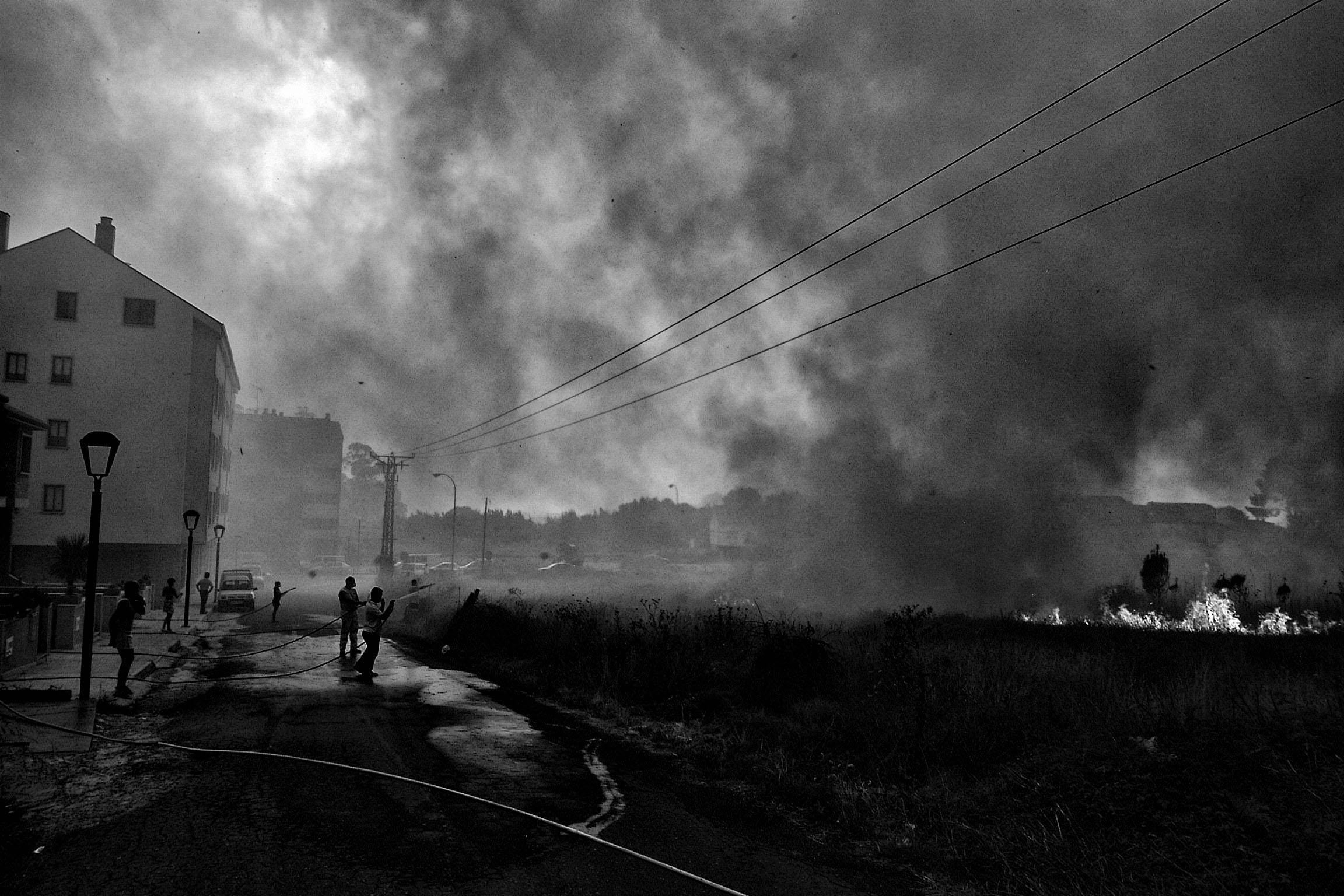
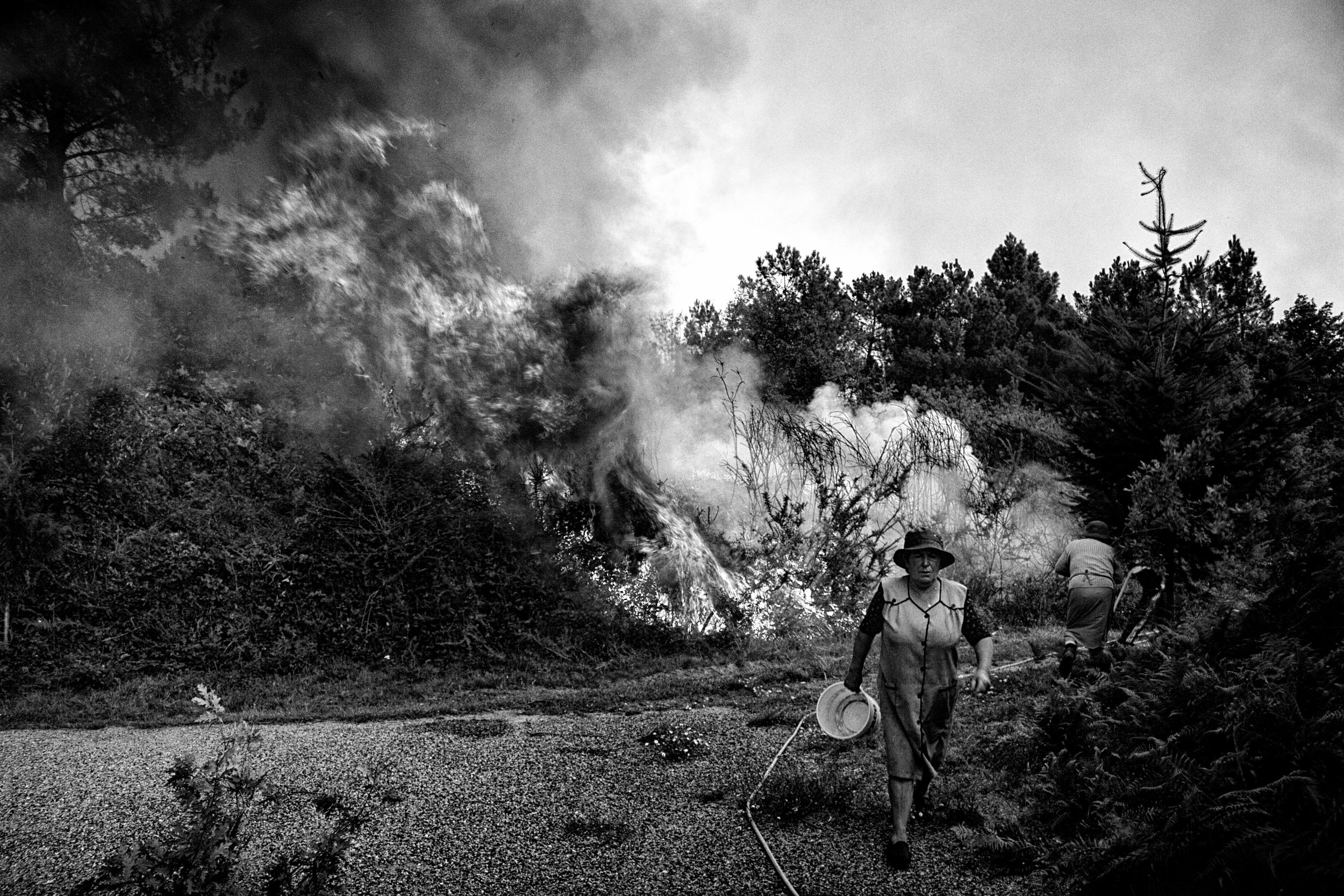
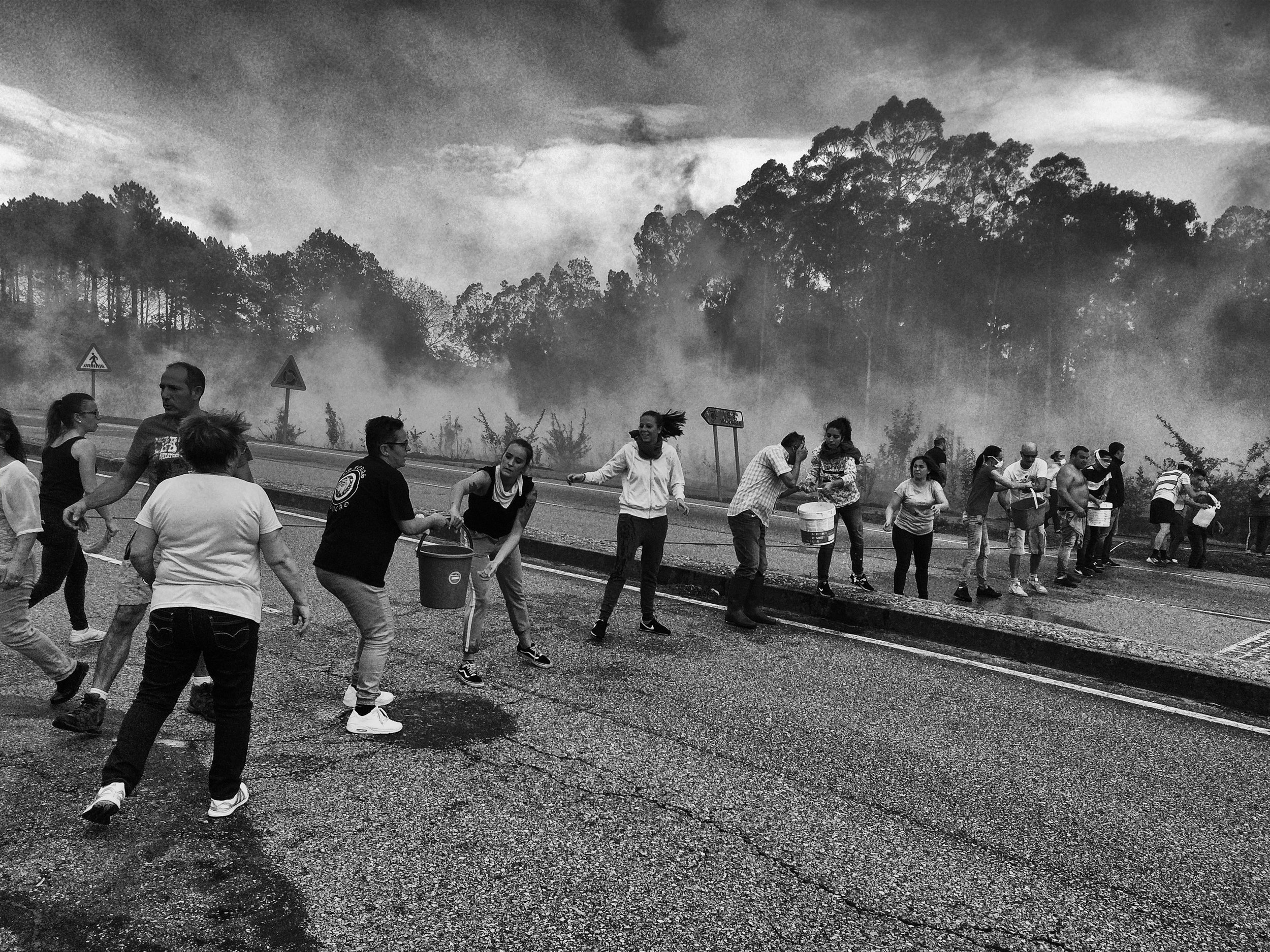
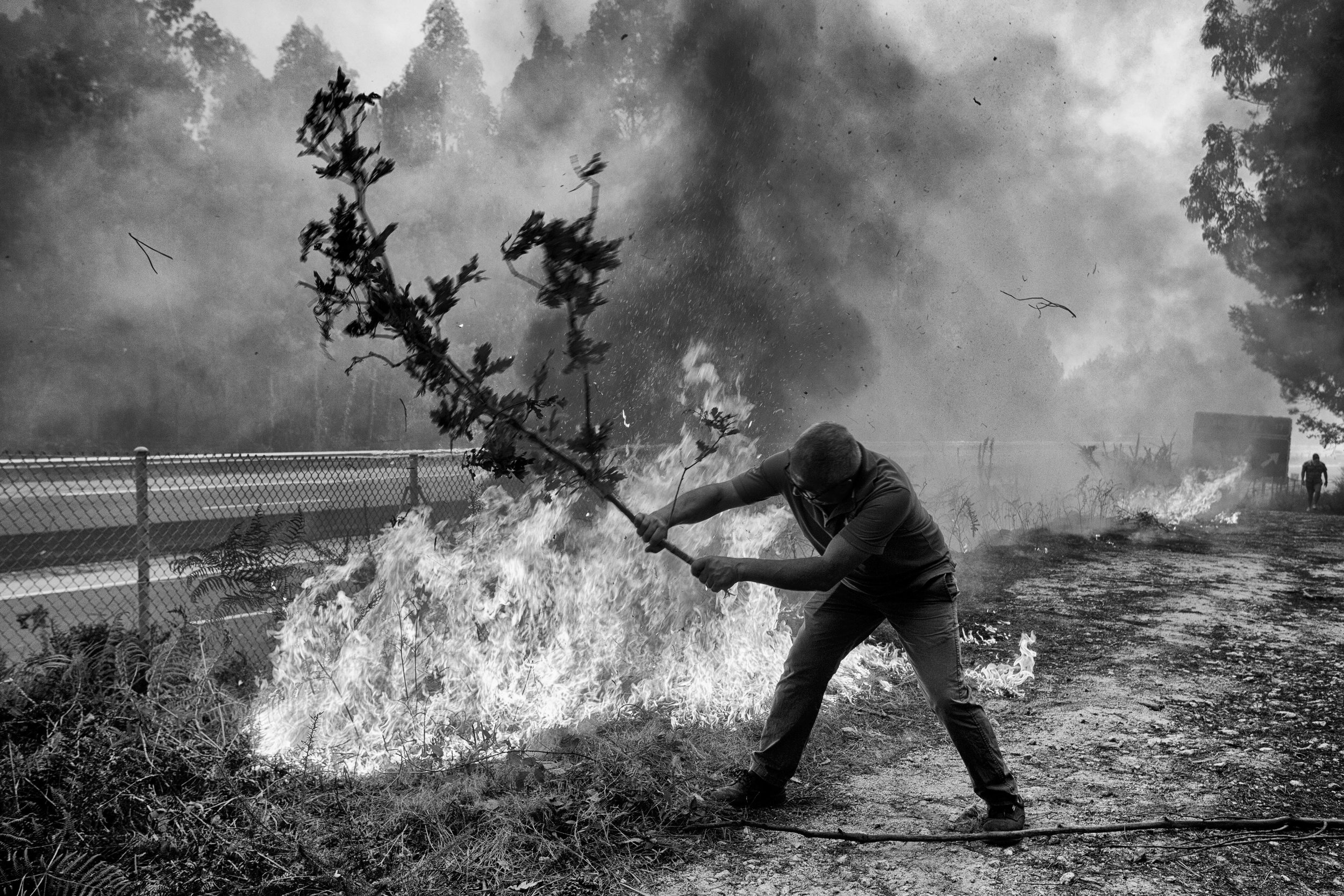
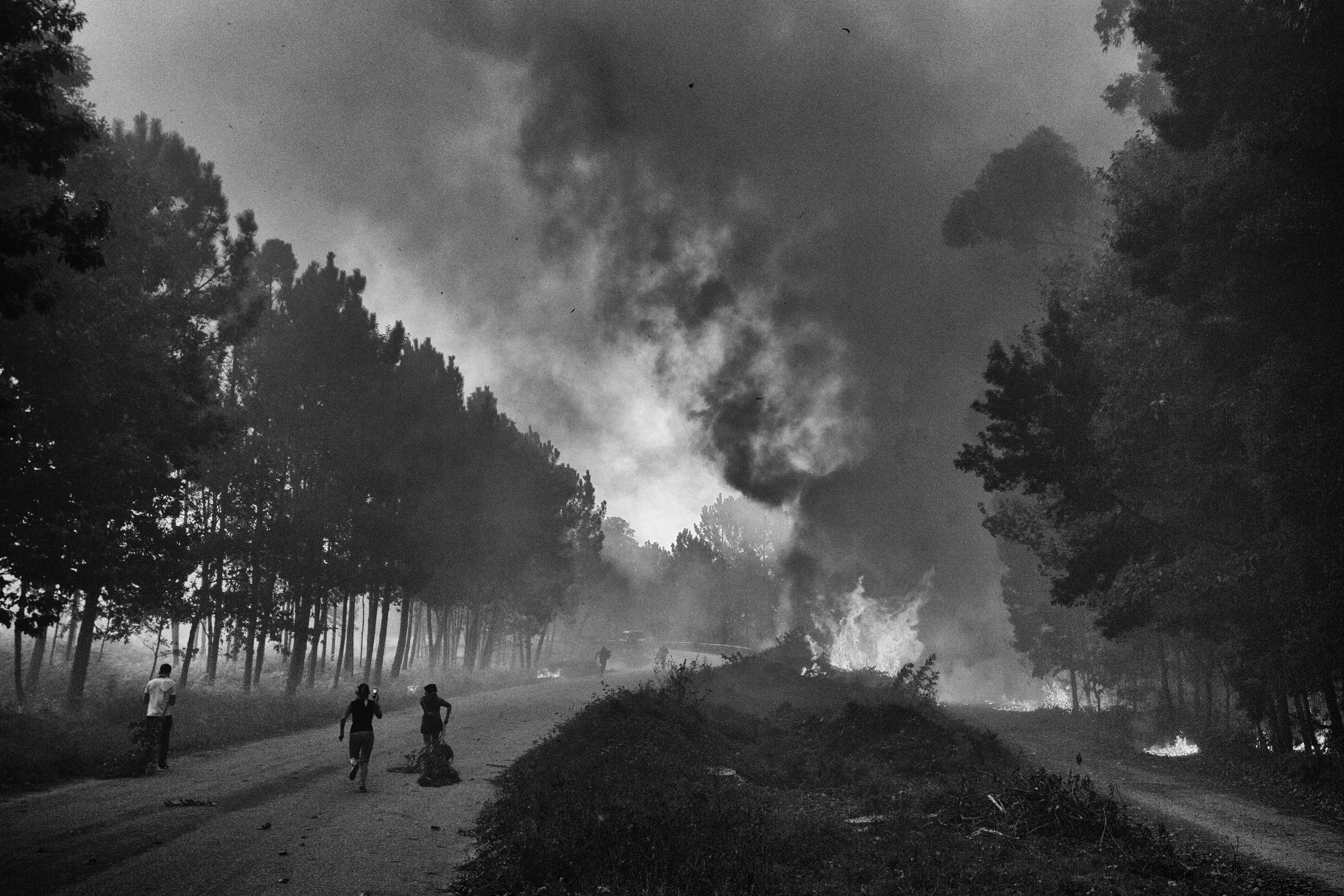
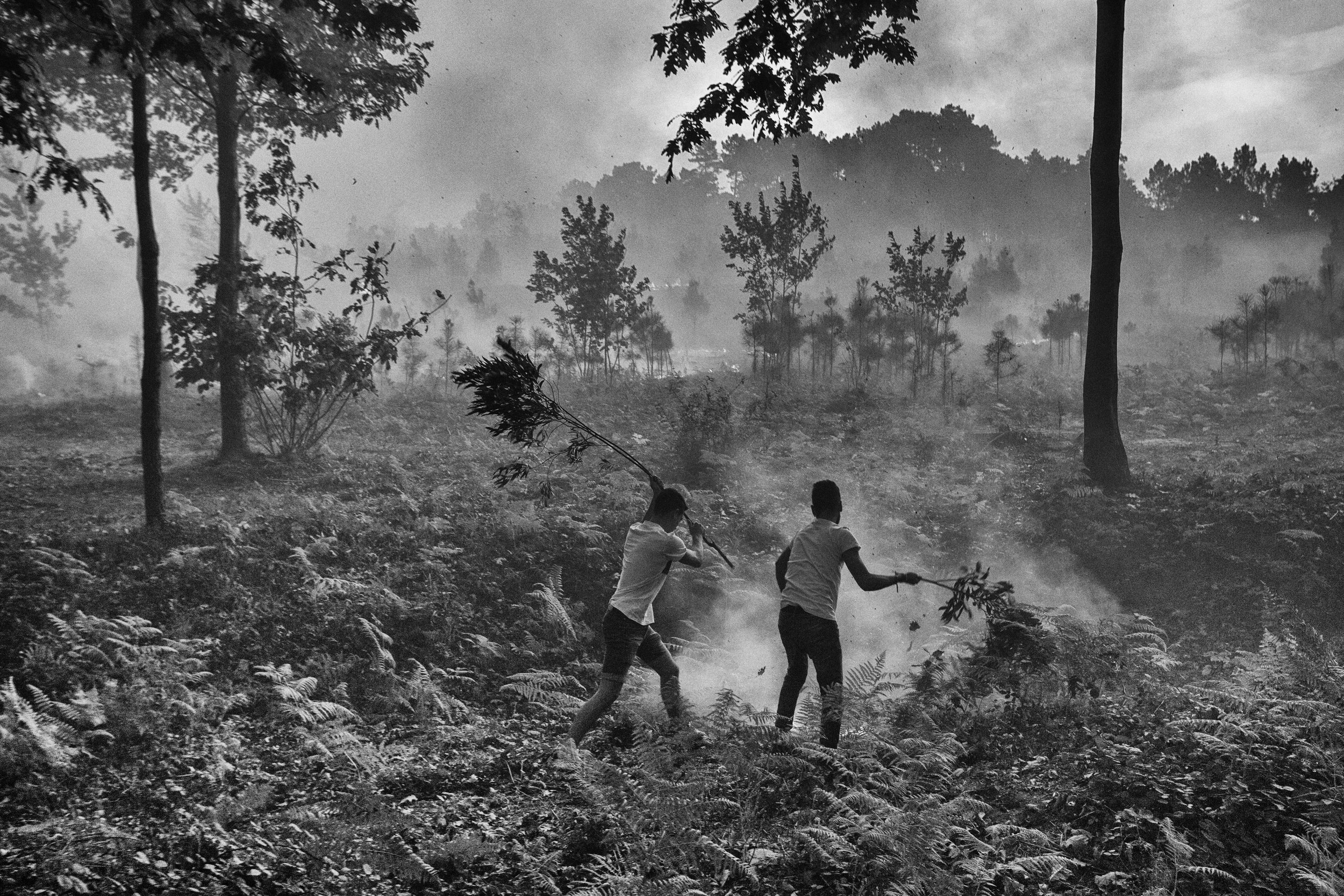
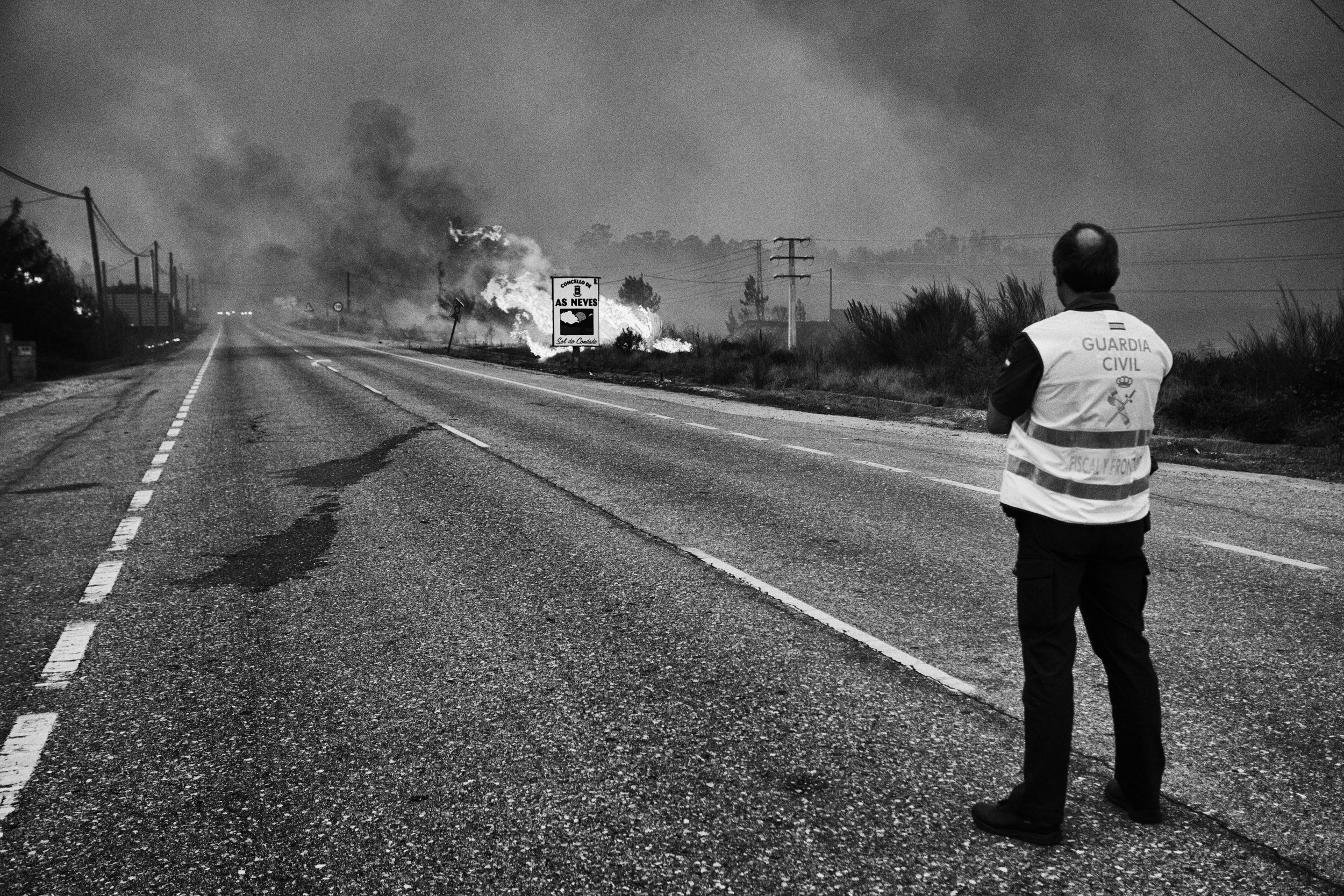
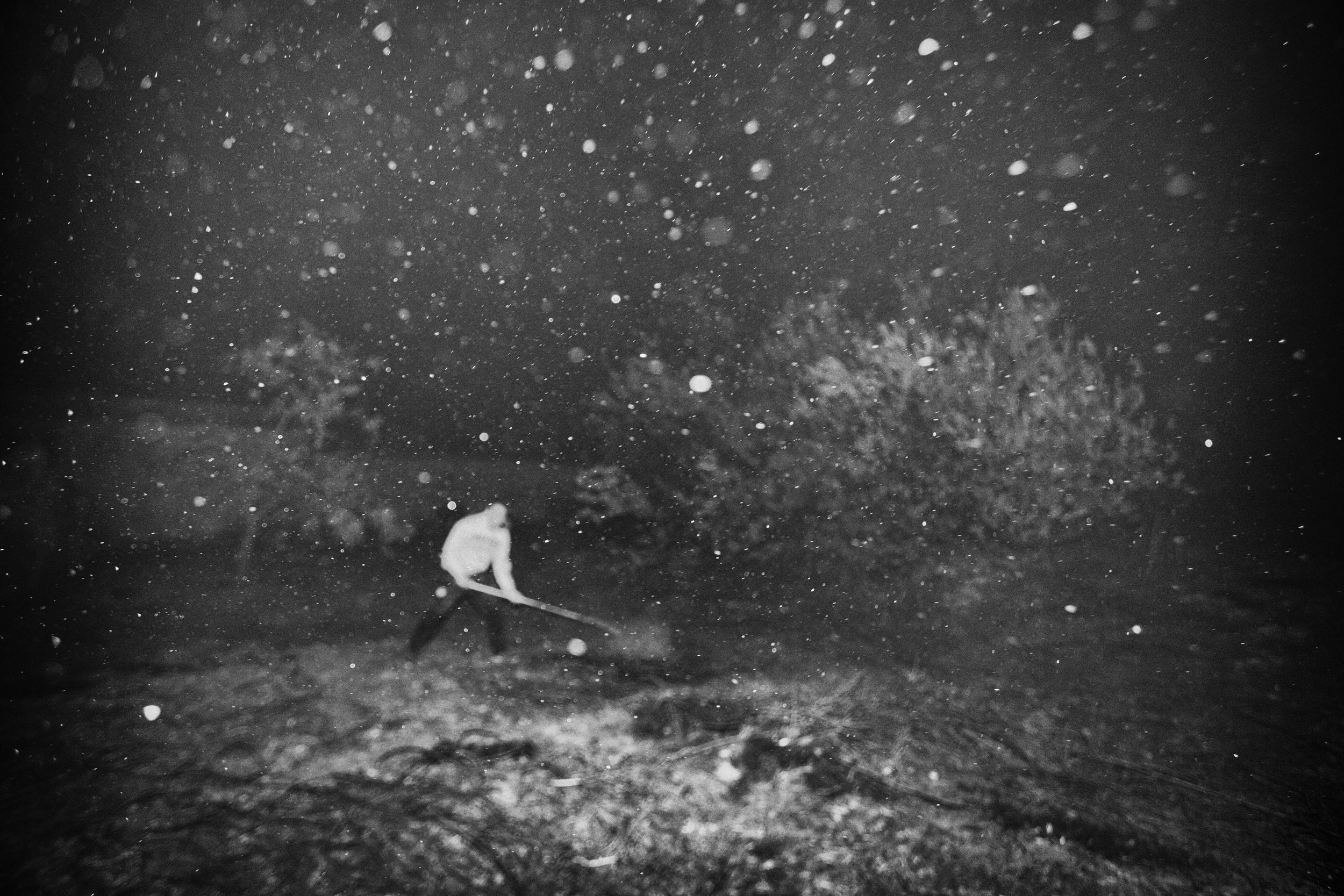
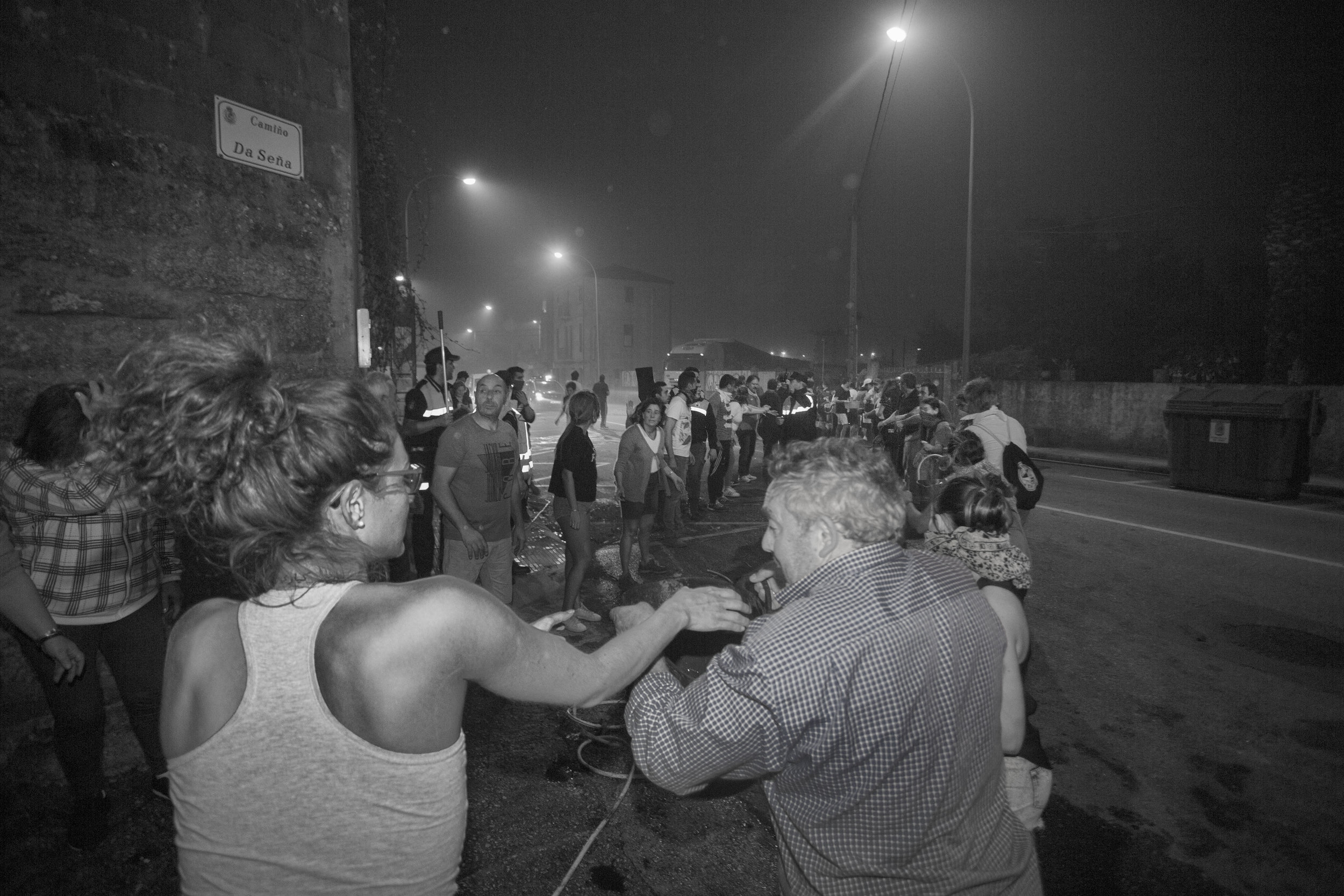
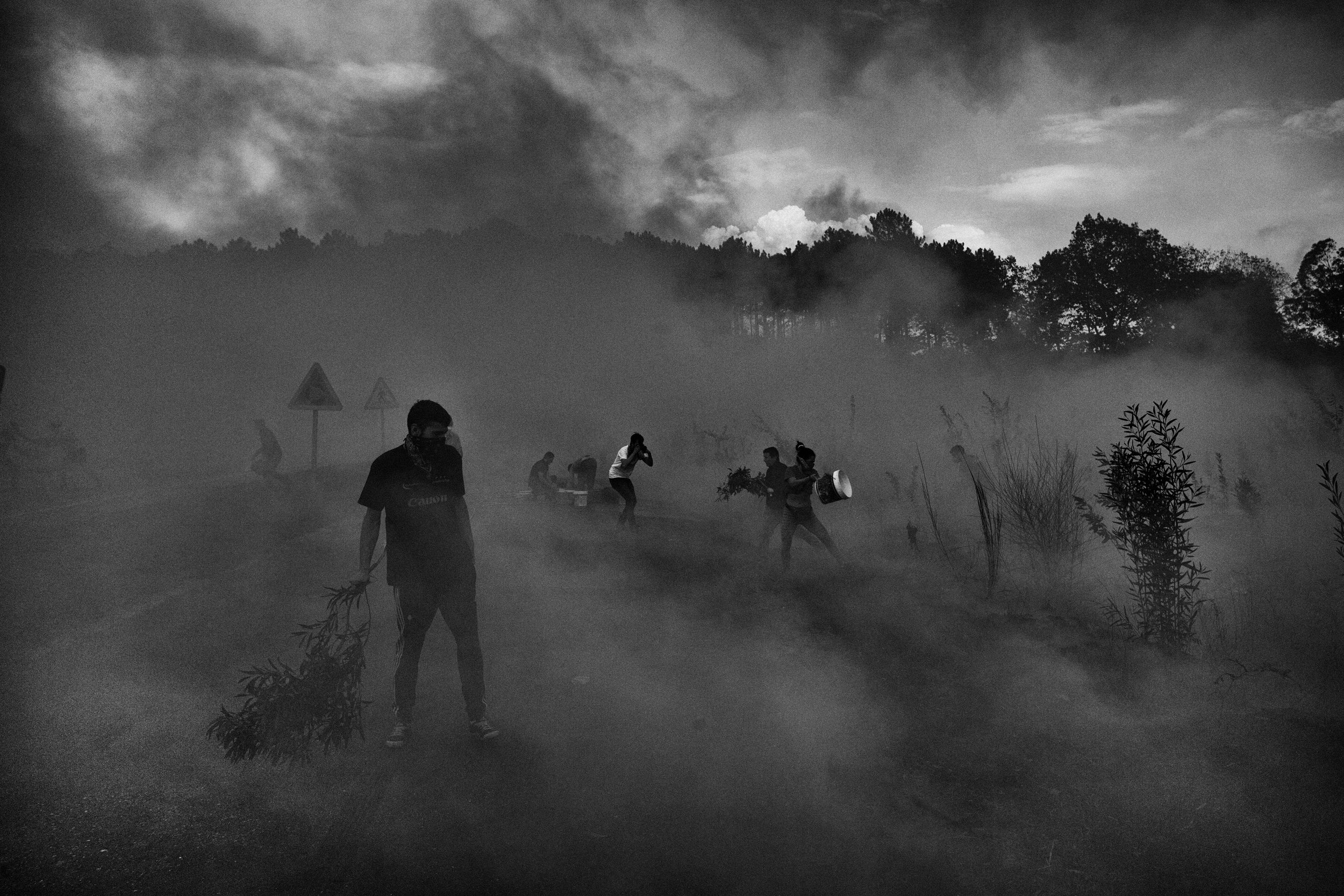
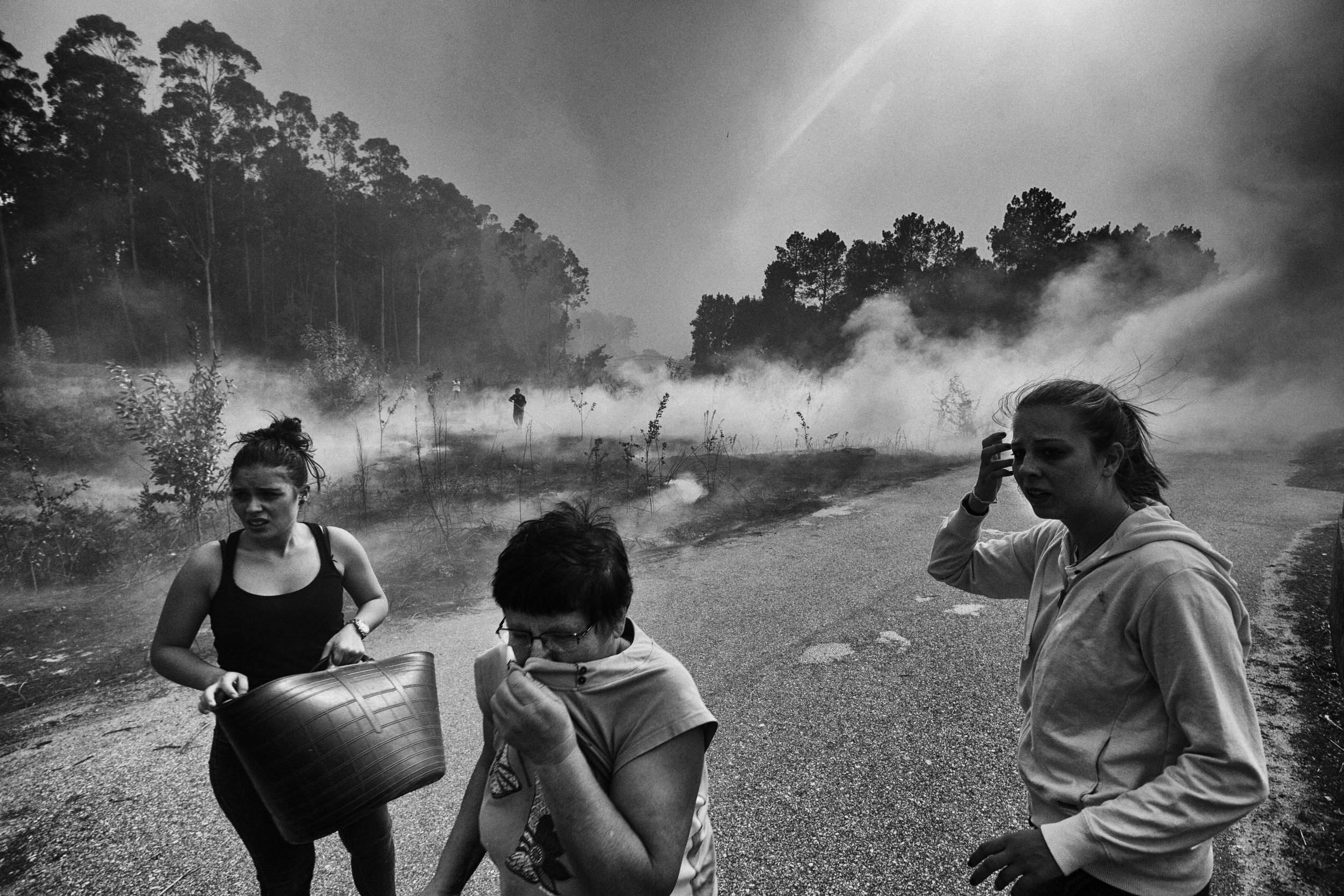
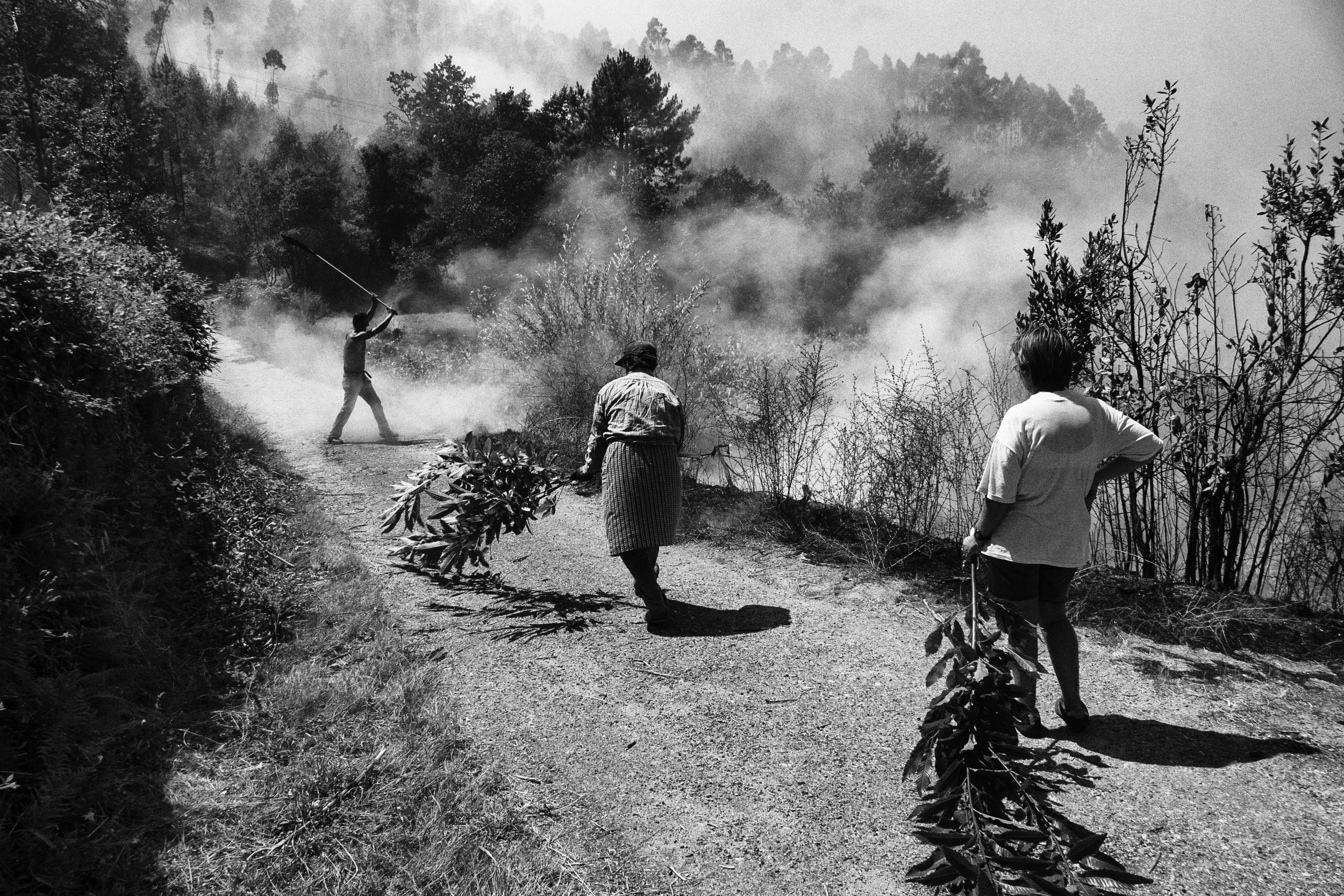
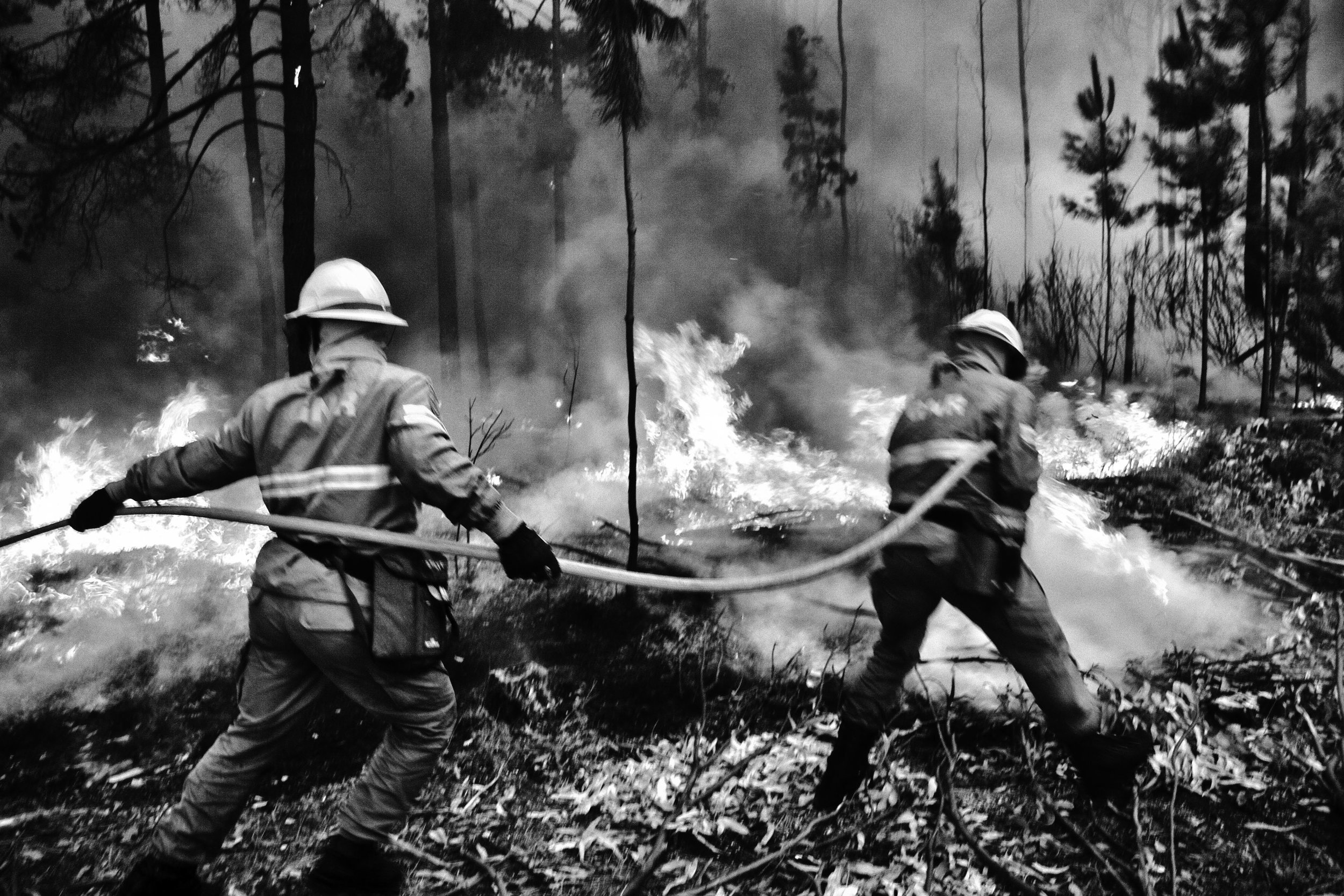
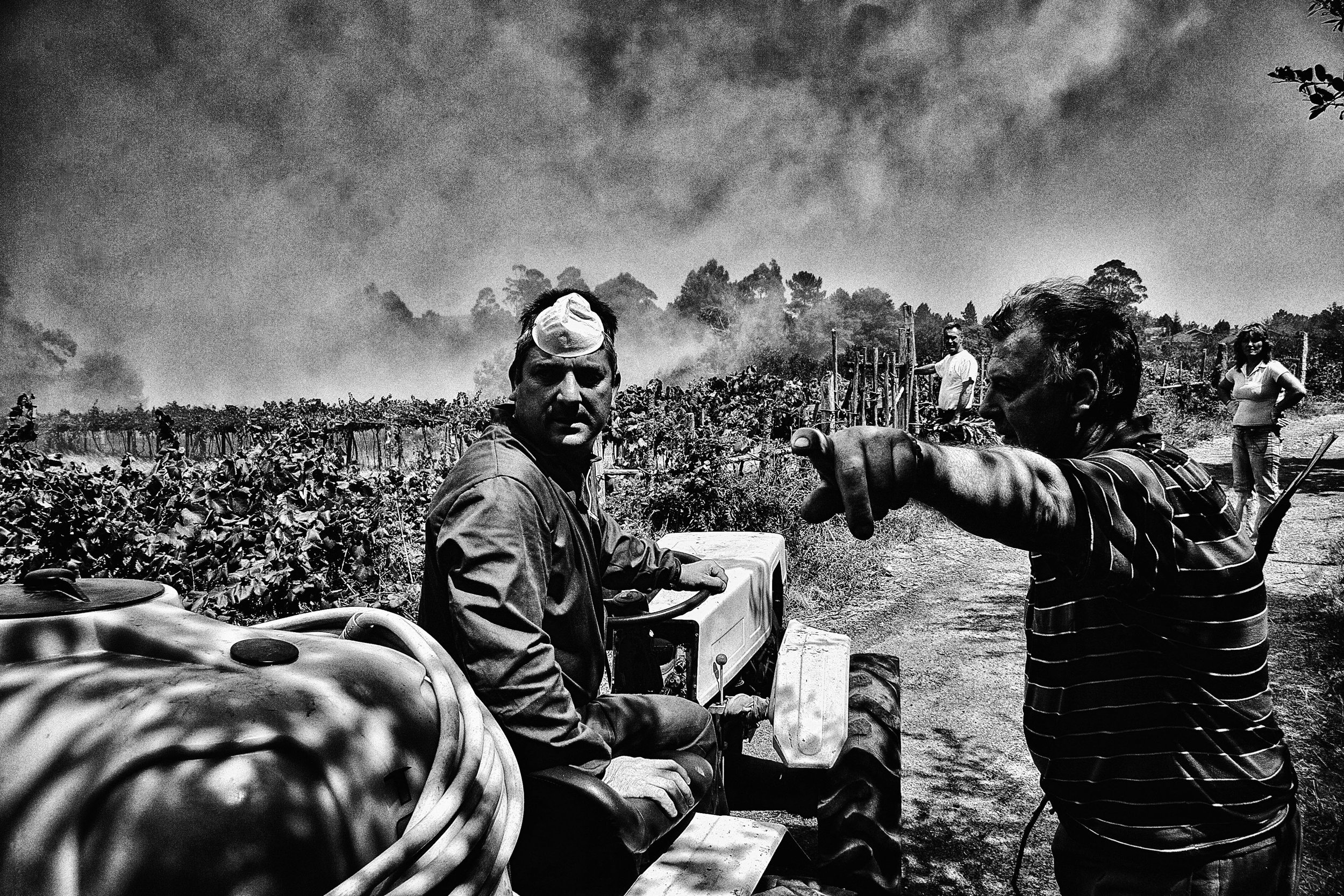
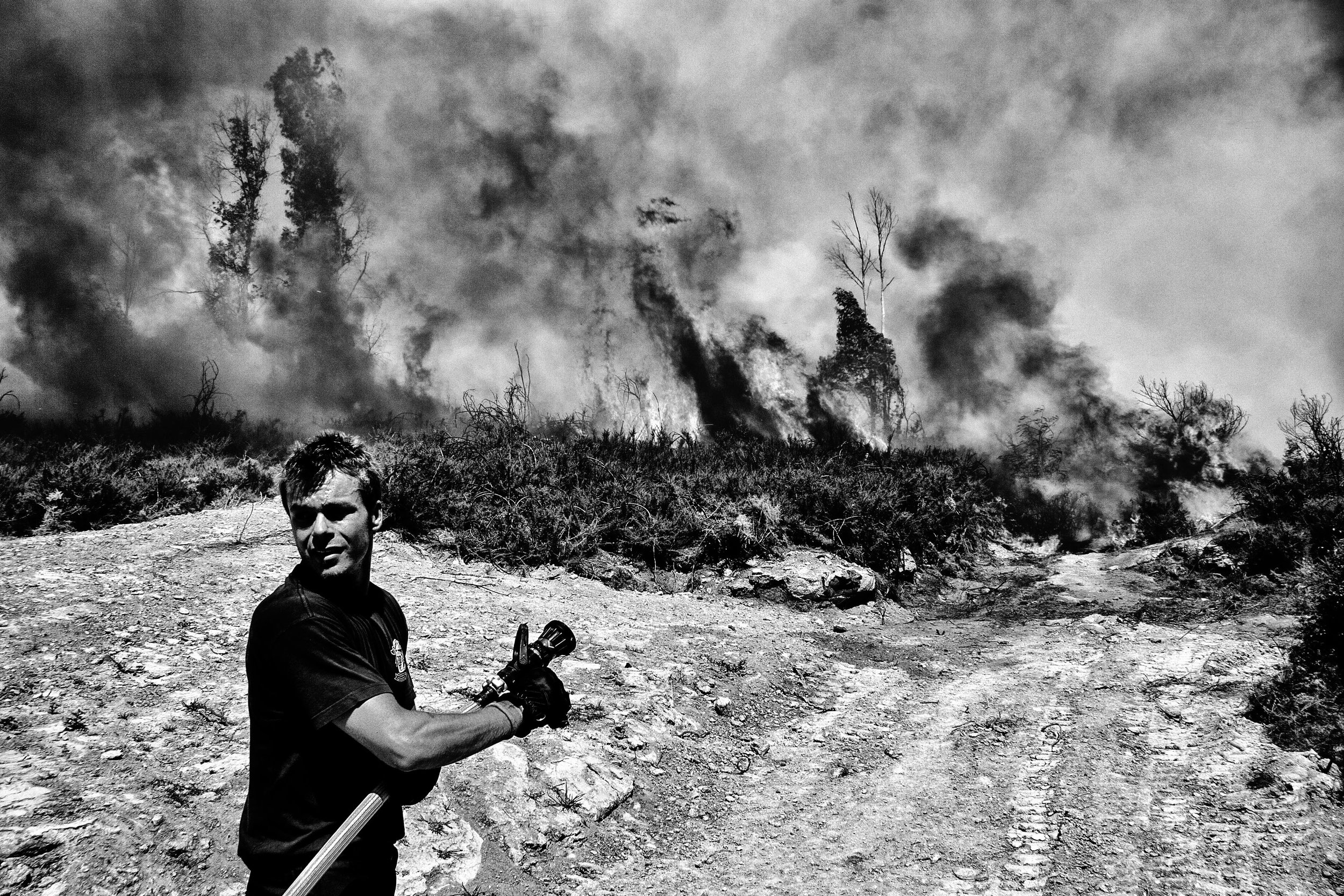
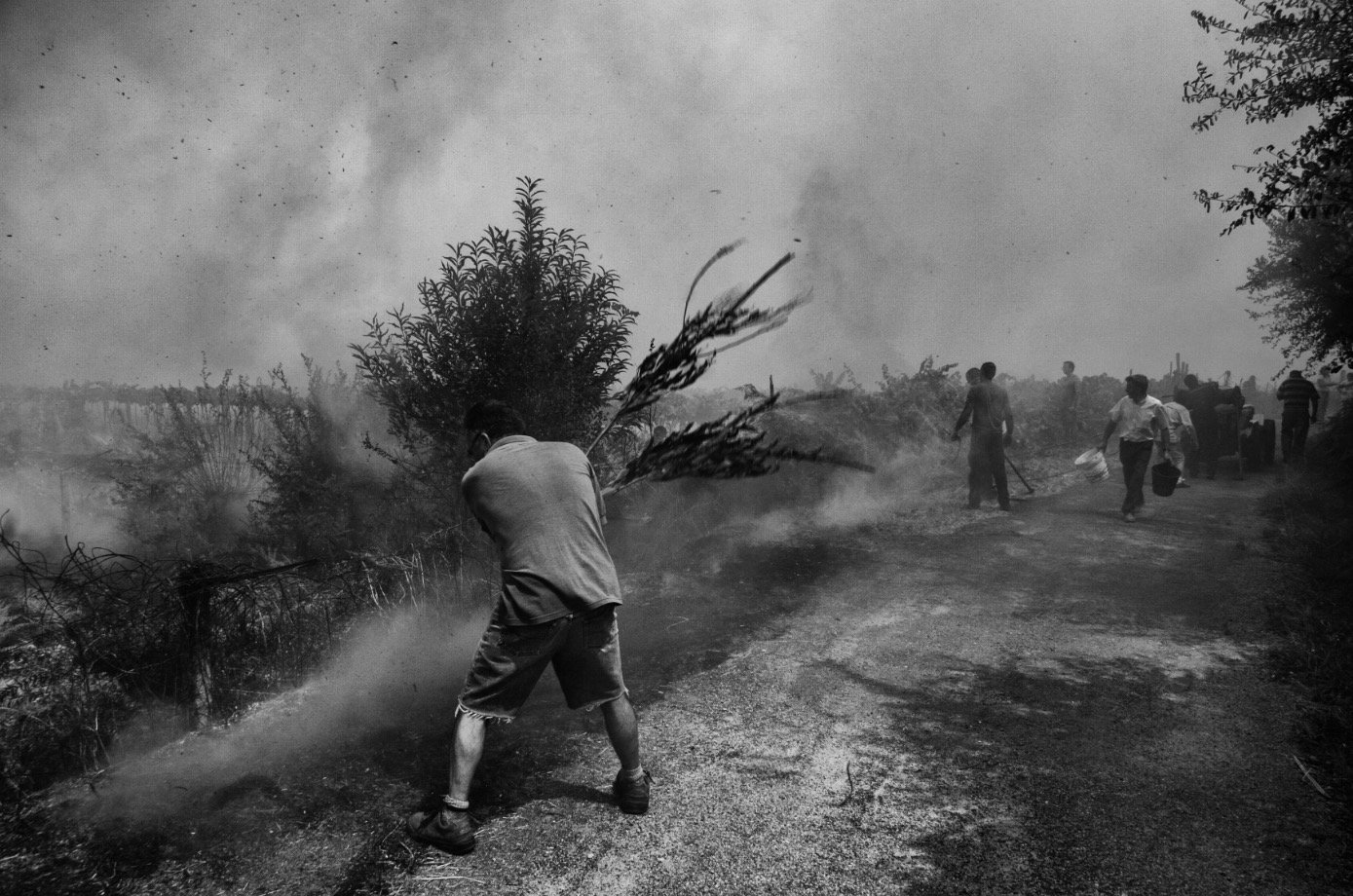
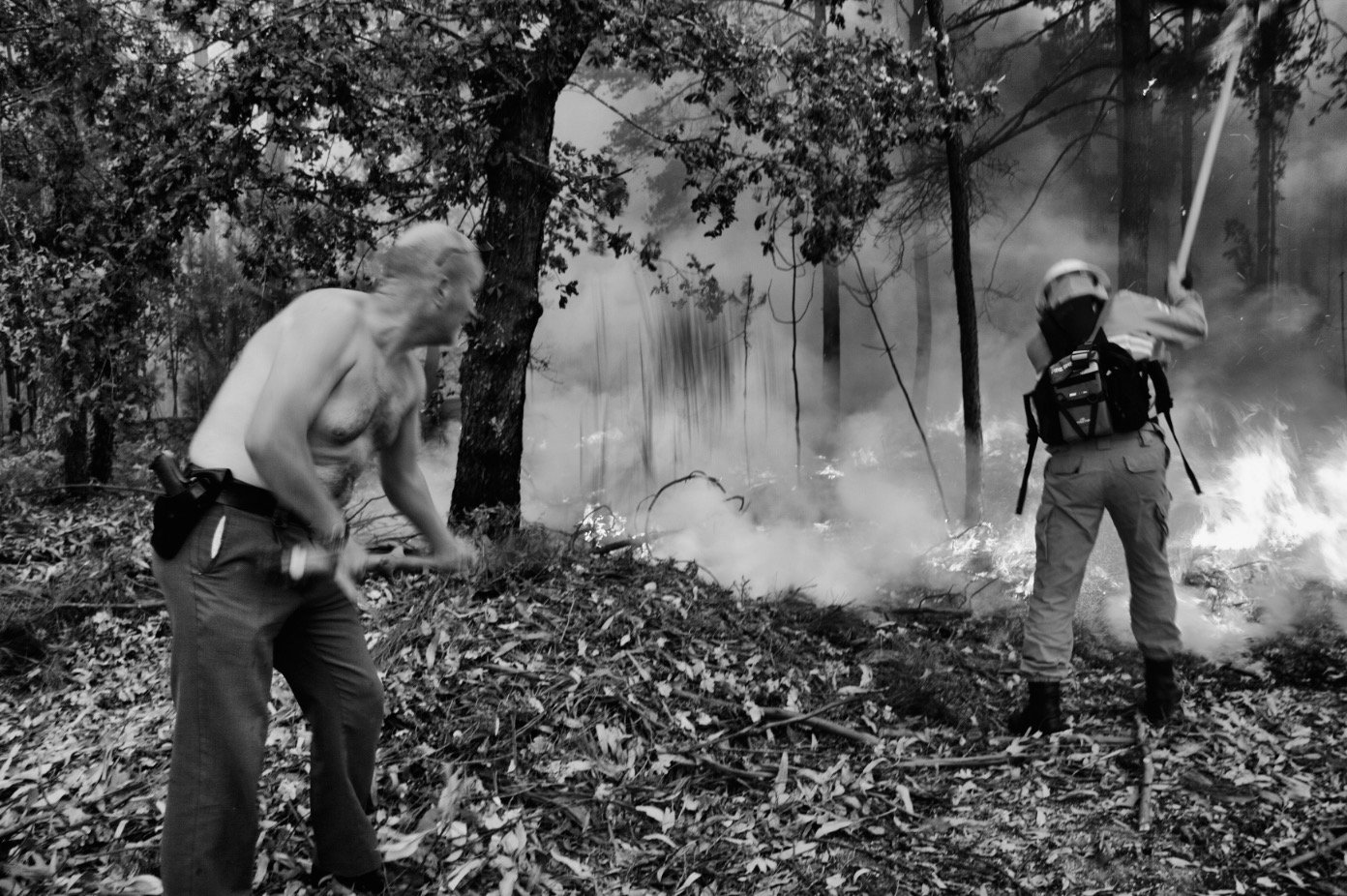
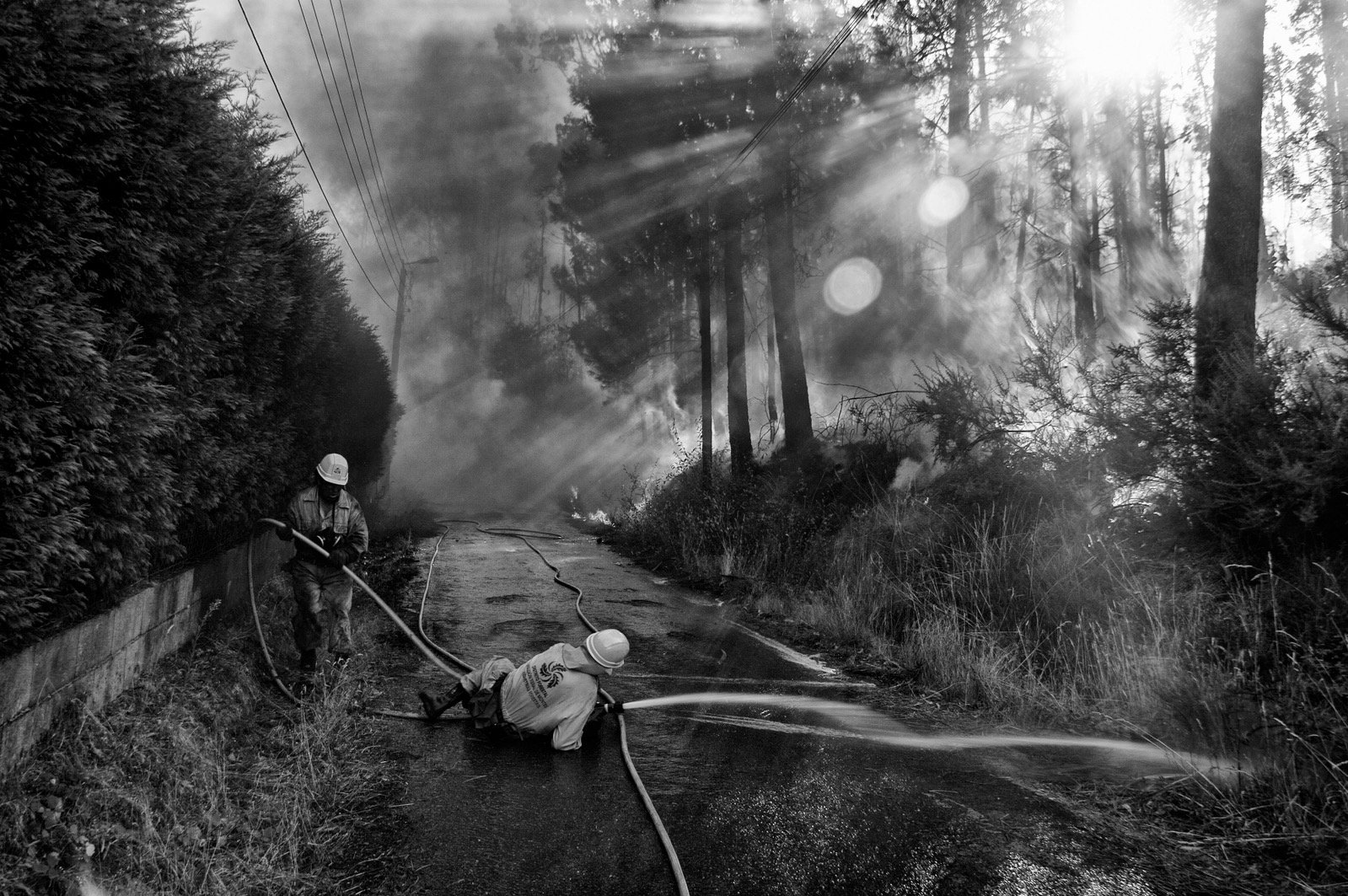
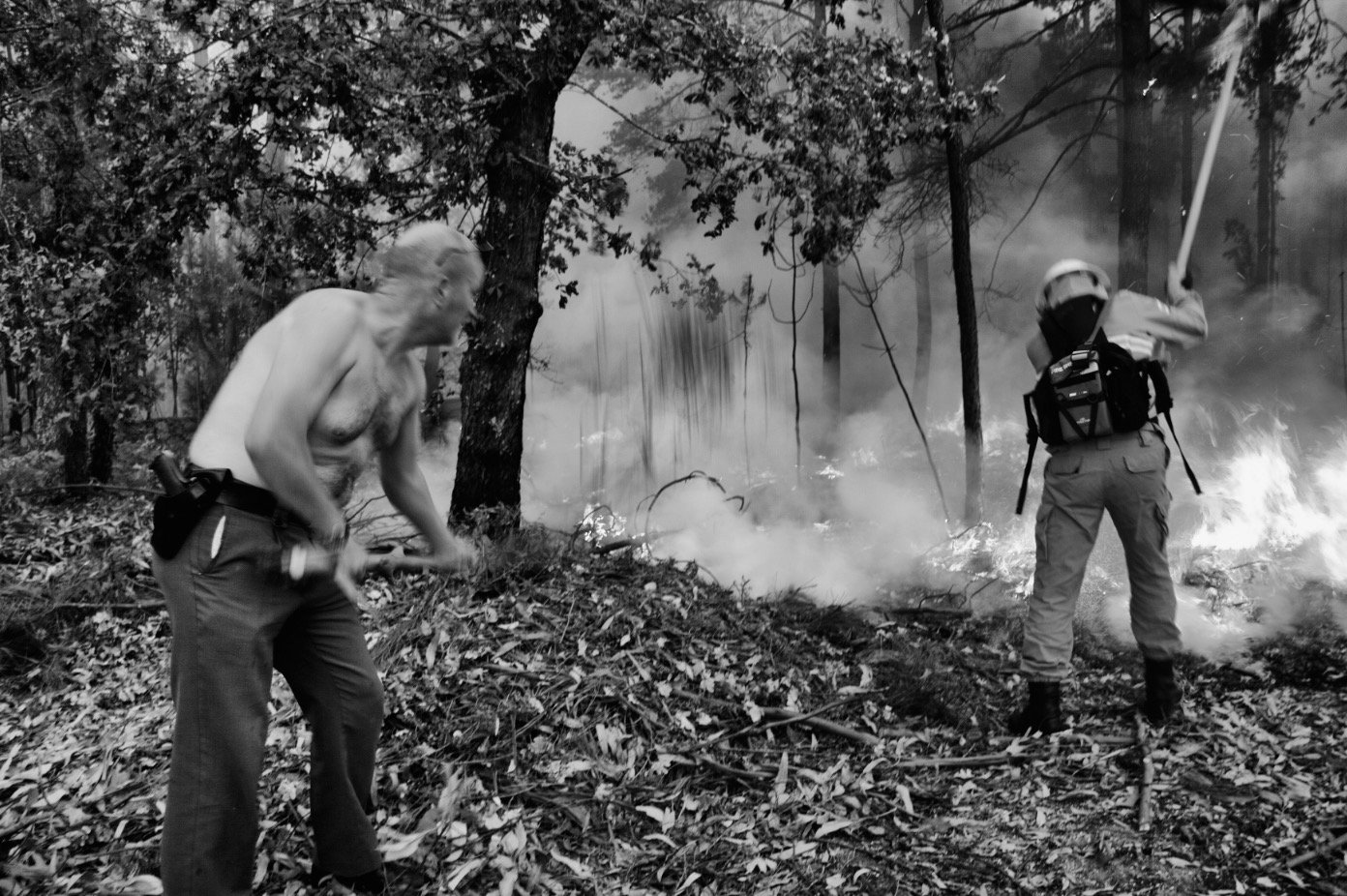
In August 2006, a group of photographers traveled through towns and mountains; we swallowed all the smoke in the world and mountains; we saw what we saw and heard: threats, prohibitions, and honest and humble people trying to put out flames mixed with civil guards naked from the waist up fighting so that a family would not be left without a home.
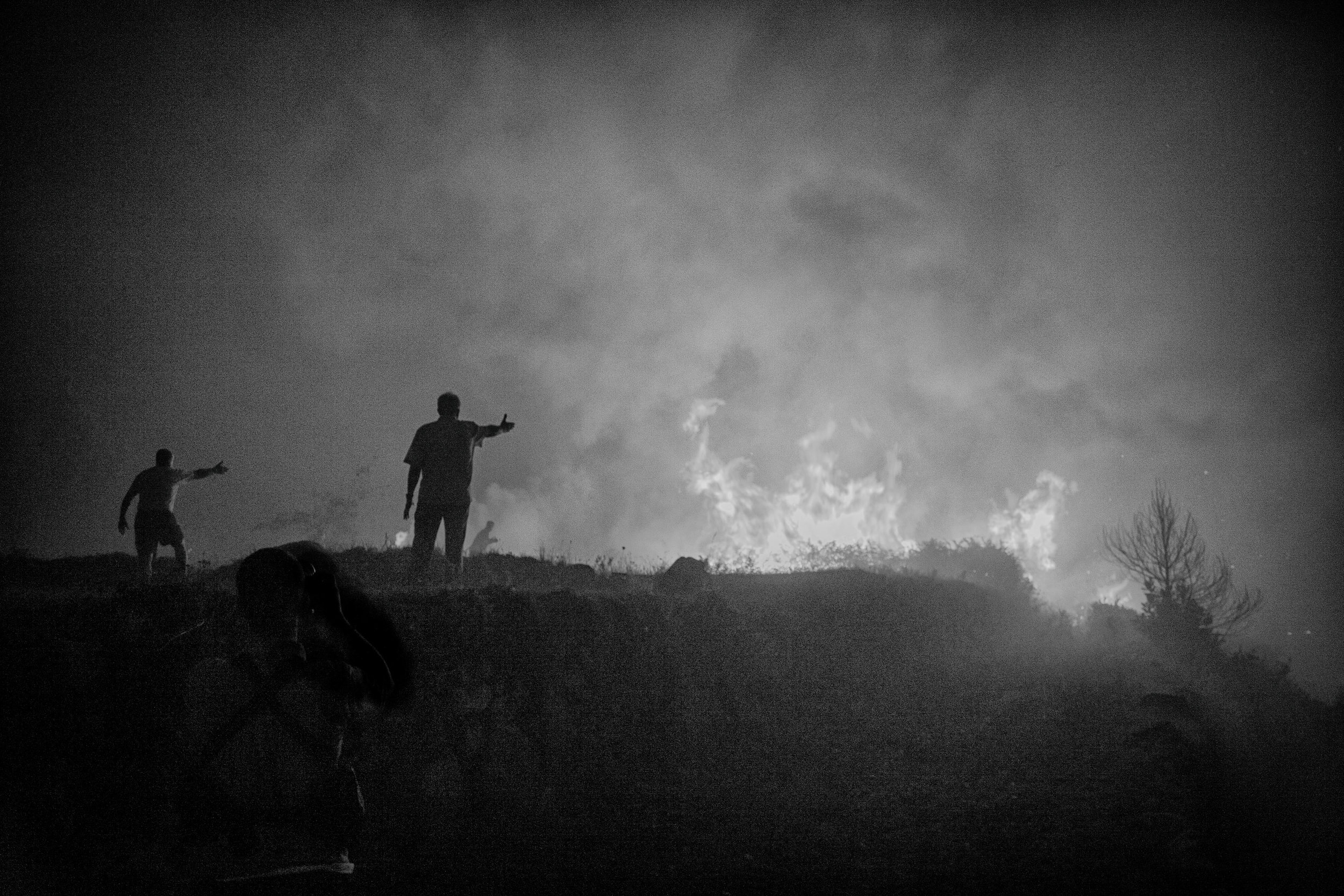
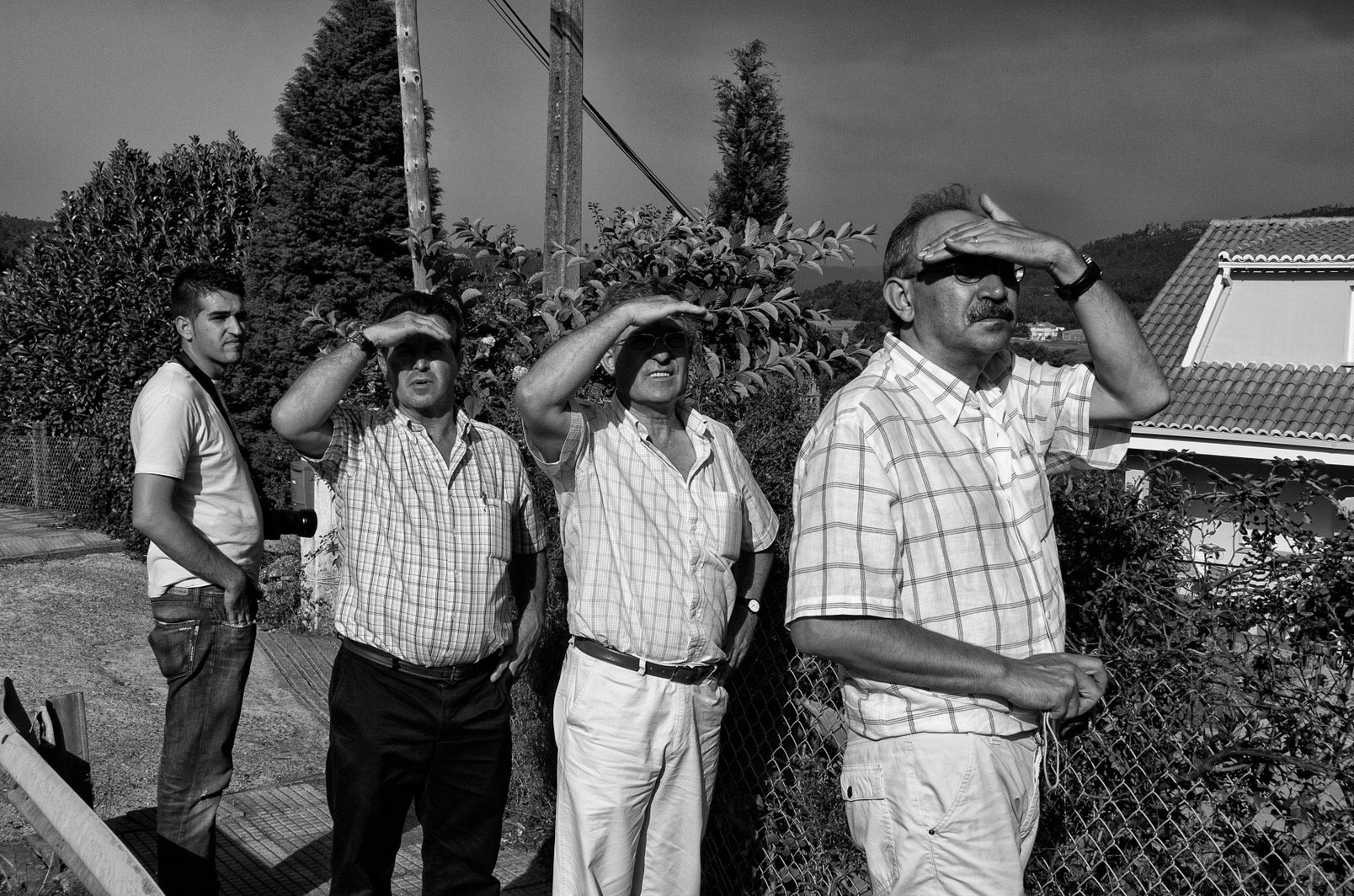
We were in the province of Pontevedra; it was a hot summer night, and our contacts informed us that the mountain was being set on fire from several points. Arsonists know exactly where and when to do it; they wait for the ideal conditions to ignite the flames of disaster.
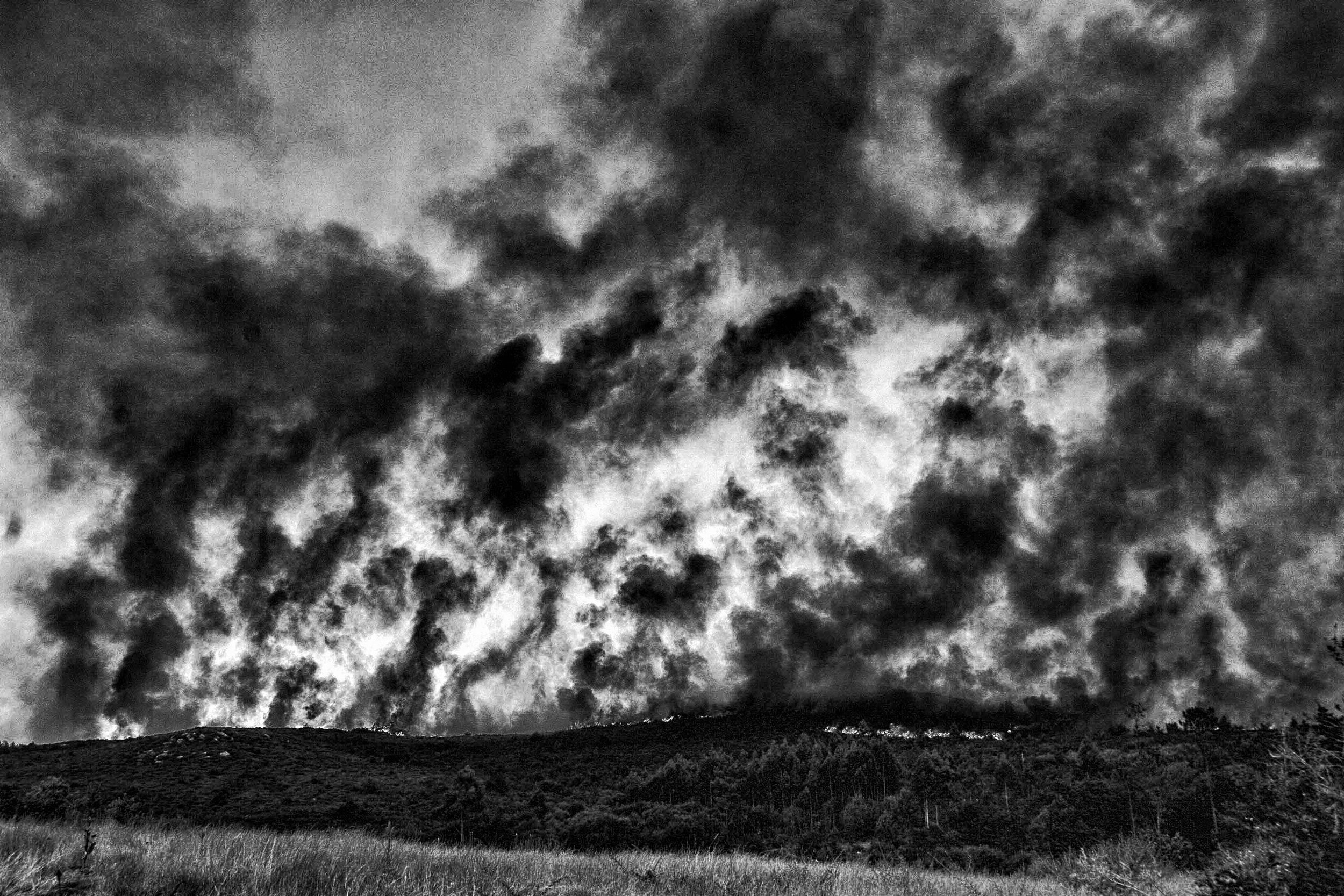
We went to the area—Gustavo drives very well—and saw how the fires on the mountainside merged to form a silhouette kilometers long. The scene was horrific, and we imagined the arsonist running down the mountain, everything planned to avoid detection. We never actually caught any of those madmen, but we did see some suspected arsonists joining the firefighting crews simply to watch the mountain burn. The Civil Guard and the firefighters suspected something was up, because these were the kinds of people who showed up at many fires and did nothing; they just watched, laughed, and disappeared.
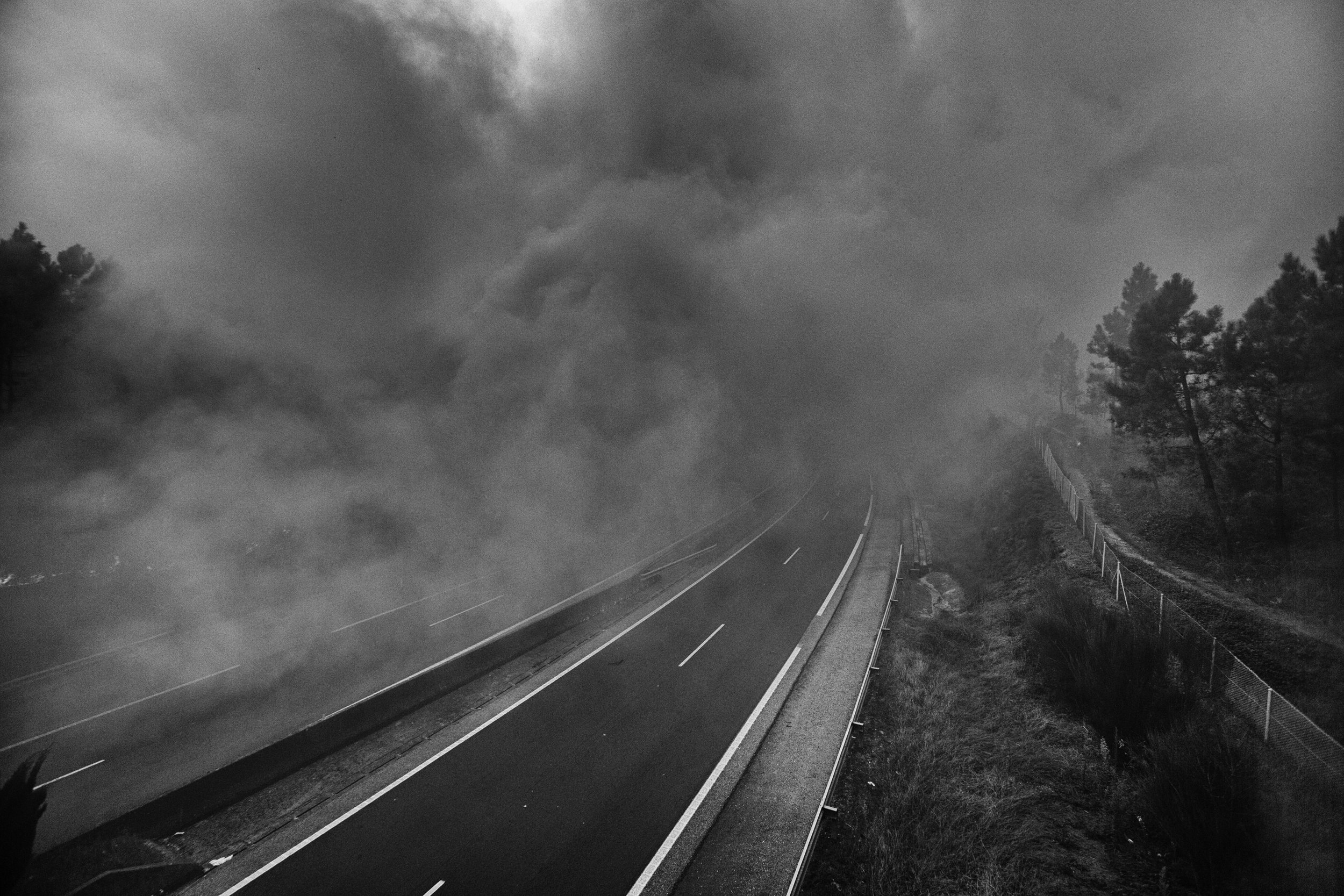
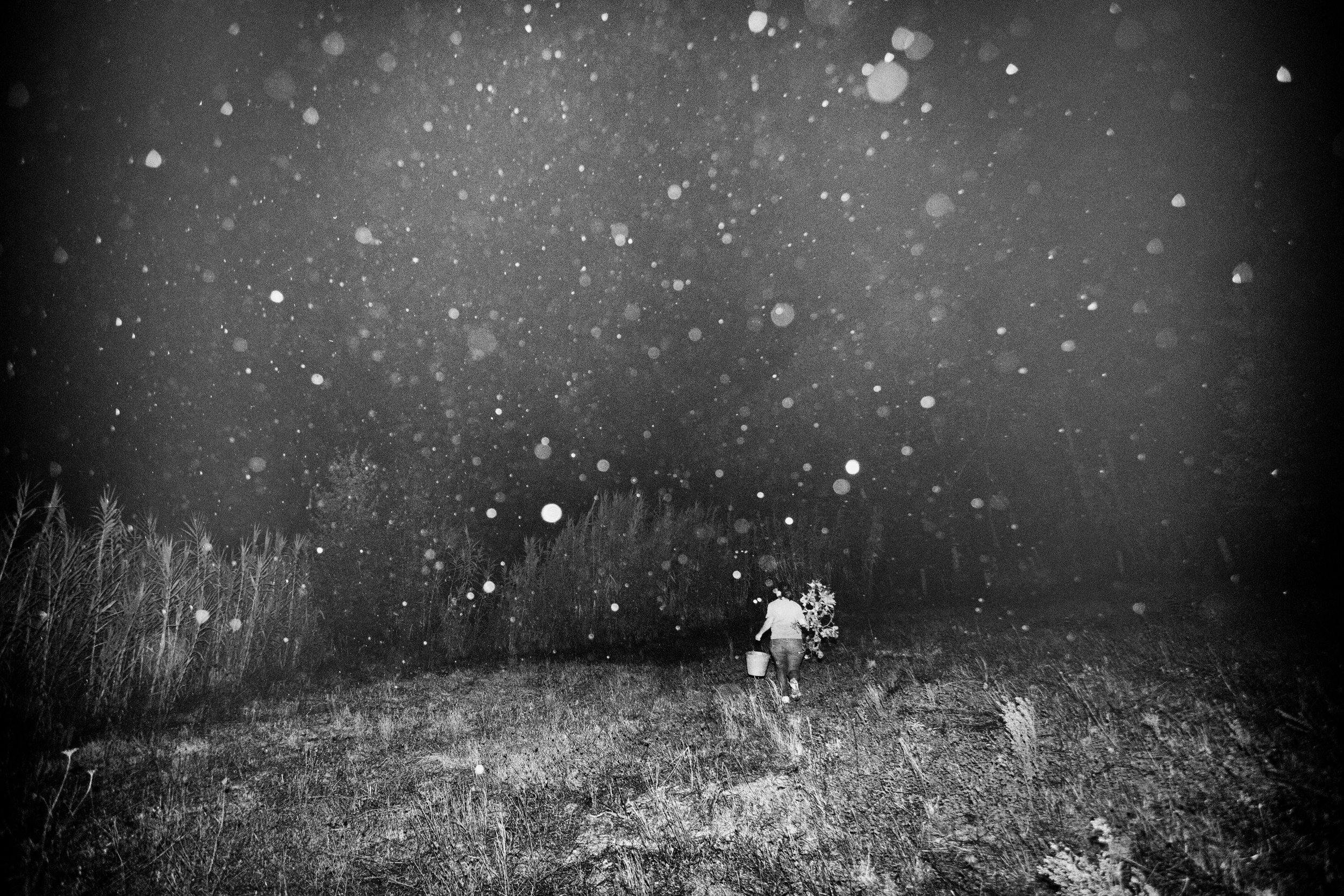
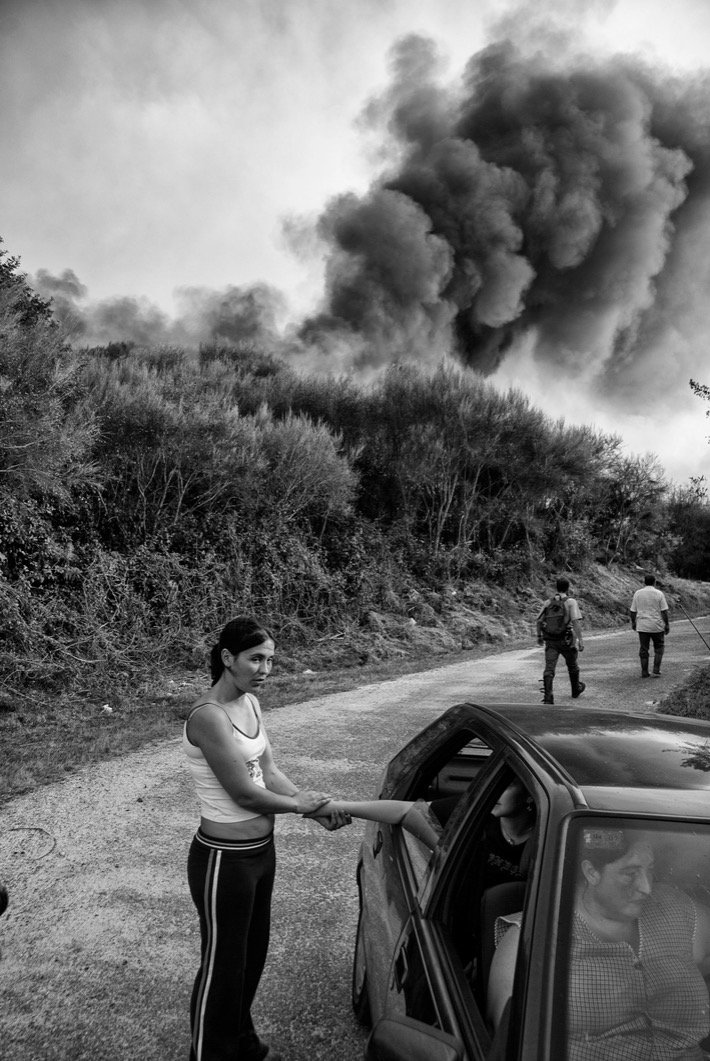
One night, like so many others, fire surrounded us and other cars on a mountain road, and the only way out of that inferno was to drive fast to avoid shattering the windows and tires. Fire doesn't give warning; the wind rules, and you need to know about meteorology, with your earpiece in one ear and your phone fully charged. Colleagues triangulate areas, receiving firsthand information.
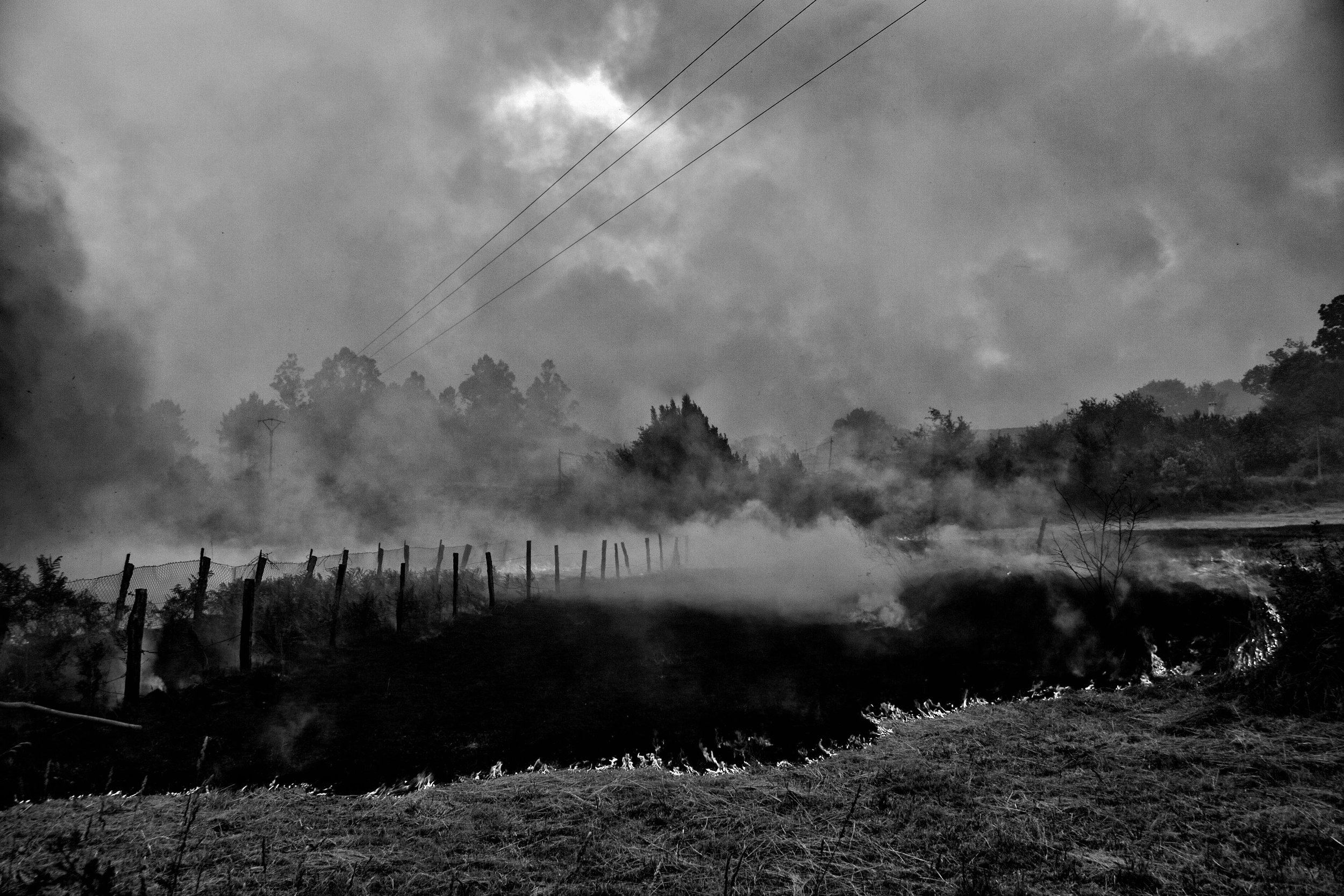
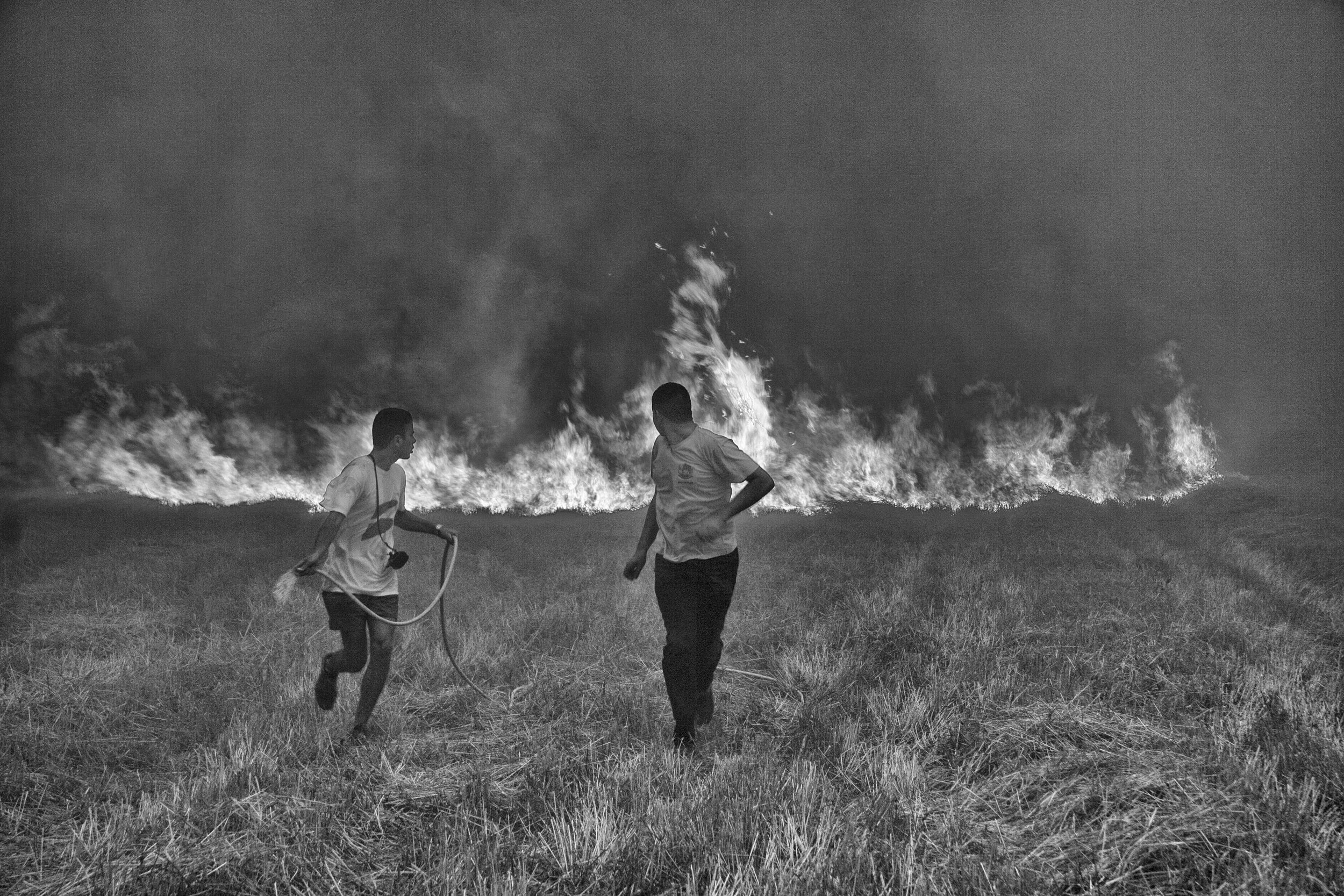
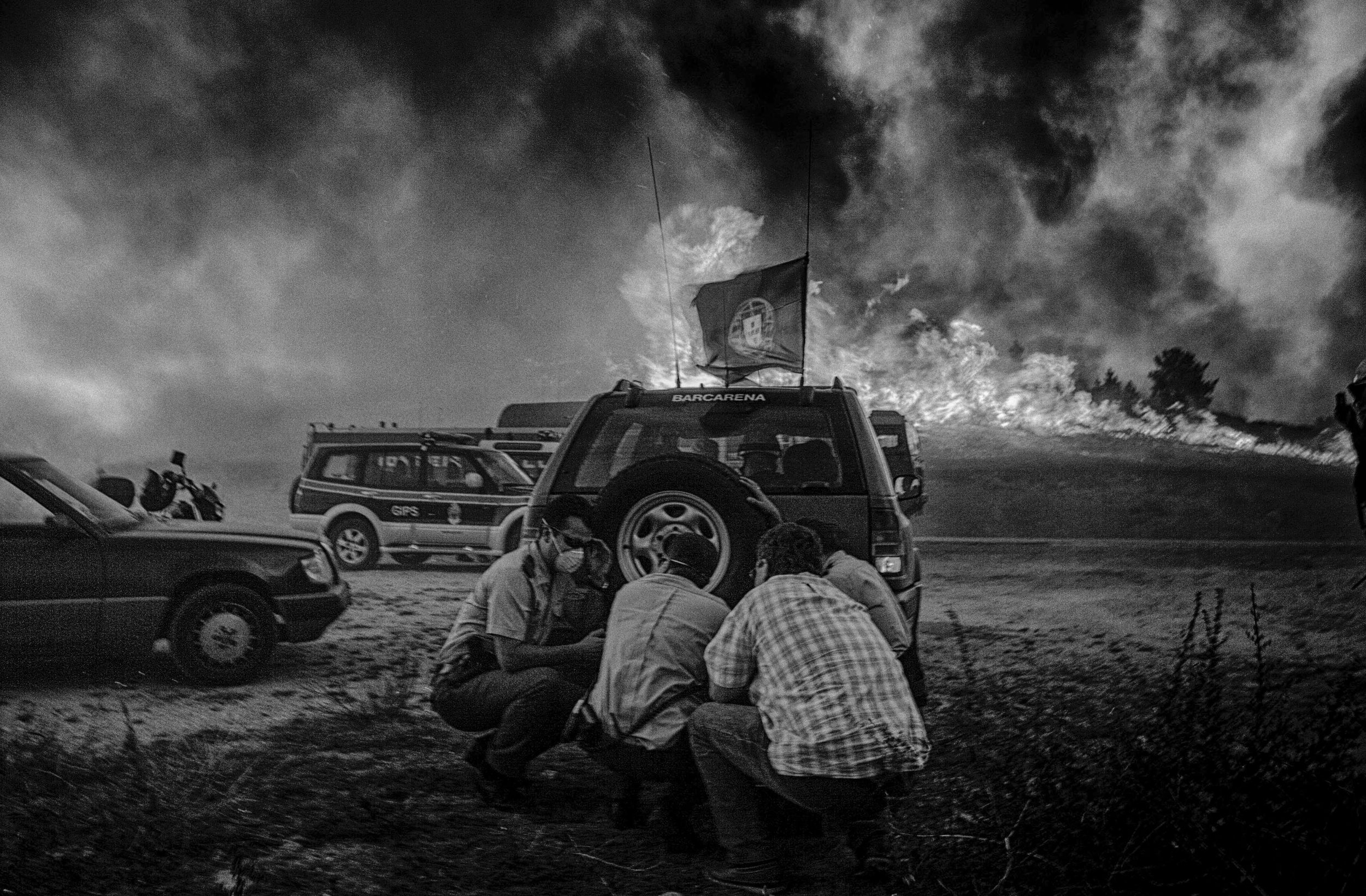
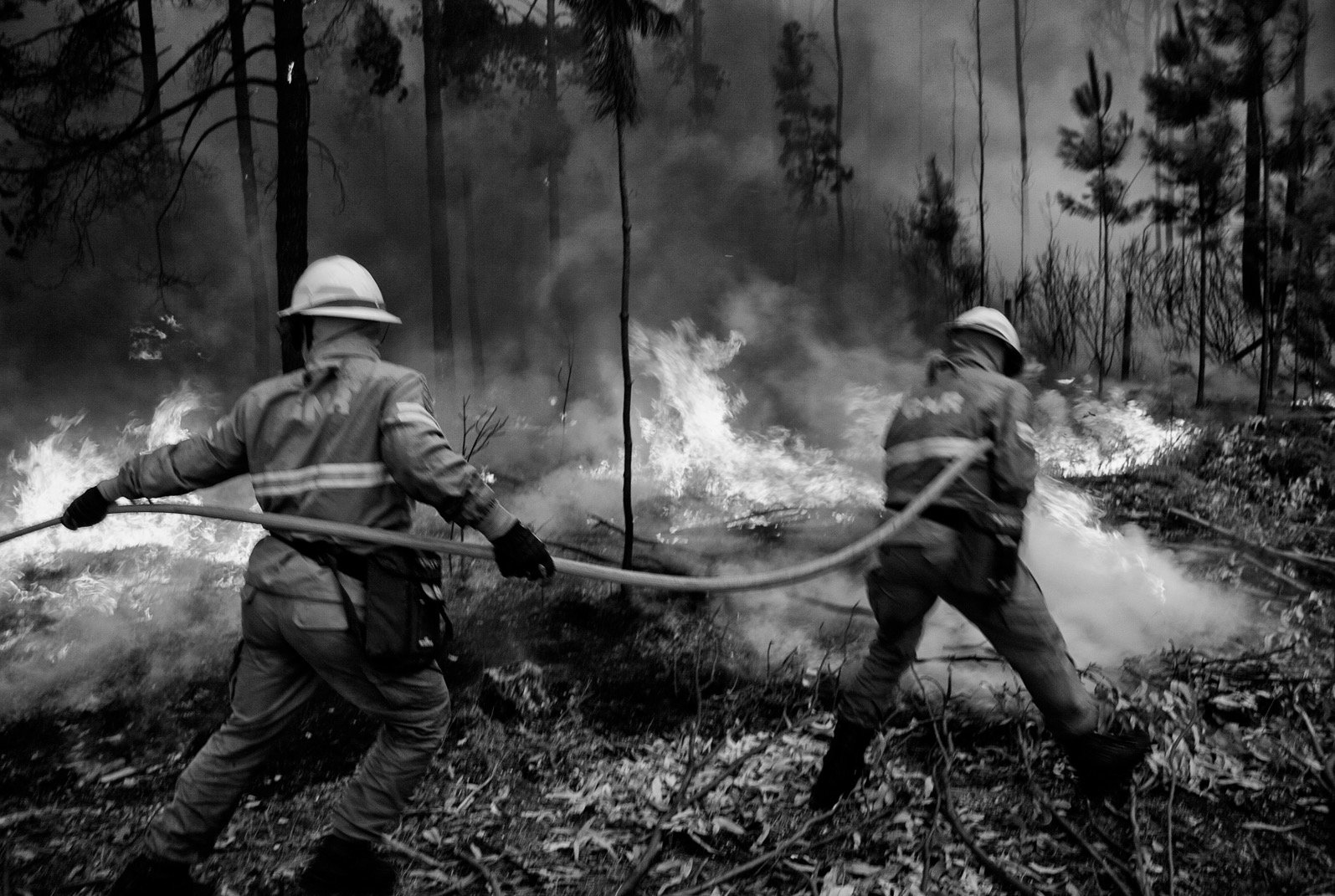
On another occasion, we encountered Portuguese firefighters, the Civil Guard, and civilians at a location where the fire appeared to be far away. They decided to carry out a controlled burn, a common practice used to stop a fire, but one that requires thorough training.
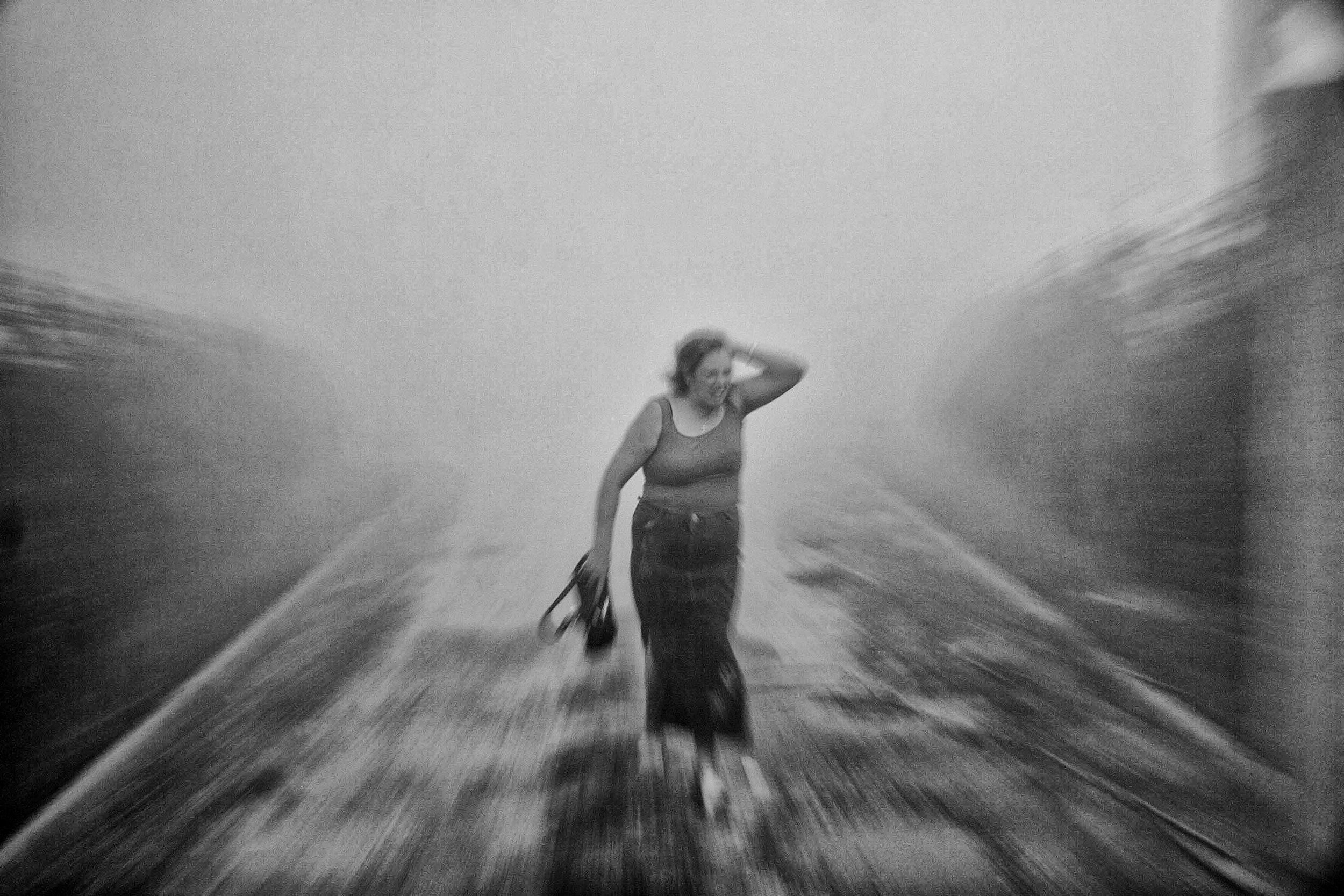
Several firefighters began using their drip torches to create a firebreak; the idea is that when the two flames meet, the fire will extinguish and not spread. But the wind picked up in seconds, creating enormous flames that nearly fried us. Even behind the vehicles, we weren't safe; the heat increased rapidly, and we had no way to escape. It's one of those moments when you think life is over; staying calm is crucial, as is trying to douse ourselves with water and avoiding looking at the fire. The feeling of being just meters away from a huge blaze radiating so much heat makes you feel insignificant in the face of Mother Nature. Hundreds of animals, insects, and other creatures have experienced this.
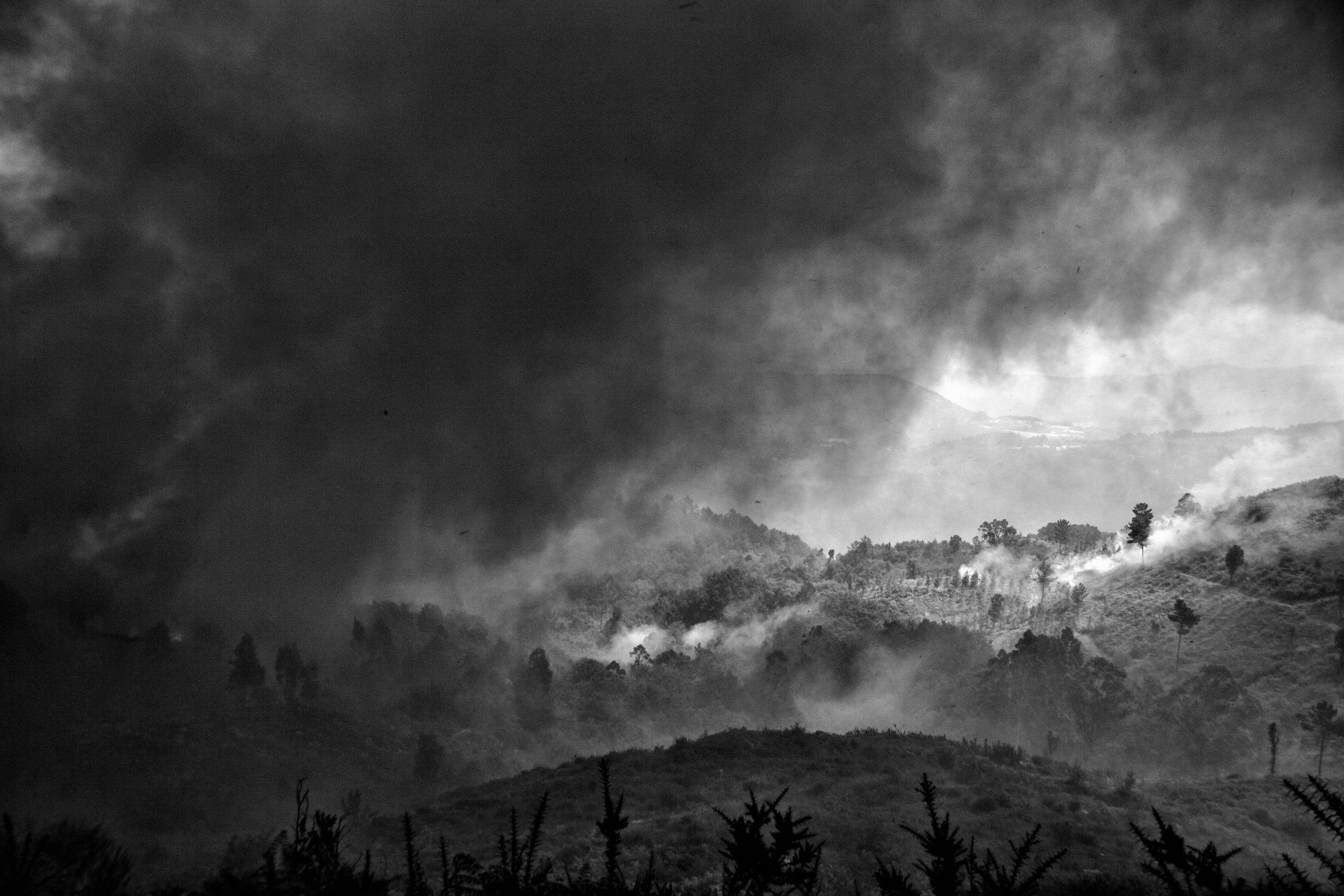
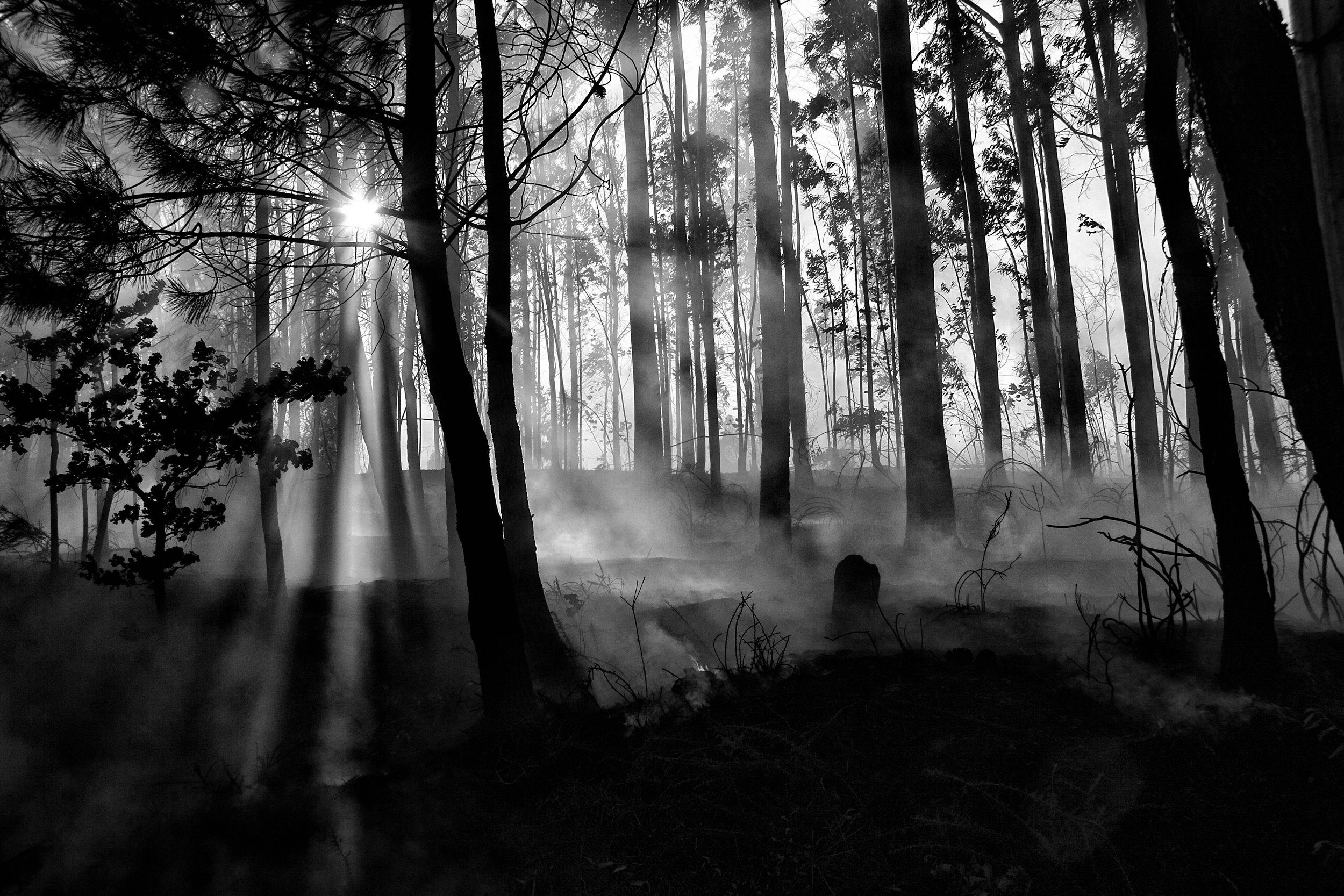
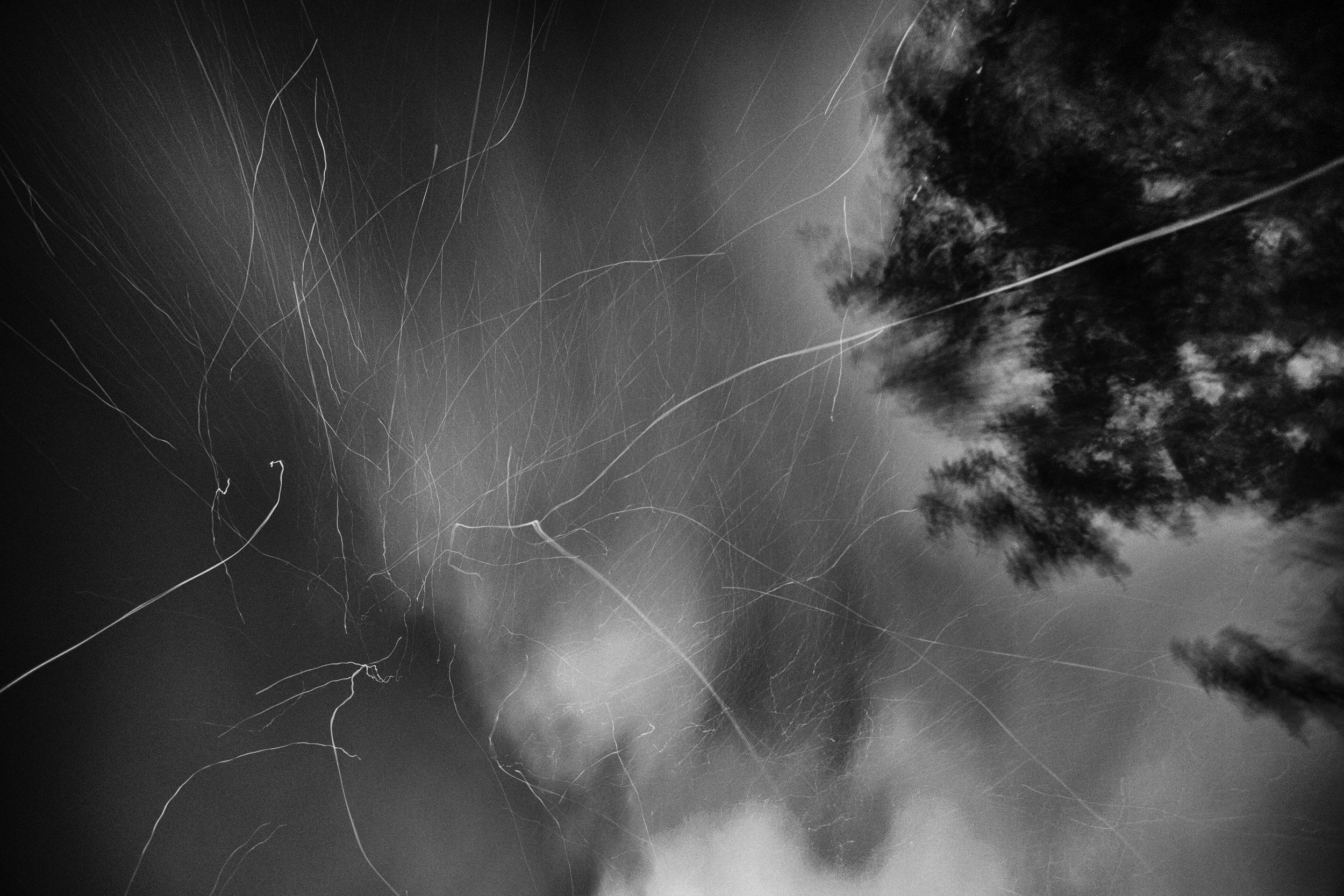
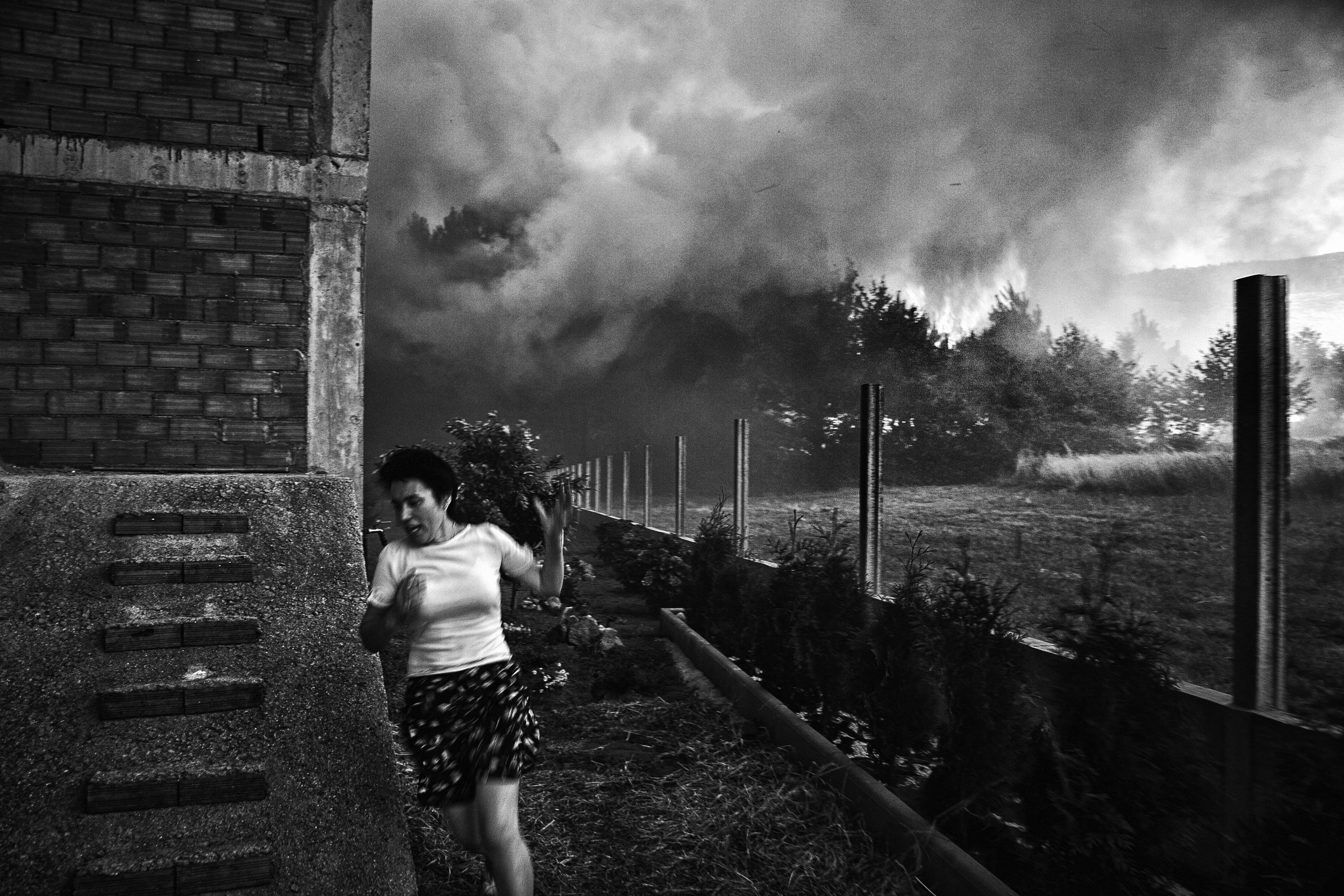
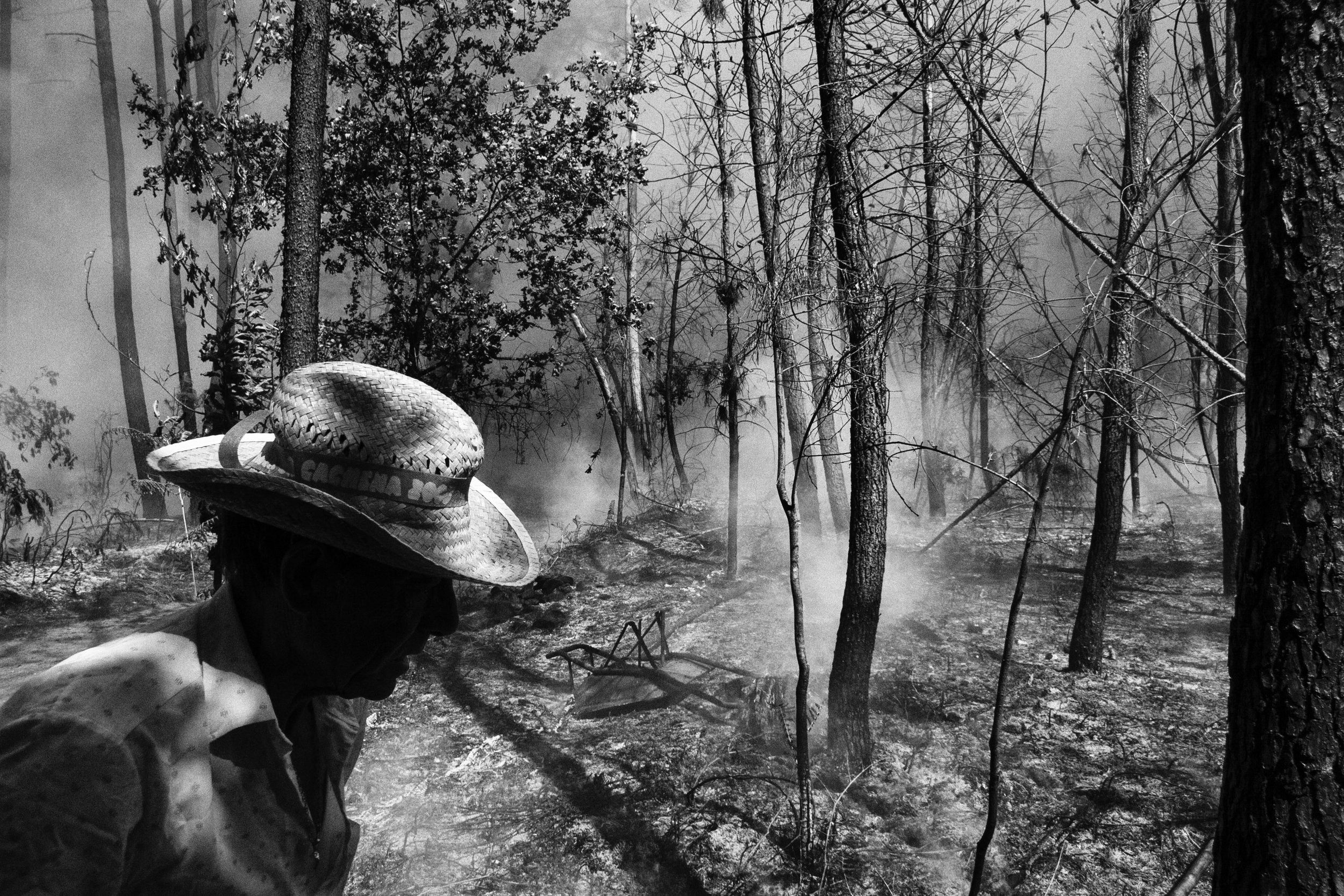
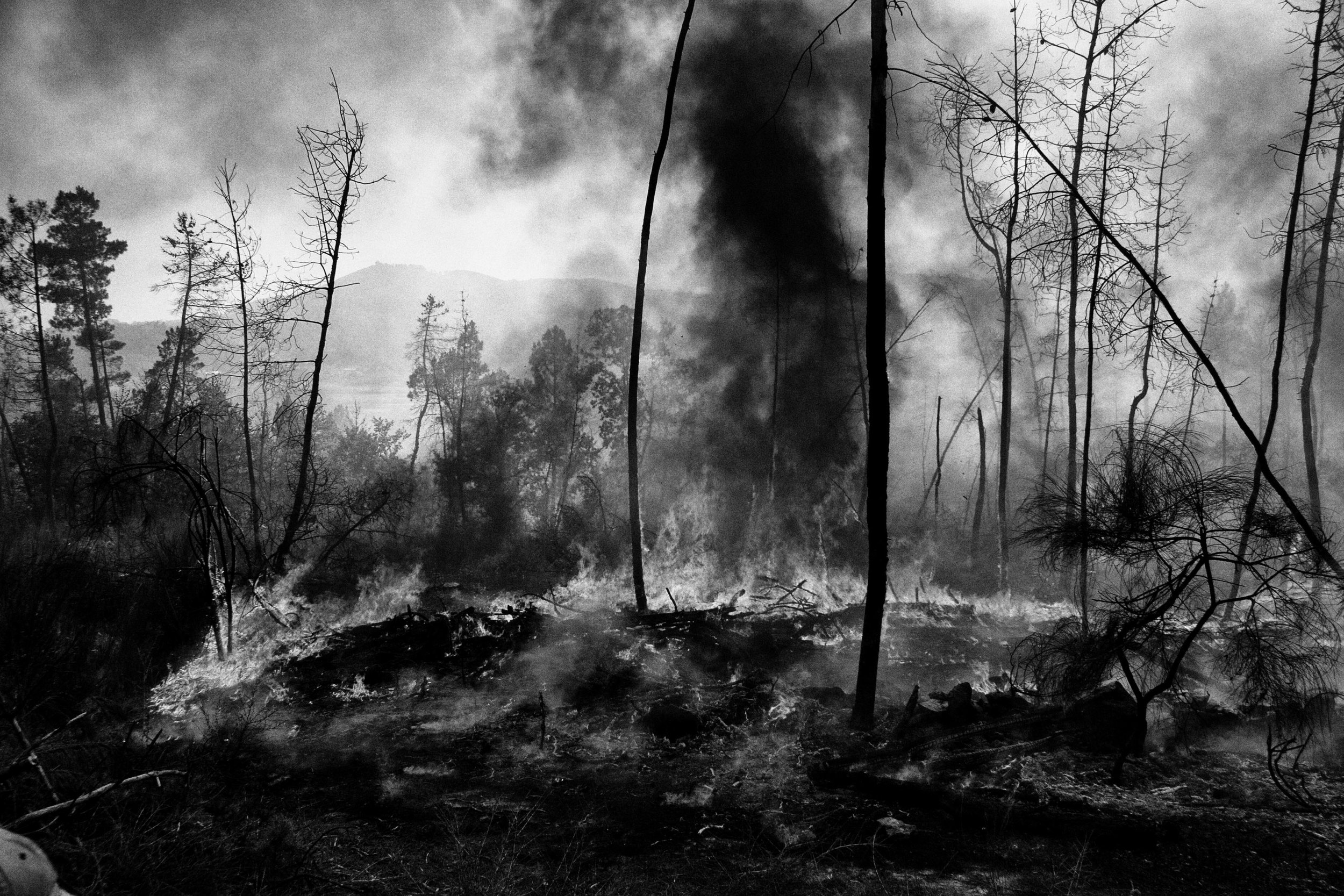
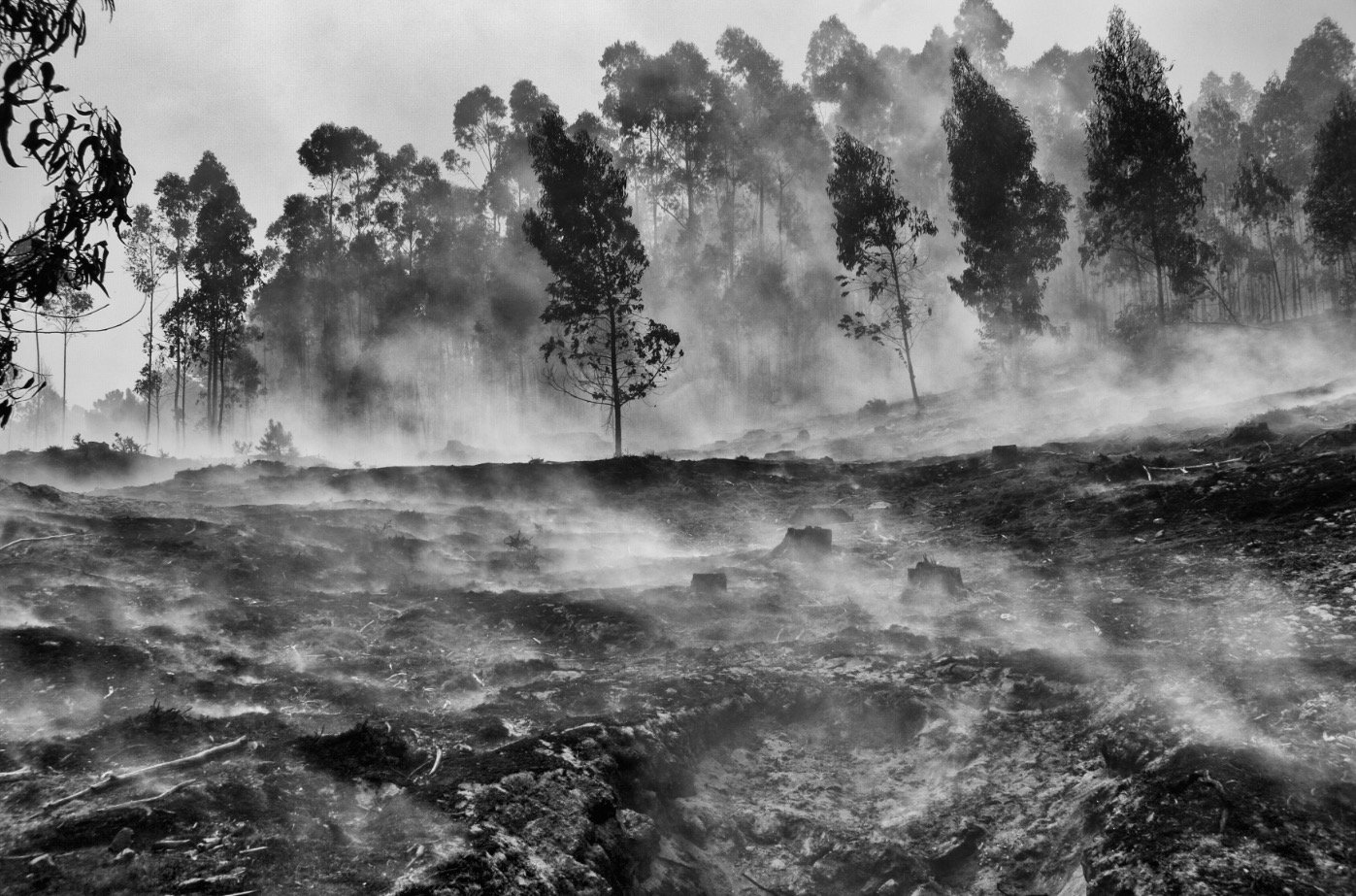
Dead animals; smoking eucalyptus trees; the silhouettes of trees burning with the voracious appetite of fire; incandescent ash flying for miles to fall on dry grass; men and women fleeing their homes, leaving everything behind and running. People died trapped in cars in 2017.
The neighbors blamed the photojournalists and reporters for encouraging psychopaths or organized crime by publishing the images because it pleased the arsonists who enjoyed it, like true modern-day Neros with harps, setting fire to the forests and watching their own neighbors' houses burn.
Galicia covers three million hectares, and half of it has trees.
Sixth generation fires:
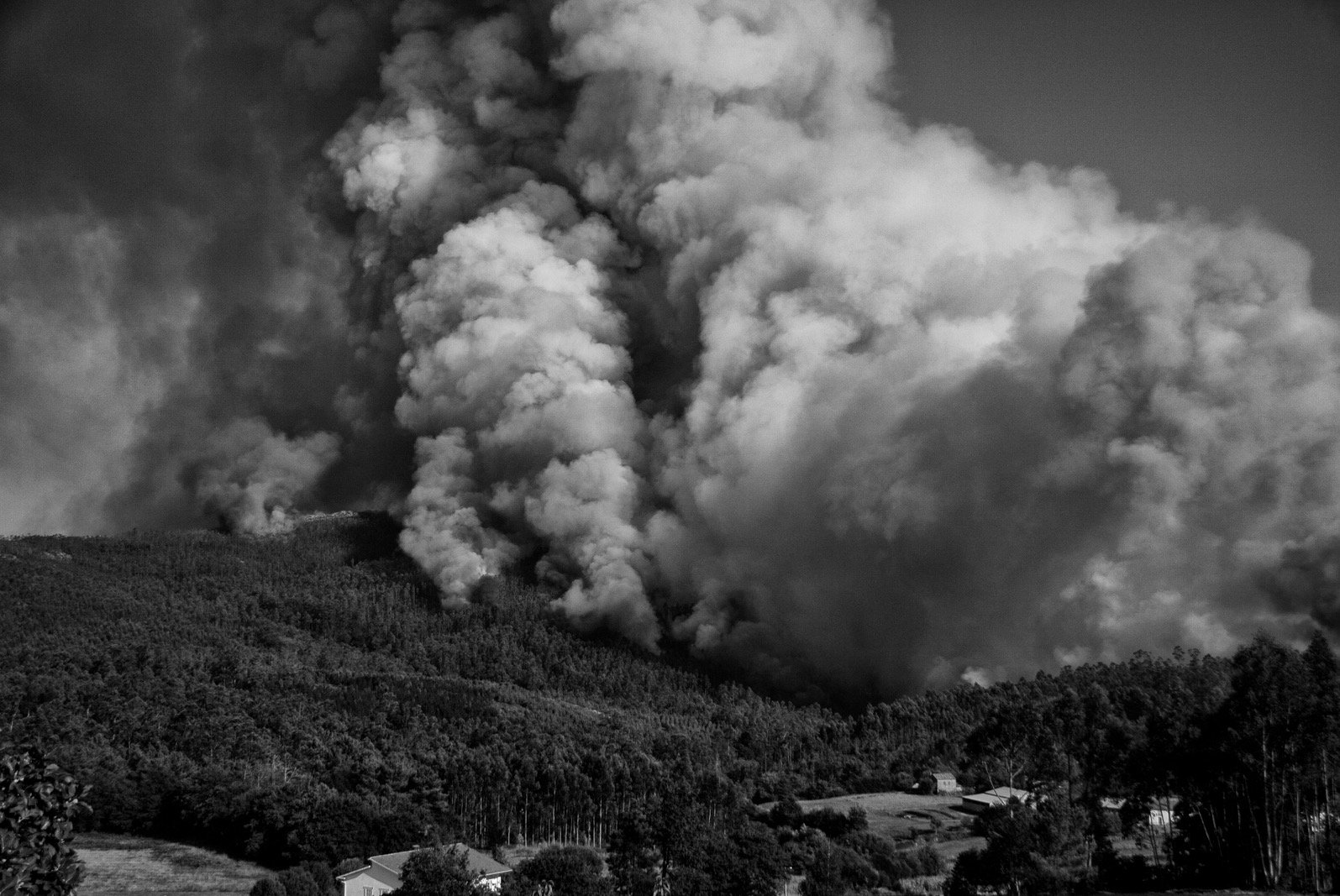
Since 2017, a new type of fire, categorized as ‘sixth generation’ fires, has been identified. These fires are capable of altering the local weather conditions and overwhelming firefighting capacity. They are high-intensity due to a large accumulation of dry fuel, which, combined with the impact of the climate crisis, makes them ‘explosive’ and unpredictable, generating pyrocumulus clouds—clouds of gas and water vapor—that can lead to firestorms.