ALA 403-01. EL BOTIJO
The pioneer of the corsairs. Baptism of the “Botijo” 01
The history of aerial firefighting in Spain has an exact date of birth: February 8, 1971. That afternoon, after an epic four-day transatlantic flight direct from the Canadair factory in Montreal, an aircraft with flat, robust shapes and a striking yellow color landed at Getafe Air Base. On its rear fuselage shone the military number UD.13-01, which would later become the legendary registration 431-01 (manufacturing number 1010). That aircraft was the first Canadair CL-215 to set foot on Spanish soil. It was not an aircraft adapted to put out fires; it was a machine designed from the first sketch to fight forest fires from the air. Its arrival officially inaugurated the journey of the 43rd Air Force Group, the current Ala 43: the Corsairs.
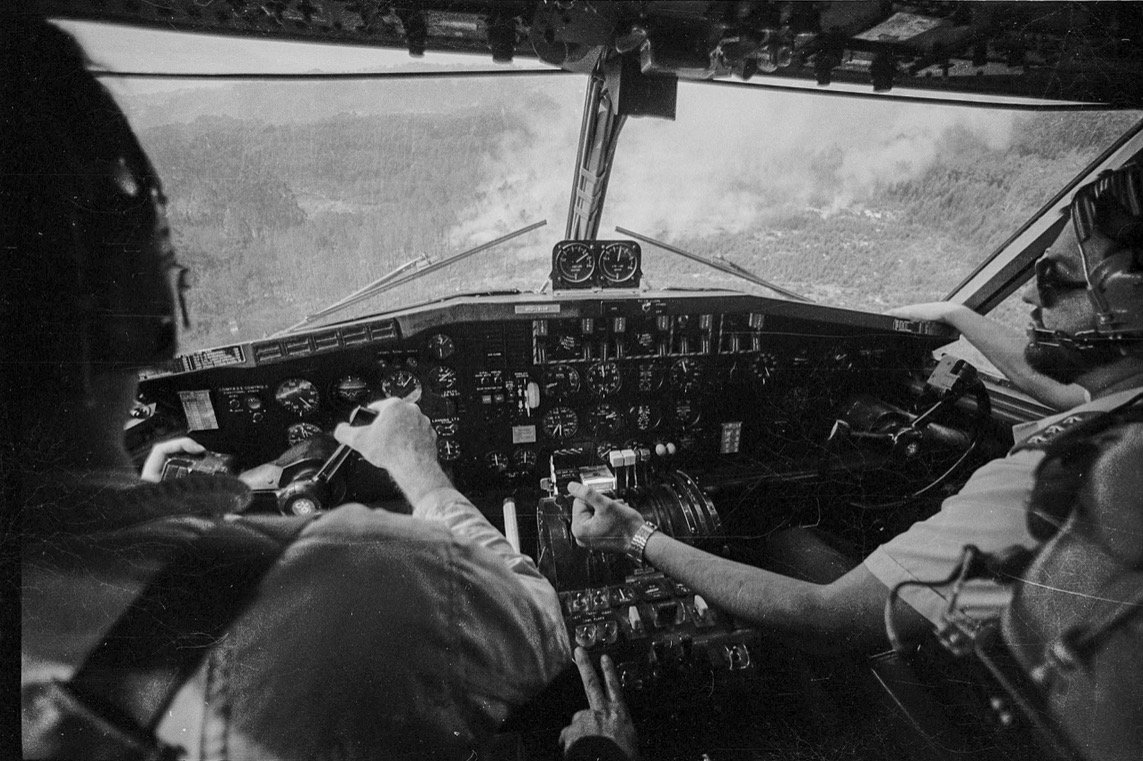
Canadair 215. Ala 403-01. El Botijo. Mission in Galicia. (cicrca 1984).
That high-winged monoplane with an amphibian hull was destined to change the defense of the Spanish mountains forever, debuting at a time when forest extinction in our country depended almost exclusively on ground efforts based on smoke bombs and axes. When the 431-01 started its engines for the first time in Spain, a legend written in water, saltpeter and smoke began. The roar of the eighteen stars and their insatiable consumption Unlike the modern models that plow the skies today, powered by silent turbines, the original CL-215 was an old-school colossus. It depended on two imposing radial internal combustion engines: the Pratt & Whitney R-2800-CA3 Double Wasp. These engines, inherited from the toughest fighters of the Second World War, consisted of eighteen cylinders arranged in a double star and cooled exclusively by the air that hit the aircraft's fairing. These power plants were marvels of analog engineering, but they exacted a brutal operational toll: titanic fuel consumption. In working mode, each of the engines devoured between 300 and 400 liters of high-octane aviation gasoline (AVGAS 100/130) per hour, in addition to a significant amount of lubricating oil that the engine consumed and evacuated naturally in each cycle. Maintaining the logistics of these aircraft in the mid-1980s at secondary bases was a complex puzzle. While the rest of the Spanish military fleet was already fueled by kerosene (Jet A-1), the old piston “Botijos” continued to require tanker trucks with specific gasoline. Their thirst was insatiable, which limited operational autonomy and forced the crews to calculate mission hours with mathematical precision. Each day became a constant loop of unloading and mandatory returns to base to refill their thirsty tanks before exhausting the safety margins.
Summer 1984: Detachment in Lavacolla. The summer of 1984 was engraved in the memory of the Galician forestry services as one of the most dramatic of the decade. An extreme drought after a winter of abundant vegetation turned the four provinces into a powder keg. The columns of smoke were visible from any point in the region and the command of the 43rd Wing activated the permanent deployment at the Santiago de Compostela Airport (Lavacolla). It was in this continuous emergency scenario that had the privilege of boarding the pioneer, the 431-01, and occupying the most coveted seat on the aircraft: the central jump seat. Located just behind the control pedestal, between the pilot and the copilot, that small folding seat became a privileged and at the same time overwhelming viewpoint. From there, it was perfectly understandable why the unit claimed that
Crew of 403-01. Lavacolla. 1984
the CL-215 was flown “with six hands”. On the left, controlling the control column with pure physical strength and without hydraulic assistance, was Captain D. Jesús Cembrano Díaz; on the right, sharing the effort in the turns, Lieutenant D. Carlos Remírez de Esparza, while the overall strategy of the deployment on the ground was coordinated by Captain D. Pedro Álvarez de Sotomayor Seoane. But in the cockpit, the vital triangle was closed by the flight mechanic. Sitting next to me, his hands were an extension of the engines: he adjusted the fuel mixture levers, monitored the critical cylinder temperatures and manually operated the cooling fins (cowl flaps) to prevent the Pratt & Whitney stars from seizing up as they swallowed the superheated air from the fire. The dance on the water and the electric rouletteWe headed south, towards the province of Ourense. The Corsarios' routine was choreographed with absolute precision.
Captain Cembrano spotted the water surface of an Ourense reservoir and launched the plane into a dizzying descent. From the transporter, seeing the liquid surface approaching at more than 130 kilometers per hour was breathtaking. The hull hit the water and the seaplane transformed into a phe speedboat. At that moment, the mechanic activated the hydraulic system, lowering the lower deflectors (probes). In just 12 seconds of violent vibrations, the plane swallowed 5,400 liters of water in its tanks. I felt the plane become dull, heavy and stuck to the liquid. The pilots squeezed the 2,100 horsepower of each engine, breaking the suction to rise again into the sky. The real danger awaited at the front of the flames. The air became dense, the smell of burning pine flooded the cabin and the ascending thermal currents shook the tens of tons of the Canadair as if it were paper. We flew low, licking the scorched slopes so that the discharge was effective. And there, crossing the valleys of Ourense, the great ghost of the extinguishing pilots appeared: the high-voltage power lines. The approach required passing within a few meters of the conductive cables.
A silent tension floated in the cabin, a technical knowledge that chilled the blood: if the continuous water jet physically touched a high-voltage line during release, the jet could act like a gigantic conductive cable, communicating thousands of volts directly to the aircraft structure and completely electrifying it in mid-flight.
It was a game of milliseconds. “Get out!”, was heard over the intercom. The hatches opened and the 5.4 tons of water fell on the focus. Freed from its load, the 431-01 took a violent leap upwards —the famous “step” in the air— that physically lifted me off the transport, while the radial engines roared with relief, saving the cables from my hair.
The return of the Corsario. That plane had a guardian angel sewn to its aluminum wings. Years earlier, in those same waters of Ourense, specifically in the Castrelo de Miño Reservoir, this same aircraft survived its appointment with death when the pilot D. José Permanyer Fábregas accidentally cut cables from an electrical line during a maneuver, miraculously managing to save the aircraft and return to base. After almost five hours of extreme turns, tense landings and with the AVGAS fuel needles caressing the red zone due to the excessive consumption of the radial engines, the nose of the pioneer pointed north again.
When the wheels of the 431-01 finally touched the Lavacolla runway to refuel its thirsty tanks, a dense silence flooded the cabin as the magnetos cut out. The pilots descended with fatigue painted on their faces and the mechanic hurried to check the hot engines. Looking from the transporter towards the empty cabin, I understood that I had witnessed an unrepeatable era: the era in which the Corsarios tamed the skies of Galicia based on piston engines, iron hands and infinite courage.